การศึกษาแบบจำลองความคิดจากการวาดภาพ เรื่องระบบสุริยะ ของนักเรียนชั้นประถมศึกษาปีที่ 4
Article Sidebar
Main Article Content
บทคัดย่อ
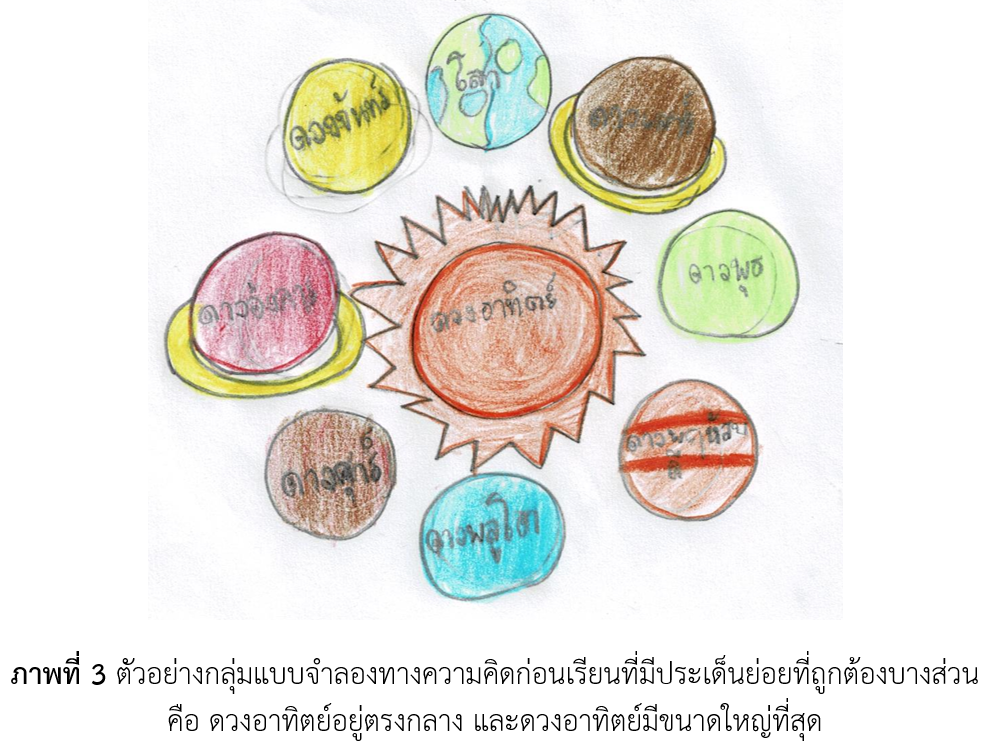
แบบจำลองทางความคิดเป็นสิ่งที่สะท้อนความรู้ความเข้าใจที่แฝงอยู่ในตัวผู้เรียนออกมาให้เห็น แบบจำลองทางความคิดจึงเป็นเครื่องมือสำคัญที่ทำให้เข้าใจผู้เรียน งานวิจัยนี้มีวัตถุประสงค์เพื่อศึกษาแบบจำลองทางความคิดประเภทแบบจำลองภาพของนักเรียน เรื่องระบบสุริยะ ก่อนและหลังการจัดการเรียนรู้แบบสืบเสาะร่วมกับสื่อการสอนที่หลากหลาย ได้แก่ การ์ดเกม และหนังสือสามมิติร่วมกับเทคโนโลยีเสมือนจริง ประชากรเป็นนักเรียนชั้นประถมศึกษาปีที่ 4 จำนวน 23 คน ภาคเรียนที่ 2 ปีการศึกษา 2563 เครื่องมือที่ใช้ในการเก็บรวบรวมข้อมูล ประกอบด้วย แบบจำลองทางความคิดที่นักเรียนวาดภาพระบบสุริยะ ร่วมกับการสัมภาษณ์กึ่งโครงสร้างของนักเรียนเป็นรายบุคคล แบบประเมินตรวจสอบรายการความเข้าใจแนวคิดการจำลองระบบสุริยะ ผลวิจัยแบ่งความเข้าใจของนักเรียนเกี่ยวกับระบบสุริยะออกเป็น 2 กลุ่ม คือกลุ่มที่มีแนวคิดถูกต้อง และกลุ่มที่มีแนวคิดไม่ถูกต้อง เช่น นักเรียนเข้าใจว่าโลกเป็นศูนย์กลางของระบบสุริยะ ดาวหาง และดวงจันทร์เป็นดาวเคราะห์ หลังการจัดการเรียนรู้ นักเรียนมีแนวคิดที่ถูกต้องในเรื่องการจำลองระบบสุริยะเพิ่มขึ้น ดังนั้นการจัดการเรียนรู้แบบสืบเสาะร่วมกับสื่อการสอนที่หลากหลายเป็นวิธีการสอนที่ดี
Article Details

อนุญาตภายใต้เงื่อนไข Creative Commons Attribution-NonCommercial-NoDerivatives 4.0 International License.
วารสารวิทยาศาสตร์และวิทยาศาสตร์ศึกษา (JSSE) เป็นผู้ถือลิสิทธิ์บทความทุกบทความที่เผยแพร่ใน JSSE นี้ ทั้งนี้ ผู้เขียนจะต้องส่งแบบโอนลิขสิทธิ์บทความฉบับที่มีรายมือชื่อของผู้เขียนหลักหรือผู้ที่ได้รับมอบอำนาจแทนผู้เขียนทุกนให้กับ JSSE ก่อนที่บทความจะมีการเผยแพร่ผ่านเว็บไซต์ของวารสาร
แบบโอนลิขสิทธิ์บทความ (Copyright Transfer Form)
ทางวารสาร JSSE ได้กำหนดให้มีการกรอกแบบโอนลิขสิทธิ์บทความให้ครบถ้วนและส่งมายังกองบรรณาธิการในข้อมูลเสริม (supplementary data) พร้อมกับนิพนธ์ต้นฉบับ (manuscript) ที่ส่งมาขอรับการตีพิมพ์ ทั้งนี้ ผู้เขียนหลัก (corresponding authors) หรือผู้รับมอบอำนาจ (ในฐานะตัวแทนของผู้เขียนทุกคน) สามารถดำเนินการโอนลิขสิทธิ์บทความแทนผู้เขียนทั้งหมดได้ ซึ่งสามารถอัพโหลดไฟล์บทความต้นฉบับ (Manuscript) และไฟล์แบบโอนลิขสิทธิ์บทความ (Copyright Transfer Form) ในเมนู “Upload Submission” ดังนี้
1. อัพโหลดไฟล์บทความต้นฉบับ (Manuscript) ในเมนูย่อย Article Component > Article Text
2. อัพโหลดไฟล์แบบโอนลิขสิทธิ์บทความ (Copyright Transfer Form) ในเมนูย่อย Article Component > Other
ดาวน์โหลด ไฟล์แบบโอนลิขสิทธิ์บทความ (Copyright Transfer Form)
เอกสารอ้างอิง
Acher, A., Arcà, M., and Sanmartí, N. (2007). Modeling as a teaching learning process for understanding materials: A case study in primary education. Science Education, 91(3), 398-418.
Chotchuang, V. Parkasem, C. and Saisaeng, V. (2019). Development of an Augmented Reality Technology Application to Enhance Knowledge on the Solar System (in Thai). In The 7th Academic Science and Technology Conference “Health Promotion Through Research Integration and Innovation” (pp. 1637-1645). Pathum Thani: Rangsit University
Gilbert, J. K. (2005). Visualization: A metacognitive skill in science and science education. In Visualization in science education (pp. 9-27). Springer: Dordrecht.
Glynn, S. (1997). Drawing mental models. The Science Teacher, 64(1), 30-32.
Harrison, A. G., and Treagust, D. F. (1996). Secondary students' mental models of atoms and molecules: Implications for teaching chemistry. Science Education, 80(5), 509-534.
Institute of Academic Development (IAD). (2020). A teacher's manual for use with science and technology textbooks. Grade 4 (in Thai). Bangkok: Institute of Academic Development (IAD) Press.
Jantrasee, R. and Kanamuang, N. (2018). Model-centered instruction sequence of evaporation on grade 10 students’ scientific modeling (in Thai). Journal of Science and Science Education, 1(1), 86-96.
Johnson-Laird, P. N. (1983). Mental models: Towards a cognitive science of language, inference, and consciousness (No. 6). Cambridge, MA: Harvard University Press.
Kaewprasong, R. (2014). The Development of 3D Pop-Up Book Together whit QR Code Subject of the Solar System for Prathomsuksa 4 (in Thai). Master’s Thesis. Phitsanulok: Naresuan University
Ministry of Education. (2017). Indicators and Curriculum in the Science, revised 2017, according to the Basic Education Core Curriculum, B.E. 2551 (in Thai). Bangkok: The Agricultural Cooperative Federation of Thailand.
Muntean, C. H., Andrews, J., and Muntean, G. M. (2017, July). Final frontier: An educational game on solar system concepts acquisition for primary schools. In IEEE 17th International Conference on Advanced Learning Technologies (pp.335-337). Timisoara: Romania
Steve, Y., Gallayanee, Y., and Erik, J. (2011). Augmented reality: An overview and five directions for AR in education. Journal of Educational Technology Development and Exchange, 4(1), 119-140.
Supasorn, S. (2012). Roles of Mental Models in Learning Chemistry at Molecular Level (in thai). Journal of Education Khon Kaen University, 35(1), 1-7.
Suttakun, L. and Ladachart, L. (2013). Sixth Graders’ Mental Model about Magnet and Magnetic Force (in Thai). Humanity and Social Science Journal, Ubon Ratchthani University, 4(1), 90-105.
Suwancanit, T. (2017). Card Game Design to Understand Communication Design Curriculum Overview (in Thai). In Proceedings of Naresurn Research Conference 13 : Research and Innovation Driving the Economy and Society (pp. 1700 – 1715). Phitsanulok: Naresuan University
Wannakhao, C., Sengsri, S. and Wachirasukmongkol, B. (2020). The Effects of Using Augmented Reality Media on Pratomsuksa 4 Students Learning in Science Subject on The Topic "Solar System” (in Thai). Journal of Education Naresuan University, 22(4), 50-61.
Warapo, A., and Tangtong, O. (2019). Learning Media for Planets in the Solar System with AR technology. Case studies of Students. Grade 4, cram school IMaths& Robots child’s Lopbur (in Thai). Journal of Project in Computer Science and Information Technology, 5(2), 77-83.
Wuttisela, K. (2011). Card Games for Teaching Elements and Compounds (in Thai). Journal of Research Unit on Science, Technology and Environment for Learning, 2(2), 132-137.
