การศึกษาผลสัมฤทธิ์ทางการเรียนวิชาคณิตศาสตร์ เรื่องทฤษฎีบทพีทาโกรัสของนักเรียนชั้นมัธยมศึกษาปีที่ 2 โดยใช้วิธีอุปนัย
Article Sidebar
Main Article Content
บทคัดย่อ
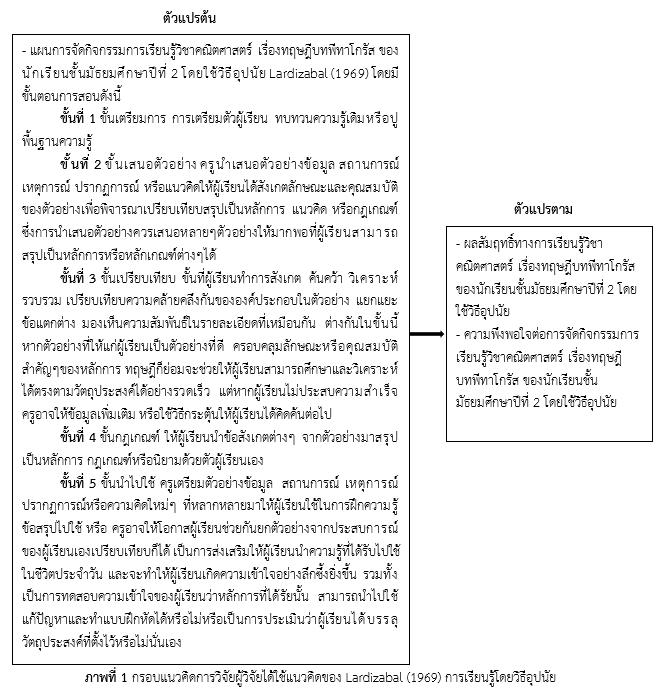
งานวิจัยนี้มีวัตถุประสงค์เพื่อ 1) เพื่อศึกษาประสิทธิภาพของแผนการจัดกิจกรรมการเรียนรู้วิชาคณิตศาสตร์ เรื่องทฤษฎีบทพีทาโกรัส ของนักเรียนชั้นมัธยมศึกษาปีที่ 2 โดยใช้วิธีอุปนัย ให้มีประสิทธิภาพตามเกณฑ์ 80/80 2) เพื่อเปรียบเทียบผลสัมฤทธิ์ทางการเรียนวิชาคณิตศาสตร์ เรื่องทฤษฎีบทพีทาโกรัส ของนักเรียนชั้นมัธยมศึกษาปีที่ 2 โดยใช้วิธีอุปนัย ระหว่างหลังเรียนและก่อนเรียน 3) เพื่อศึกษาความพึงพอใจต่อการจัดกิจกรรมการเรียนรู้วิชาคณิตศาสตร์ เรื่องทฤษฎีบทพีทาโกรัส ของนักเรียนชั้นมัธยมศึกษาปีที่ 2 โดยใช้วิธีอุปนัย กลุ่มตัวอย่างได้มาจากการสุ่มแบบง่ายด้วยวิธีจับฉลากเป็นนักเรียนชั้นมัธยมศึกษาปีที่ 2 โรงเรียนมัธยมสุวิทย์เสรีอนุสรณ์ จำนวน 30 คน เครื่องมือวิจัย ได้แก่ แผนการจัดกิจกรรมการเรียนรู้ แบบทดสอบวัดผลสัมฤทธิ์ทางการเรียนรู้วิชาคณิตศาสตร์ และแบบสอบถามความพึงพอใจของนักเรียน สถิตที่ใช้ในการวิเคราะห์ข้อมูล คือ ค่าเฉลี่ยเลขคณิต ( ) ส่วนเบี่ยงเบนมาตรฐาน (S.D.) และสถิติการทดสอบค่าที (t-test) แบบ dependent ผลการวิจัยพบว่า 1) ประสิทธิภาพของแผนการจัดกิจกรรมการเรียนรู้ มีประสิทธิภาพตามเกณฑ์ที่ตั้งไว้ 2) การเปรียบเทียบผลสัมฤทธิ์ทางการเรียนรู้คณิตศาสตร์ ระหว่างหลังเรียนสูงกว่าก่อนเรียน อย่างมีนัยสำคัญทางสถิติที่ระดับ .05 และ 3) ระดับความพึงพอใจต่อการพัฒนากิจกรรมการเรียนรู้ภาพรวมอยู่ในระดับมากที่สุดมีค่าเฉลี่ย 4.89
Article Details

อนุญาตภายใต้เงื่อนไข Creative Commons Attribution-NonCommercial-NoDerivatives 4.0 International License.
วารสารวิทยาศาสตร์และวิทยาศาสตร์ศึกษา (JSSE) เป็นผู้ถือลิสิทธิ์บทความทุกบทความที่เผยแพร่ใน JSSE นี้ ทั้งนี้ ผู้เขียนจะต้องส่งแบบโอนลิขสิทธิ์บทความฉบับที่มีรายมือชื่อของผู้เขียนหลักหรือผู้ที่ได้รับมอบอำนาจแทนผู้เขียนทุกนให้กับ JSSE ก่อนที่บทความจะมีการเผยแพร่ผ่านเว็บไซต์ของวารสาร
แบบโอนลิขสิทธิ์บทความ (Copyright Transfer Form)
ทางวารสาร JSSE ได้กำหนดให้มีการกรอกแบบโอนลิขสิทธิ์บทความให้ครบถ้วนและส่งมายังกองบรรณาธิการในข้อมูลเสริม (supplementary data) พร้อมกับนิพนธ์ต้นฉบับ (manuscript) ที่ส่งมาขอรับการตีพิมพ์ ทั้งนี้ ผู้เขียนหลัก (corresponding authors) หรือผู้รับมอบอำนาจ (ในฐานะตัวแทนของผู้เขียนทุกคน) สามารถดำเนินการโอนลิขสิทธิ์บทความแทนผู้เขียนทั้งหมดได้ ซึ่งสามารถอัพโหลดไฟล์บทความต้นฉบับ (Manuscript) และไฟล์แบบโอนลิขสิทธิ์บทความ (Copyright Transfer Form) ในเมนู “Upload Submission” ดังนี้
1. อัพโหลดไฟล์บทความต้นฉบับ (Manuscript) ในเมนูย่อย Article Component > Article Text
2. อัพโหลดไฟล์แบบโอนลิขสิทธิ์บทความ (Copyright Transfer Form) ในเมนูย่อย Article Component > Other
ดาวน์โหลด ไฟล์แบบโอนลิขสิทธิ์บทความ (Copyright Transfer Form)
เอกสารอ้างอิง
Bruner, J. S. (1993). Explaining and interpreting two ways of using mind. In G. Harman (2nd ed.). Conceptions of the human mind: Essays in Honor of George A. Miller.
Bureau of Academic Affairs and Educational Standards. (2012). Guideline for learning management in mathematics thinking. Bangkok: Chumnumkasetakorn printing.
Institute for the Promotion of Teaching Science and Technology IPST. (2018). Mathematical skills and processes (in Thai). Bangkok: Academic development.
Khammanee, T. (2012). Science of teaching: Knowledge for effective learning process Management. Bangkok: Chulalongkorn University Press.
Lardizabal, A. (1969). Methods and principles of teaching. Phoenix Press.
Maslow, A. H. (1970). Motivation and personality. Harper and Row.
Naoyenphon, P. (2011). The research of teaching and learning mathematics in processing package on the experience of mathematics learning (in Thai). Bangkok: Sukhothai Thammathirat Open University.
National Institute of Educational Testing Service. (2020). Report on the results of the test the national level basic O-Net Grade 6, Year 2019 (in Thai). Bangkok: Public Organization.
Onnuam, D. (2008). Mathematics instruction focusing on the processes (in Thai). Mathematics Journal, 3(9), 51-65.
Phattiyathani, S. (2008). Statistical methods for research (4th ed.). Bangkok: Prasankarnpim printing.
Plangprasopchok, S., Boomprajak, S. and Pooudom, C. (2008). The survey of the problems of Thai students in mathematics (in Thai). Journal of Mathematics, 54(2), 20-28.
Promwong, C. (2013). Efficiency testing of media or instructional packages (in Thai). Silpakorn Educational Research Journal, 5(1), 7-20.
Sanguansin, N. (2004). Creating a set of mathematics activities using inductive and deductive teaching techniques subject polynomials in Mathayom 3 level. Master’s Thesis. Songkla: Prince of Songkla University.
Skinner, B. F. (1957). Verbal behavior: Appleton-Century-Crofts.
Wilson, G. W. (1971). Evaluation of learning in secondary school mathematics in Handbook on formative and summative evaluation of student learning. Edited by Benjamin S. Bloom. U.S.A.: McGraw-Hill.
