
แนวทางการบูรณาการใช้เทคโนโลยี iNaturalist ร่วมกับการจัดการเรียนรู้แบบอิงสถานที่เพื่อส่งเสริมความผูกพันกับถิ่นที่อยู่และความรับผิดชอบต่อสิ่งแวดล้อมของนักเรียน
Article Sidebar
Main Article Content
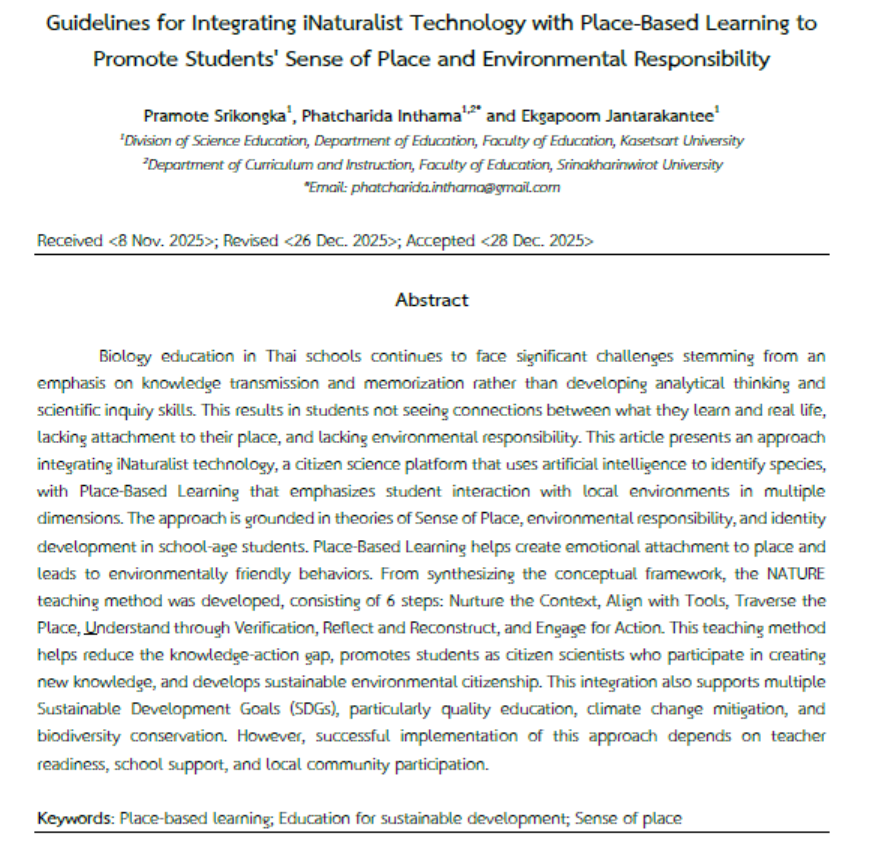
บทคัดย่อ
การจัดการเรียนรู้ชีววิทยาในโรงเรียนไทยยังคงเผชิญความท้าทายสำคัญจากการเน้นการถ่ายทอดความรู้และ
การท่องจำมากกว่าการพัฒนาทักษะการคิดวิเคราะห์และการสืบเสาะทางวิทยาศาสตร์ ส่งผลให้นักเรียนไม่เห็นความเชื่อมโยงระหว่างสิ่งที่เรียนกับชีวิตจริง ขาดความผูกพันกับถิ่นที่อยู่ และขาดความรับผิดชอบต่อสิ่งแวดล้อม บทความนี้นำเสนอแนวทางการบูรณาการเทคโนโลยี iNaturalist ซึ่งเป็นแพลตฟอร์มวิทยาศาสตร์พลเมืองที่ใช้ปัญญาประดิษฐ์ในการระบุชนิดสิ่งมีชีวิต ร่วมกับการจัดการเรียนรู้แบบอิงสถานที่ที่เน้นให้นักเรียนมีปฏิสัมพันธ์กับสภาพแวดล้อมท้องถิ่นในหลากหลายมิติ โดยมีฐานคิดจากความผูกพันกับถิ่นที่อยู่ ความรับผิดชอบต่อสิ่งแวดล้อม และการพัฒนาอัตลักษณ์ในวัยเรียน การจัดการเรียนรู้แบบอิงสถานที่ช่วยสร้างความผูกพันทางอารมณ์กับพื้นที่และนำไปสู่พฤติกรรมที่เป็นมิตรต่อสิ่งแวดล้อม จากการสังเคราะห์กรอบแนวคิดได้พัฒนาวิธีการสอนแบบ NATURE ที่ประกอบด้วย 6 ขั้นตอน ได้แก่ บ่มเพาะบริบท เตรียมความพร้อมและเครื่องมือ ลงพื้นที่สำรวจ ทำความเข้าใจผ่านการตรวจสอบ สะท้อนคิดและสังเคราะห์ และลงมือเพื่อการเปลี่ยนแปลง วิธีการสอนนี้ช่วยลดช่องว่างระหว่างความรู้กับการปฏิบัติ ส่งเสริมให้นักเรียนเป็นนักวิทยาศาสตร์พลเมืองที่มีส่วนร่วมในการสร้างความรู้ใหม่ และพัฒนาจิตสำนึกพลเมืองสิ่งแวดล้อมที่ยั่งยืน การบูรณาการนี้ยังสนับสนุนเป้าหมายการพัฒนาที่ยั่งยืน โดยเฉพาะด้านการศึกษาที่มีคุณภาพ การรับมือการเปลี่ยนแปลงสภาพภูมิอากาศ และการอนุรักษ์ความหลากหลายทางชีวภาพ อย่างไรก็ตาม ความสำเร็จของการนำแนวทางนี้ไปใช้ขึ้นอยู่กับความพร้อมของครู การสนับสนุนจากโรงเรียน และการมีส่วนร่วมของชุมชนท้องถิ่น
Article Details

อนุญาตภายใต้เงื่อนไข Creative Commons Attribution-NonCommercial-NoDerivatives 4.0 International License.
วารสารวิทยาศาสตร์และวิทยาศาสตร์ศึกษา (JSSE) เป็นผู้ถือลิสิทธิ์บทความทุกบทความที่เผยแพร่ใน JSSE นี้ ทั้งนี้ ผู้เขียนจะต้องส่งแบบโอนลิขสิทธิ์บทความฉบับที่มีรายมือชื่อของผู้เขียนหลักหรือผู้ที่ได้รับมอบอำนาจแทนผู้เขียนทุกนให้กับ JSSE ก่อนที่บทความจะมีการเผยแพร่ผ่านเว็บไซต์ของวารสาร
แบบโอนลิขสิทธิ์บทความ (Copyright Transfer Form)
ทางวารสาร JSSE ได้กำหนดให้มีการกรอกแบบโอนลิขสิทธิ์บทความให้ครบถ้วนและส่งมายังกองบรรณาธิการในข้อมูลเสริม (supplementary data) พร้อมกับนิพนธ์ต้นฉบับ (manuscript) ที่ส่งมาขอรับการตีพิมพ์ ทั้งนี้ ผู้เขียนหลัก (corresponding authors) หรือผู้รับมอบอำนาจ (ในฐานะตัวแทนของผู้เขียนทุกคน) สามารถดำเนินการโอนลิขสิทธิ์บทความแทนผู้เขียนทั้งหมดได้ ซึ่งสามารถอัพโหลดไฟล์บทความต้นฉบับ (Manuscript) และไฟล์แบบโอนลิขสิทธิ์บทความ (Copyright Transfer Form) ในเมนู “Upload Submission” ดังนี้
1. อัพโหลดไฟล์บทความต้นฉบับ (Manuscript) ในเมนูย่อย Article Component > Article Text
2. อัพโหลดไฟล์แบบโอนลิขสิทธิ์บทความ (Copyright Transfer Form) ในเมนูย่อย Article Component > Other
ดาวน์โหลด ไฟล์แบบโอนลิขสิทธิ์บทความ (Copyright Transfer Form)
เอกสารอ้างอิง
Ballard, H. L., Dixon, C. G. and Harris, E. M. (2017). Youth-focused citizen science: Examining the role of environmental science learning and agency for conservation. Biological Conservation, 208, 65–75.
Bonney, R., Cooper, C. B., Dickinson, J., Kelling, S., Phillips, T., Rosenberg, K. V. and Shirk, J. (2009). Citizen science: A developing tool for expanding science knowledge and scientific literacy. BioScience, 59(11), 977–984.
Chawla, L. (1999). Life paths into effective environmental action. Journal of Environmental Education, 31(1), 15–26.
Chawla, L. and Cushing, D. F. (2007). Education for strategic environmental behavior. Environmental Education Research, 13(4), 437–452.
Erikson, E. H. (1968). Identity: Youth and crisis. Norton.
Freeman, S., Eddy, S. L., McDonough, M., Smith, M. K., Okoroafor, N., Jordt, H. and Wenderoth, M. P. (2014). Active learning increases student performance in science, engineering, and mathematics. Proceedings of the National Academy of Sciences, 111(23), 8410–8415.
Garner, A. V. and Rosenberg, J. (2023). Utilizing iNaturalist to support place-based learning and data analysis. Science Scope, 46(7), 54–60.
Gruenewald, D. A. (2003). The best of both worlds: A critical pedagogy of place. Educational Researcher, 32(4), 3–12.
Handal, B., Campbell, C. and Cavanagh, M. (2013). Pre-service teachers’ beliefs about teaching with technology: Resolving the transformative paradox. Australasian Journal of Educational Technology, 29(2), 168–185.
Herodotou, C., Aristeidou, M., Miller, G., Ballard, H. and Robinson, L. (2020). What do we know about young people’s participation in citizen science? A systematic review. Citizen Science: Theory and Practice, 5(1), Article 2, 1–13.
Hines, J. M., Hungerford, H. R. and Tomera, A. N. (1987). Analysis and synthesis of research on responsible environmental behavior: A meta-analysis. Journal of Environmental Education, 18(2), 1–8.
Johnson, J. T. (2010). Place-based learning and knowing: Critical pedagogies grounded in indigeneity. GeoJournal, 77(6), 829–836.
Kang, J. and Keinonen, H. (2017). The effect of student-centered approaches on students’ interest levels in science learning. Eurasia Journal of Mathematics, Science and Technology Education, 13(8), 5147–5168.
Kıran, D. and Sungur, S. (2012). Middle school students’ science self-efficacy and its sources: Implications for science achievement. Journal of Science Education and Technology, 21(5), 619–625.
Kendall, D., Davis, M. A. and Niemiller, M. L. (2021). Addressing biodiversity naivety through project-based learning using iNaturalist. Journal for Nature Conservation, 64, 126070.
Kollmuss, A. and Agyeman, J. (2002). Mind the gap: Why do people act environmentally and what are the barriers to pro-environmental behavior? Environmental Education Research, 8(3), 239–260.
Kudryavtsev, A., Stedman, R. C. and Krasny, M. E. (2012). Sense of place in environmental education. Environmental Education Research, 18(2), 229–250.
Osborne, J. and Dillon, J. (2008). Science education in Europe: Critical reflections. King’s College London.
Pimsarn, P. and Tuntiwongwanich, S. (2015). Barriers to implementing active learning in biology teaching: Teachers’ perspectives in Thailand. Asia-Pacific Forum on Science Learning and Teaching, 16(1), 1–21.
Rauf, R. A. A., Rasul, M. S., Mansor, A. N., Zaini, A. Z. and Deniz, H. (2013). Problem-based learning in technology education. Procedia – Social and Behavioral Sciences, 102, 406–416.
Scannell, L. and Gifford, R. (2010). Defining place attachment: A tripartite organizing framework. Journal of Environmental Psychology, 30(1), 1–10.
Semken, S. and Freeman, C. B. (2008). Sense of place in the practice and assessment of place-based science teaching. Science Education, 92(6), 1042–1057.
Smith, G. A. and Sobel, D. (2010). Place and community-based education in schools. Routledge.
Sobel, D. (2004). Place-based education: Connecting classrooms & communities. Orion Society.
Stern, P. C., Dietz, T., Abel, T., Guagnano, G. A. and Kalof, L. (2000). A value-belief-norm theory of support for social movements: The case of environmentalism. Human Ecology Review, 6(2), 81–97.
Stedman, R.C. (2002) Toward a Social Psychology of Place Predicting Behavior from Place-Based Cognitions, Attitude, and Identity. Environment and Behavior, 34, 561-581.
Tuan, Y. F. (1977). Space and Place: The Perspective of Experience. Minneapolis, MN: University of Minnesota Press.
Unger, S., Pörn, M. and Hoffmann, A. (2021). Performance and limitations of AI-based image recognition software for smartphone-supported species identification: The case study of iNaturalist. Frontiers in Artificial Intelligence, 4, 621283.
Unger, S., Rollins, M., Tietz, A. and Dumais, H. (2021). iNaturalist as an engaging tool for identifying organisms in outdoor activities. Journal of Biological Education, 55(5), 537–547.
Vander Ark, T., Liebtag, E. and McClennen, N. (2020). The power of place: Authentic learning through place-based education. ASCD.
Zimmerman, H. T. and Land, S. M. (2014). Facilitating place-based learning in outdoor informal environments with mobile computers. TechTrends, 58(1), 77–83.
