การพัฒนาสมรรถนะการแก้ปัญหาทางวิทยาศาสตร์ของนักศึกษาปริญญาตรี ด้วยการจัดการเรียนรู้โดยใช้ปัญหาเป็นฐาน เรื่อง ความปลอดภัยทางเคมี
Article Sidebar
Main Article Content
บทคัดย่อ
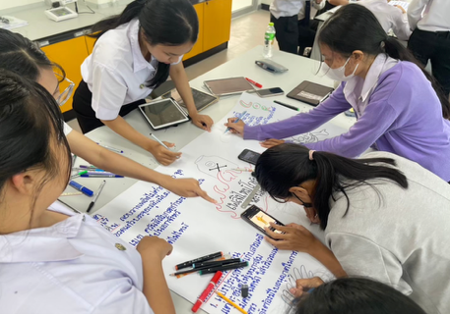
งานวิจัยนี้มีวัตถุประสงค์เพื่อ 1) เปรียบเทียบผลสัมฤทธิ์ทางการเรียน เรื่องความปลอดภัยทางเคมี ของนักศึกษาปริญญาตรี ด้วยการจัดการเรียนรู้โดยใช้ปัญหาเป็นฐาน 2) ศึกษาการประเมินทักษะกระบวนการทางวิทยาศาสตร์ขั้นบูรณาการ และ 3) ศึกษาความพึงพอใจที่มีต่อการเรียนรู้เรื่อง ความปลอดภัยทางเคมี 4) เปรียบเทียบความสามารถในการแก้ปัญหาของนักศึกษา 5) ศึกษาผลการจัดการเรียนรู้โดยใช้ปัญหาเป็นฐาน กลุ่มตัวอย่าง คือ นักศึกษาระดับปริญญาตรี หลักสูตรครุศาสตรบัณฑิต สาขาวิชาการศึกษา วิชาเอกวิทยาศาสตร์ทั่วไป คณะครุศาสตร์และการพัฒนามนุษย์ ที่ลงทะเบียนเรียนวิชาปฏิบัติการวิทยาศาสตร์ในโรงเรียน ในภาคเรียนที่ 1 ปีการศึกษา 2567 จำนวน 49 คน แบบวิธีการเลือกแบบเจาะจง เครื่องมือที่ใช้ 1) แบบทดสอบวัดผลสัมฤทธิ์ทางการเรียนวิทยาศาสตร์ 2) แบบวัดความสามารถในการแก้ปัญหาทางวิทยาศาสตร์ 3) แบบประเมินทักษะกระบวนทางวิทยาศาสตร์แบบบูรณาการ และ 4) แบบประเมินความพึงพอใจต่อการจัดการเรียนรู้ โดยสถิติที่ใช้ในการวิเคราะห์ข้อมูล ได้แก่ ร้อยละ ค่าเฉลี่ย ส่วนเบี่ยงเบนมาตรฐานและสถิติทดสอบค่าทีแบบไม่เป็นอิสระต่อกัน ผลการวิจัย พบว่า 1) ผลสัมฤทธิ์ทางการเรียนของผู้เรียนหลังการใช้รูปแบบการเรียนการสอน มีคะแนนหลังเรียนสูงกว่าก่อนเรียนอย่างมีนัยสำคัญทางสถิติที่ระดับ.05 2) ประเมินผลทักษะขั้นบูรณาการหลังจากใช้กิจกรรม พบว่ามีคะแนนเฉลี่ยร้อยละเท่ากับ 77.80 3) ผู้เรียนมีความพึงพอใจต่อการเรียนรู้โดยใช้ปัญหาเป็นฐานอยู่ในระดับมากที่สุด ในด้านการจัดกิจกรรม ด้านการนำไปใช้และด้านคุณค่าและประโยชน์ที่ได้รับ 4) ความสามารถในการแก้ปัญหาของผู้เรียนมีคะแนนหลังเรียนสูงกว่าก่อนเรียนอย่างมีนัยสำคัญทางสถิติที่ระดับ.05 5) เมื่อเปรียบเทียบคะแนนผลสัมฤทธิ์ทางการเรียน ทักษะทางวิทยาศาสตร์ขั้นบูรณาการและความพึงพอใจ พบว่าความพึงพอใจมีคะแนนสูงที่สุดคิดเป็นร้อยละ 85.60
Article Details

อนุญาตภายใต้เงื่อนไข Creative Commons Attribution-NonCommercial-NoDerivatives 4.0 International License.
วารสารวิทยาศาสตร์และวิทยาศาสตร์ศึกษา (JSSE) เป็นผู้ถือลิสิทธิ์บทความทุกบทความที่เผยแพร่ใน JSSE นี้ ทั้งนี้ ผู้เขียนจะต้องส่งแบบโอนลิขสิทธิ์บทความฉบับที่มีรายมือชื่อของผู้เขียนหลักหรือผู้ที่ได้รับมอบอำนาจแทนผู้เขียนทุกนให้กับ JSSE ก่อนที่บทความจะมีการเผยแพร่ผ่านเว็บไซต์ของวารสาร
แบบโอนลิขสิทธิ์บทความ (Copyright Transfer Form)
ทางวารสาร JSSE ได้กำหนดให้มีการกรอกแบบโอนลิขสิทธิ์บทความให้ครบถ้วนและส่งมายังกองบรรณาธิการในข้อมูลเสริม (supplementary data) พร้อมกับนิพนธ์ต้นฉบับ (manuscript) ที่ส่งมาขอรับการตีพิมพ์ ทั้งนี้ ผู้เขียนหลัก (corresponding authors) หรือผู้รับมอบอำนาจ (ในฐานะตัวแทนของผู้เขียนทุกคน) สามารถดำเนินการโอนลิขสิทธิ์บทความแทนผู้เขียนทั้งหมดได้ ซึ่งสามารถอัพโหลดไฟล์บทความต้นฉบับ (Manuscript) และไฟล์แบบโอนลิขสิทธิ์บทความ (Copyright Transfer Form) ในเมนู “Upload Submission” ดังนี้
1. อัพโหลดไฟล์บทความต้นฉบับ (Manuscript) ในเมนูย่อย Article Component > Article Text
2. อัพโหลดไฟล์แบบโอนลิขสิทธิ์บทความ (Copyright Transfer Form) ในเมนูย่อย Article Component > Other
ดาวน์โหลด ไฟล์แบบโอนลิขสิทธิ์บทความ (Copyright Transfer Form)
เอกสารอ้างอิง
Aktamis, H. and Ergin, Ö. (2008). The effect of scientific process skills education on students' scientific creativity, science attitudes and academic achievements. Asia-Pacific Forum on Science Learning and Teaching, 9(1), 1-21.
Akkuzu Guven, N. and Uyulgan, M. A. (2022). Thinking about the chemical substances through real-life incidents: A case study on pre-service teachers' knowledge on various dimensions of laboratory safety. Educational Policy Analysis and Strategic Research, 17(3), 263–291.
Almulla, M. A. (2020). The effectiveness of the project-based learning (PBL) approach as a way to engage students in learning. SAGE Open, 10(3), 2158244020938702.
Barrows, H. S. and Tamblyn, R. M. (1980). Problem-based learning: An approach to medical education. Springer Publishing Company.
Baviskar, S. N., Hartle, R. T. and Whitney, T. (2009). Essential criteria to characterize constructivist teaching: Derived from a review of the literature and applied to five constructivist-teaching method articles. International Journal of Science Education, 31(4), 541-550.
Bloom, B. S., Engelhart, M. D., Furst, E. J., Hill, W. H. and Krathwohl, D. R. (1956). Taxonomy of educational objectives: The classification of educational goals. Handbook I: Cognitive domain. New York: Longman
Burns, J. C., Okey, J. R. and Wise, K. C. (1985). Development of an integrated process skill test: TIPS II. Journal of Research in Science Teaching, 22(2), 169–177.
Chaowakeratipong, N. (2021). The development of ability in designing activities to enhance learner’s capabilities in constructing scientific explanations of student teachers majoring in science education, school of education studies, Sukhothai Thammathirat Open University (in Thai). Journal of Kasetsart Education Review, 35(2), 1-14.
Chaphithak, R. and Chaipichit, D. (2021). Development of grade 3 student’s scientific process skill and learning achievement through problem-based learning activities (in Thai). Journal of Roi Kaensarn Academi, 6(6), 215-232.
Damrimungkit, A. (2023). The development of science methods course secondary competencies of science pre-service teachers (in Thai). Doctoral Dissertation. Phitsanulok: Naresuan University.
Derilo, R. C. (2019). Basic and integrated science process skills acquisition and science achievement of seventh-grade learners. European Journal of Education Studies, 6(3).281-294.
Garay-Rondero, C. L., Castillo-Paz, A., Gijón-Rivera, C., Domínguez-Ramírez, G., Rosales-Torres, C. and Oliart-Ros, A. (2024). Competency-based assessment tools for engineering higher education: A case study on complex problem-solving. Cogent Education, 11(1), 2392424.
Hanprasert, T. and Inmuong, U. (2021). Laboratory safety behavior and management among students at Sirindhorn College of Public Health Khon Kaen (in Thai). Journal of Health Science and Community Public Health, 4(2), 134 – 144.
Höper, J., Jegstad, K. M. and Remmen, K. B. (2022). Student teachers' problem-based investigations of chemical phenomena in the nearby outdoor environment. Chemistry Education Research and Practice, 23(2), 361–372.
Jardinico, E. C. and Linaugo, J. D. (2023). Acquired basic and integrated science process skills and academic performance in Earth Science of Grade 11 students in a Philippine public high school. Philippine Social Science Journal, 6(1), 63–73.
Jatmaneerungjaroen, S. and Boontum, P. (2021). Development of grade 5 student’s problem solving skills in science of students through STEM education (in Thai). Journal of Education Mahasarakhum University, 18(1), 138 – 152
Kamarudin, N., Wahida, M. and Ahrari, S. (2022). Exploring basic and integrated science process skills and their impact on science achievement among university students. Journal of Public Administration and Governance, 12(4), 74–79.
Kolb, D. A. (1984). Experiential learning: Experience as the source of learning and development. Englewood Cliffs, NJ: Prentice Hall.
Klomim, K. (2016). Learning management based on stem education for student teachers (in Thai). Journal of Education Naresuan University, 18(4), 334 – 348.
Klongklaw, R. and Teamsaree, S. (2020). The development of problem-solving abilities of private university undergraduate students based on instructional development theory (in Thai). Retrieved 26 Oct 2025, from Rangsit University National Conference Proceedings : https://rsucon.rsu.ac.th/files/proceedings/nation2020/NA20-036.pdf
Koocharoenpisal, N. (2019). Learning achievement and scientific problem solving ability of the undergraduate students through the problem-based learning activity on chemical safety (in Thai). Journal of education Mahasarakham, 13(1), 154-169.
Kurniawan, M., Lestariani, N. and Krismayanti. L. (2025). Unveiling the impact of problem-based learning on students' science process skills and cognitive outcomes. Bioeduca: Journal of Biology Education, 7(1), 1–14.
Lawson, A. E. (2010). Basic inferences of scientific reasoning, argumentation, and discovery. Science Education, 94(2), 336-364.
Liu, Y., and Pasztor, A. (2022). Effects of problem-based learning instructional intervention on critical thinking in higher education: A meta-analysis. Thinking Skills and Creativity, 45, 101069.
Liu, Y., Xu, H., Chen, Q., and Zhan, P. (2022). The measurement of problem-solving competence using process data. Advances in Psychological Science, 30(3), 522–538.
Nasaree, N., Buosonte, R., Teeraputon, D. and Vibulrangson, S. (2019). A needs assessment of pre-service teacher in science for developing assessment literacy (in Thai). Silpakorn University Journal, 40(2), 78-98.
National Research Council. (2012). A framework for K-12 science education: Practices, crosscutting concepts, and core ideas. The National Academies Press.
Ngema, S., James, A. and Sibanda, D. (2024). The role of novice physical sciences teachers' goals in the implementation of inquiry-based instruction. Cogent Education, 11(1), 2429364.
Ningsih, T. Z., Aman, A., Nasrulloh, A., Ofianto, O., Erniwati, E., Asri, Z., Judijanto, L. and Firza, F. (2025). Enhancing communication and collaboration skills through discovery, cooperative and problem-based learning models in Social Studies education. Cogent Education, 12(1), 2500110.
Okyere, G. A., Saah, A. A., Oduro, W., Achamfour, J. B. and Amoako, S. (2023). Students' satisfaction of blended problem-based learning: An academic experience at Kwame Nkrumah University of Science and Technology. Education Research International, 2023(1), 6005752.
Perera, H. N., Maghsoudlou A., Miller, C. J., McIlveen P., Barber D., Part R. and Reyes, A. L. (2022). Relations of science teaching self-efficacy with instructional practices, student achievement and support, and teacher job satisfaction. Contemporary Educational Psychology. 69,102041.
Price, A. M., Kim, C. J., Burkholder, E. W., Fritz, A. V. and Wieman, C. E. (2021). A detailed characterization of the expert problem-solving process in science and engineering: Guidance for teaching and assessment. CBE—Life Sciences Education, 20(3), 1-15.
Pozuelo-Muñoz, J., Calvo-Zueco, E., Sánchez-Sánchez, E. and Cascarosa-Salillas, E. (2023). Science skills development through problem-based learning in secondary education. Education Sciences, 13(11), 1096.
Ribeirinha, T. and Correia, M. (2025). Enhancing pre-service teachers' science teaching efficacy beliefs and attitudes toward science using the flipped classroom model. Frontiers in Education, 10, 1512320.
Schwarz, C. V., Reiser, B. J., Davis, E. A., Kenyon, L., Achér, A., Fortus, D., Shwartz, Y., Hug, B. and Krajcik, J. (2009). Developing a learning progression for scientific modeling: Making scientific modeling accessible and meaningful for learners. Journal of Research in Science Teaching, 46(6), 632-654.
Smith, K., Maynard, N., Berry, A., Stephenson, T., Spiteri, T., Corrigan, D., Mansfield, J., Ellerton, P. and Smith, T. (2022). Principles of problem-based learning (PBL) in STEM education: Using expert wisdom and research to frame educational practice. Education Sciences, 12(10), 728.
Strat, T. T. S., Henriksen, E. K. and Jegstad, K. M. (2024). Inquiry-based science education in science teacher education: a systematic review. Studies in Science Education, 60(2), 191-249.
Sturrock, K., Woods-McConney, A. and Maor, D. (2025). Science inquiry instruction and direct instruction in authentic primary and secondary classroom contexts. International Journal of Science Education, 1-23.
Susilawati, Harjono, A. and Firdaus, F. (2024). Improving students' science process skills through project based learning models: A systematic review. Jurnal Penelitian Pendidikan IPA, 10(10), 721-730.
Thongkam, S. (2022). The development of science instructional model by using blended learning with inquiry-based learning to enhanced solving problem ability and integrated science process skills for undergraduate student (in Thai). Doctoral Dissertation. Bangkok: Silpakorn University.
Urdanivia Alarcon, D. A., Talavera-Mendoza, F., Rucano Paucar, F. H., Cayani Caceres, K. S. and Machaca Viza, R. (2023). Science and inquiry-based teaching and learning: A systematic review. Frontiers in Education, 8, 1170487.
Wu, G., Yang, Y. and Xu, C. (2023). Determination of university students' laboratory safety awareness: A cross-sectional study. Journal of Chemical Education, 100(9), 3402–3409.
Yew, E. H. J. and Goh, K. (2016). Problem-based learning: An overview of its process and impact on learning. Health Professions Education, 2(2), 75-79.
Zhou X., Shu L., Xu Z. and Padrón Y. (2023). The effect of professional development on in-service STEM teachers' self-efficacy: a meta-analysis of experimental studies. International Journal of STEM Education, 10(1), 37.
