
การพัฒนาสื่อ 3 มิติ ด้วยเทคโนโลยีเสมือนจริง เรื่อง การบวกและลบเวกเตอร์ ในระบบพิกัดฉาก 3 มิติ
Article Sidebar
Main Article Content
บทคัดย่อ
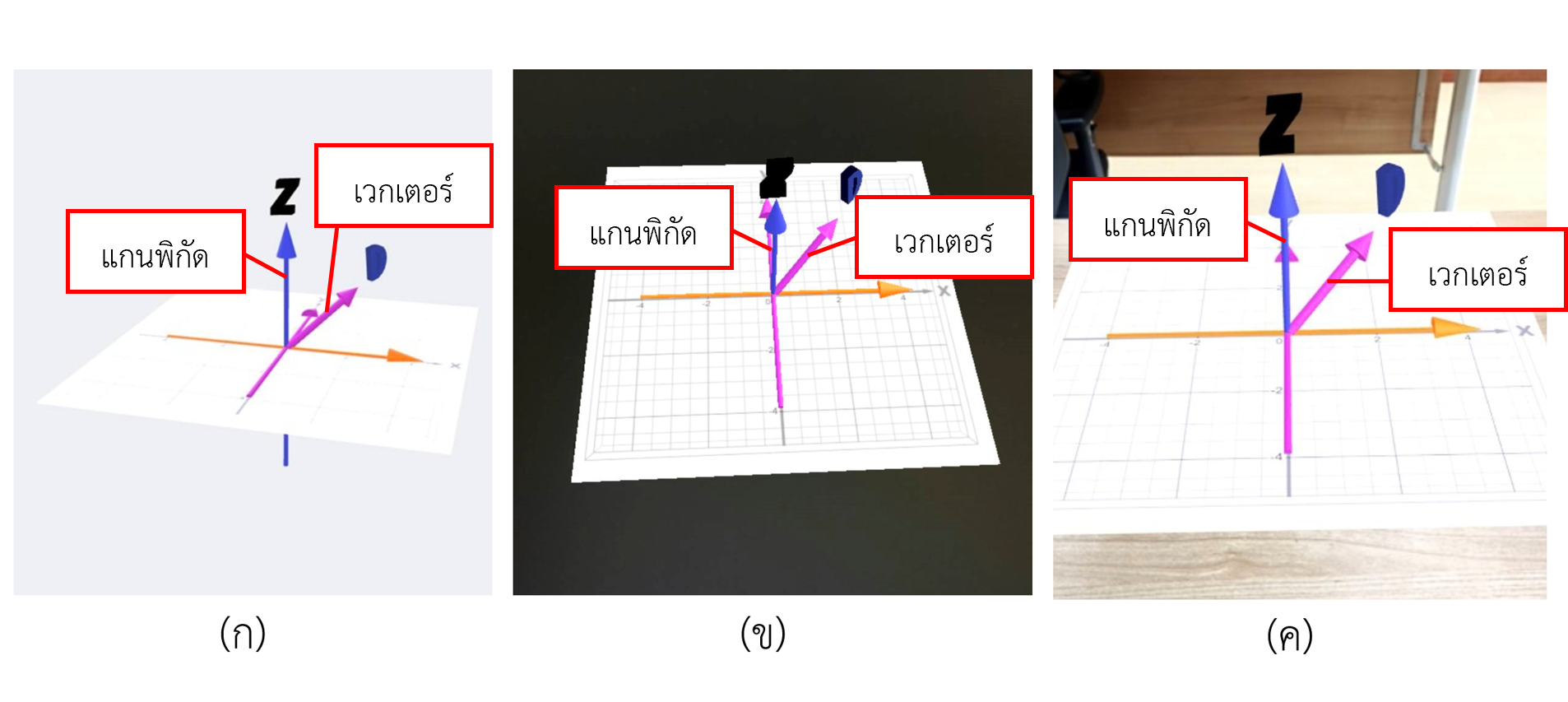
งานวิจัยนี้มีวัตถุประสงค์เพื่อ (1) ศึกษามโนทัศน์ที่คลาดเคลื่อน เรื่อง การบวกและลบเวกเตอร์ในระบบพิกัดฉาก 3 มิติ (2) พัฒนาชุดสื่อ 3 มิติ ด้วยเทคโนโลยีเสมือนจริง เรื่อง การบวกและลบเวกเตอร์ในระบบพิกัดฉาก 3 มิติและ (3) ศึกษาประสิทธิผลของชุดสื่อ 3 มิติ เรื่อง การบวกและลบเวกเตอร์ในระบบพิกัดฉาก 3 มิติ โดยผลการศึกษาพบมโนทัศน์ที่คลาดเคลื่อนเกี่ยวกับแกนพิกัด x, y, z การระบุพิกัด 3 มิติ การแสดงเวกเตอร์ 3 มิติ นิเสธของเวกเตอร์และการนำขนาดของเวกเตอร์มาบวกและลบกัน และจากการพัฒนาและศึกษาประสิทธิผลของชุดสื่อ 3 มิติ เรื่อง การบวกและลบเวกเตอร์ในระบบพิกัดฉาก 3 มิติ พบว่ามีค่า Normalized change รวมเท่ากับ 0.55 และค่า Normalized change เฉลี่ยเท่ากับ 0.46 ซึ่งแสดงให้เห็นว่าชุดสื่อ 3 มิติมีประสิทธิผลในการพัฒนามโนทัศน์เรื่องการบวกและลบเวกเตอร์ในระบบพิกัดฉาก 3 มิติของผู้เรียนในระดับปานกลางจนถึงสูง ดังเห็นได้จากร้อยละ 65 ของ Normalized change รายบุคคลมีค่าสูงกว่า 0.30 (ระดับปานกลาง) และร้อยละ 38 สูงกว่า 0.70 (ระดับสูง) ซึ่งแสดงว่าชุดสื่อ 3 มิติมีศักยภาพในการส่งเสริมการเรียนรู้ของผู้เรียนส่วนใหญ่ได้อย่างมีประสิทธิภาพ
Article Details

อนุญาตภายใต้เงื่อนไข Creative Commons Attribution-NonCommercial-NoDerivatives 4.0 International License.
วารสารวิทยาศาสตร์และวิทยาศาสตร์ศึกษา (JSSE) เป็นผู้ถือลิสิทธิ์บทความทุกบทความที่เผยแพร่ใน JSSE นี้ ทั้งนี้ ผู้เขียนจะต้องส่งแบบโอนลิขสิทธิ์บทความฉบับที่มีรายมือชื่อของผู้เขียนหลักหรือผู้ที่ได้รับมอบอำนาจแทนผู้เขียนทุกนให้กับ JSSE ก่อนที่บทความจะมีการเผยแพร่ผ่านเว็บไซต์ของวารสาร
แบบโอนลิขสิทธิ์บทความ (Copyright Transfer Form)
ทางวารสาร JSSE ได้กำหนดให้มีการกรอกแบบโอนลิขสิทธิ์บทความให้ครบถ้วนและส่งมายังกองบรรณาธิการในข้อมูลเสริม (supplementary data) พร้อมกับนิพนธ์ต้นฉบับ (manuscript) ที่ส่งมาขอรับการตีพิมพ์ ทั้งนี้ ผู้เขียนหลัก (corresponding authors) หรือผู้รับมอบอำนาจ (ในฐานะตัวแทนของผู้เขียนทุกคน) สามารถดำเนินการโอนลิขสิทธิ์บทความแทนผู้เขียนทั้งหมดได้ ซึ่งสามารถอัพโหลดไฟล์บทความต้นฉบับ (Manuscript) และไฟล์แบบโอนลิขสิทธิ์บทความ (Copyright Transfer Form) ในเมนู “Upload Submission” ดังนี้
1. อัพโหลดไฟล์บทความต้นฉบับ (Manuscript) ในเมนูย่อย Article Component > Article Text
2. อัพโหลดไฟล์แบบโอนลิขสิทธิ์บทความ (Copyright Transfer Form) ในเมนูย่อย Article Component > Other
ดาวน์โหลด ไฟล์แบบโอนลิขสิทธิ์บทความ (Copyright Transfer Form)
เอกสารอ้างอิง
Bani-Salameh, H. N., Alkofahi, K. A., Al-Khateeb, H. M. and Alharbi, S. H. (2020). Investigating the knowledge of vector concepts of first year medical students. Health Professions Education, 6(3), 428-433.
Barniol, P. and Zavala, G. (2010). Vector addition: Effect of the context and position of the vectors. AIP Conference Proceedings, 1289(1), 73-76.
Barniol, P. and Zavala, G. (2012). Students' difficulties with unit vectors and scalar multiplication of a vector. AIP Conference Proceedings, 1413(1), 115-118.
Barniol, P. and Zavala, G. (2014). Test of understanding of vectors: A reliable multiple-choice vector concept test. Physical Review Special Topics-Physics Education Research, 10(1), 010121.
Barniol, P. and Zavala, G. (2009). Investigation of students’ preconceptions and difficulties with the vector direction concept at a Mexican University. AIP Conference Proceedings, 1179(1), 85-88.
Bollen, E., Van Kampen, P., Baily, C., Kelly, M. and Cock, M. D. (2017). Student difficulties regarding symbolic and graphical representations of vector fields. Physical Review Special Topics-Physics Education Research, 13(2), 020109.
Campos, E., Hidrogo, I. and Zavala, G. (2022). Impact of virtual reality use on the teaching and learning of vectors. Frontiers in Education, 7, 965640.
Chalermdit, J., Wittayakhom, N. and Jeerungsuwan, N. (2018). Challenges on augmented reality for education 4.0 (in Thai). Journal of Education Naresuan University, 20(2), 266-279.
Chujitarom, W. and Piriyasurawong, P. (2017). Animation augmented reality book model (AAR book model) to enhance teamwork. International Education Studies, 10(7), 59-64.
Chutosri, T., Uipanith, T., Intarapoo, A., Jankaweekool, P., Linjee, I. and Yenrayub, L. (2019). Augmented reality technology development in the science on digestive system for grade 4 students (in Thai). Journal of Education Naresuan University, 23(3), 103-117.
Flores, S., Kanim, S. E. and Kautz, C. H. (2004). Student use of vectors in introductory mechanics. American Journal of Physics, 72(4), 460-468.
Flores-Garcı´a, S., Alfaro-Avena, L. L., Dena-Ornelas, O. and González-Quezada, M. D. (2008). Students’ understanding of vectors in the context of forces. Revista Mexicana de Física E, 54(1), 7–14.
Gargish, S., Kaur, D. P., Mantri, A., Singh, G. and Sharma, B. (2021). Measuring effectiveness of augmented reality-based geometry learning assistant on memory retention abilities of the students in 3D geometry. Computer Applications in Engineering Education, 29(6), 1811-1824.
Heckler, A. F. and Scaife, T. M. (2015). Adding and subtracting vectors: The problem with the arrow representation. Physical Review Special Topics-Physics Education Research, 11(1), 010101.
Herrera, L. M., Pérez, J. C. and Ordóñez, S. J. (2019). Developing spatial mathematical skills through 3D tools: Augmented reality, virtual environments and 3D printing. International Journal on Interactive Design and Manufacturing (IJIDeM), 13(4), 1385-1399.
Hinrichs, B. E. (2010). Writing position vectors in 3-d space: A student difficulty with spherical unit vectors in intermediate E & M. Journal of Physics: Conference Series, 1289, 173.
Ibili, E., Çat, M., Resnyansky, D., Şahin, S. and Billinghurst, M. (2020). An assessment of geometry teaching supported with augmented reality teaching materials to enhance students’ 3D geometry thinking skills. International Journal of Mathematical Education in Science and Technology, 51(2), 224–246.
Knight, R. D. (1995). The vector knowledge of beginning physics students. The Physics Teacher, 33(2), 74-77.
Langer, K., Lietze, S. and Krizek, G. C. (2020). Vector AR3-APP – A good-practice example of learning with augmented reality. European Journal of Open, Distance and e-Learning, 23(2), 51-64.
Marx, J. D. and Cummings, K. (2007). Normalized change. American Journal of Physics, 75(1), 87-91.
Nguyen, N. and Meltzer, D. E. (2003). Initial understanding of vector concepts among students in introductory physics course. American Journal of Physics, 71(6), 630-638.
Nguyen, N. and Meltzer, D. E. (2005). Visualization tool for 3-D relationships and the right-hand rule. The Physics Teacher, 43(3), 155-157.
Nishizawa, H., Shimada, K., Ohno, W. and Yoshioka, T. (2013). Increasing reality and educational merits of a virtual game. Procedia Computer Science, 25, 32–40.
Pakorn, J. (2018). AR (Augmented Reality) virtual world technology combined with the real world (in Thai). Retrieved November 21 2022, from SciMath Knowledge Repository: https://www.scimath.org/article-technology/item/7755-ar-augmented-reality
Pale, J. W. (2018). Students’ learning difficulties in secondary mathematics classroom in Bungoma County and pedagogical remedies by the teachers to help students overcome these difficulties. Journal of Education and Practice, 9(27), 116-125.
Saraçoğlu, H. and Kol, Ö. (2018). Evaluation of teacher candidates' knowledge about vectors. Asia-Pacific Forum on Science Learning and Teaching, 19(2).
Shaffer, P. S. and McDermott, L. C. (2005). A research-based approach to improving student understanding of the vector nature of kinematical concepts. American Journal of Physics, 73(10), 921-931.
Srifar, D. (2018). The Virtual World Brings Aesthetic Experience (in Thai). Siam Communication Review, 17(22), 74–78.
Unjanam, W. and Roungrong, P. (2022). Development of augmented reality technology on knotting for scouts (in Thai). Journal of Education Naresuan University, 24(2), 222-231.
Wittayakhom, N. and Piriyasurawong, P. (2020). Learning management STEAM model on massive open online courses using augmented reality to enhance creativity and innovation. Higher Education Studies, 10(4), 44-53.
Wunderlich, F. J., Hones, M. J. and Shaw, D. E. (1976). Three-dimensional vector demonstrator. The Physics Teacher, 14(4), 232-233.
Wutchana, U. and Emarat, N. (2011). Students’ understanding of graphical vector addition in one and two dimensions. Eurasian Journal of Physics and Chemistry, 3(2), 102-111.
Wutchana, U., Bunrangsri, K. and Emarat, N. (2019). Paper pop-ups demonstrating 3D vectors in Cartesian coordinates. Physics Education, 54(5), 053004.
