
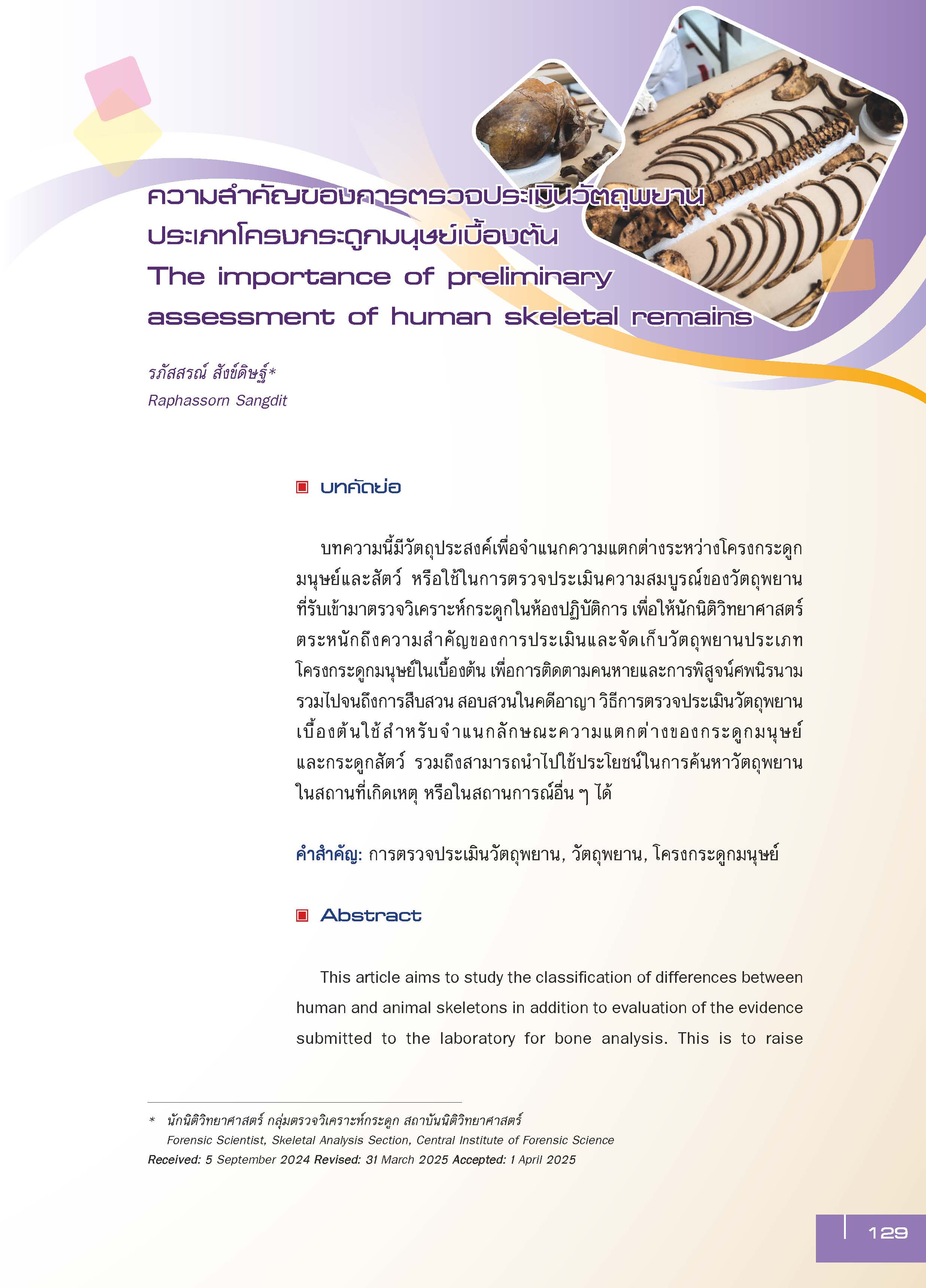
ความสำคัญของการตรวจประเมินวัตถุพยาน ประเภทโครงกระดูกมนุษย์เบื้องต้น
Article Sidebar
Main Article Content
บทคัดย่อ
บทความนี้มีวัตถุประสงค์เพื่อจำแนกความแตกต่างระหว่างโครงกระดูกมนุษย์และสัตว์ หรือ ใช้ในการตรวจประเมินความสมบูรณ์ของวัตถุพยานที่รับเข้ามาตรวจวิเคราะห์กระดูกในห้องปฏิบัติการ เพื่อให้นักนิติวิทยาศาสตร์ตระหนักถึงความสำคัญของการประเมินและจัดเก็บวัตถุพยานประเภทโครงกระดูกมนุษย์ในเบื้องต้น เพื่อการติดตามคนหายและการพิสูจน์ศพนิรนามรวมไปจนถึงการสืบสวน สอบสวนในคดีอาญา วิธีการตรวจประเมินวัตถุพยานเบื้องต้นใช้สำหรับจำแนกลักษณะความแตกต่างของกระดูกมนุษย์ และกระดูกสัตว์ รวมถึงสามารถนำไปใช้ประโยชน์ในการค้นหาวัตถุพยานในสถานที่เกิดเหตุ หรือในสถานการณ์อื่น ๆ ได้
Article Details

อนุญาตภายใต้เงื่อนไข Creative Commons Attribution-NonCommercial-NoDerivatives 4.0 International License.
ต้นฉบับที่ได้รับการตีพิมพ์ในวารสาร เป็นลิขสิทธิ์ของวารสารกระบวนการยุติธรรม แต่ความคิดเห็นที่ปรากฏในเนื้อหาของบทความในวารสารกระบวนการยุติธรรม ถือเป็นความรับผิดชอบของผู้เขียนแต่เพียงผู้เดียว
เอกสารอ้างอิง
Atthaphon Chaemsuwanwongl. (2002). Faculty of forensic science 4 for investigation (forensic science). Daoreuk Company Limited: Thammasat Bookstore.
Cattaneo, C., DiMartino, S., Scali, S., Craig, O. E., Grandi, M., & Sokol, R. J. (1999). Determining the human origin of fragments of burnt bone: a comparative study of histological, immunological and DNA techniques. Forensic Science International, 102(2-3), 181-191. https://www.sciencedirect.com/science/article/abs/pii/S0379073899000596
Croker, S. L., Reed, W., & Donlon, D. (2016). Comparative cortical bone thickness between the long bones of humans and five common non-human mammal taxa. Forensic Science International, 260(17), 1-104. https://www.sciencedirect.com/science/article/abs/pii/S037907381500523X
Heavy, A. L. (2023). Collection and chain of evidence. Encyclopedia of Forensic Sciences, 1(4), 591-595. https://www.sciencedirect.com/science/article/abs/pii/B9780128236772001847
Sarawut Benjakul. (2007). Forensic evidence and the justice process. Court of Justice Review Journal, 1(9), 64-67.
Sasisis Boonsonti. (2024). The importance of evidence preservation for skeletal remains. Journal of Thai Justice System, 17(1), 51-65.
Wanna Charoenphonnaphachai. (2021). The role of scientific evidence in the justice process: The case of DNA testing from hair. Krisdika Ocs Library. www.krisdika.go.th
