About the Journal
Objective
Oceans are important for humans. We have relied on them, extending from coasts to offshore zones. The sea is much more than just a “highway made of water” to transport goods and people. Coastal areas are valuable. Coastal protection and management are important for community development. Sustainable exploitation of oceanic resources while managing marine pollution is required. Understanding them is a foundation for the sustainable use of maritime resources.
MTR is a peer-reviewed journal covering all areas of maritime technology. It provides a forum for discussion of current issues, new ideas, and developments, as well as breakthroughs in coastal and oceanic arenas. The range of topics extends from coastal zone to deep ocean, including engineering, environment, logistics, as well as other management aspects such as maritime policy, maritime education, and the well-being of seafarers.
---------------------------------------------------------------------------------------------------------------------
Topics of interest
The coverage of Maritime Technology and Research (MTR) includes, but is not limited to, the following areas:
- Maritime and port management such as maritime logistics and supply chains, container and yard management, maritime economics, port design and planning, maritime safety and risk assessment, maritime history, maritime laws and policy, piracy, seafarers’ welfare and health, and maritime education
- Oceanographic earth and management such as coastline, bathymetry, marine pollution, ship-generated wastes, and green technology in maritime transportation
- Marine and coastal resources such as mangroves, seagrasses, sediments, ocean energy, and sustainable utilization. However, topics that are purely related to marine biology are outside the scope of MTR
- Marine and offshore engineering such as material improvement for marine applications, marine corrosion, marine structural mechanics, naval architecture, offshore structures, ship design, ship resistance and propulsion, ship spare parts, subsea and underwater technology
- Coastal engineering and management such as integrated coastal management, coastal structures, beach management, coastal erosion, coastal simulations, port and waterfront structures
- Maritime navigation such as navigational safety, navigational techniques, ship maneuvering
--------------------------------------------------------------------------------------------------------------
Peer review process
After submission, MTR will screen for plagiarism. If the similarity percentage is greater than 15 % (except the reference list), the submission will be rejected immediately. MTR implements a double-blinded review system with at least 2 expert reviewers. In this way, MTR can ensure that comments from the reviewers are academically sound, unbiased, and their recommendations are useful for authors.
Once the reviewers agree to review, they will be given 4 weeks to complete the review. They can also request an extension of the review deadline. The chief editor will make a decision based on their recommendations. In the case of revision, after the authors submit a revision along with the tabulated responses to the reviewers' comments, the chief editor will perform a thorough check on how the authors address them and decide whether or not the revision should be sent to the same reviewers for re-assessment. A second or third revision is possible. There may be cases in which even a revision is rejected because the authors do not seriously consider the reviewers' comments and address them critically. Please read the whole review process here.
----------------------------------------------------------------------------------------------------------------
Accepted article types
Research article
MTR accepts and publishes original research articles that contribute to advancements in maritime society. A research article should be well-structured and contain novelty that makes a significant contribution to how we explore, utilize, or manage the ocean and coast more sustainably. The average number of words in a research article is 7,000 - 10,000 words.
Review article
MTR welcomes review articles on emerging topics of current interest. There is no page limit as long as the article contains the necessary content for the review. A review article should comprehensively summarize the current understanding of an ocean-related topic and should be based on an extensive collection of previously published research. A systematic review is also welcome. The average number of words in a review article is 8,000 - 13,000 words. Longer manuscripts are acceptable as long as their contents are critical and relevant.
----------------------------------------------------------------------------------------------------------------
Submission and publication charge policy
Supported by the Faculty of International Maritime Studies (Kasetsart University, Thailand), MTR aims to be a venue for researchers to share advancements. We believe sharing research results in an open-access fashion can strengthen our maritime community.
On 10 February 2025, our policy on the publication charge was as follows,
Manuscripts submitted after 1 July 2025, if accepted for publication in MTR, will be requested to pay the Article Processing Charge (APC) of 290 USD.
Collecting the APC does not affect any decision made by the editor on the manuscript.
----------------------------------------------------------------------------------------------------------------
Journal history
MTR was launched to celebrate the 12th Anniversary of the Faculty of International Maritime Studies, Kasetsart University, Thailand in 2019. Originally, it published only 2 issues per year. Later on, MTR received great interest from international maritime communities and increased its publication frequency to 4 issues per year.
MTR has been indexed by Thai-Journal Citation Index Centre to be in Tier-1 (a category of the best Thai journals). In other words, MTR has been domestically regarded as the best Thai journal, specializing in the ocean only.
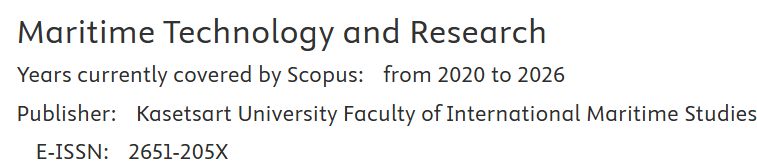
On 30 January 2024, MTR was accepted for Scopus. Contents from the past 4 years (starting from Jan 2020) have also been indexed in Scopus.