
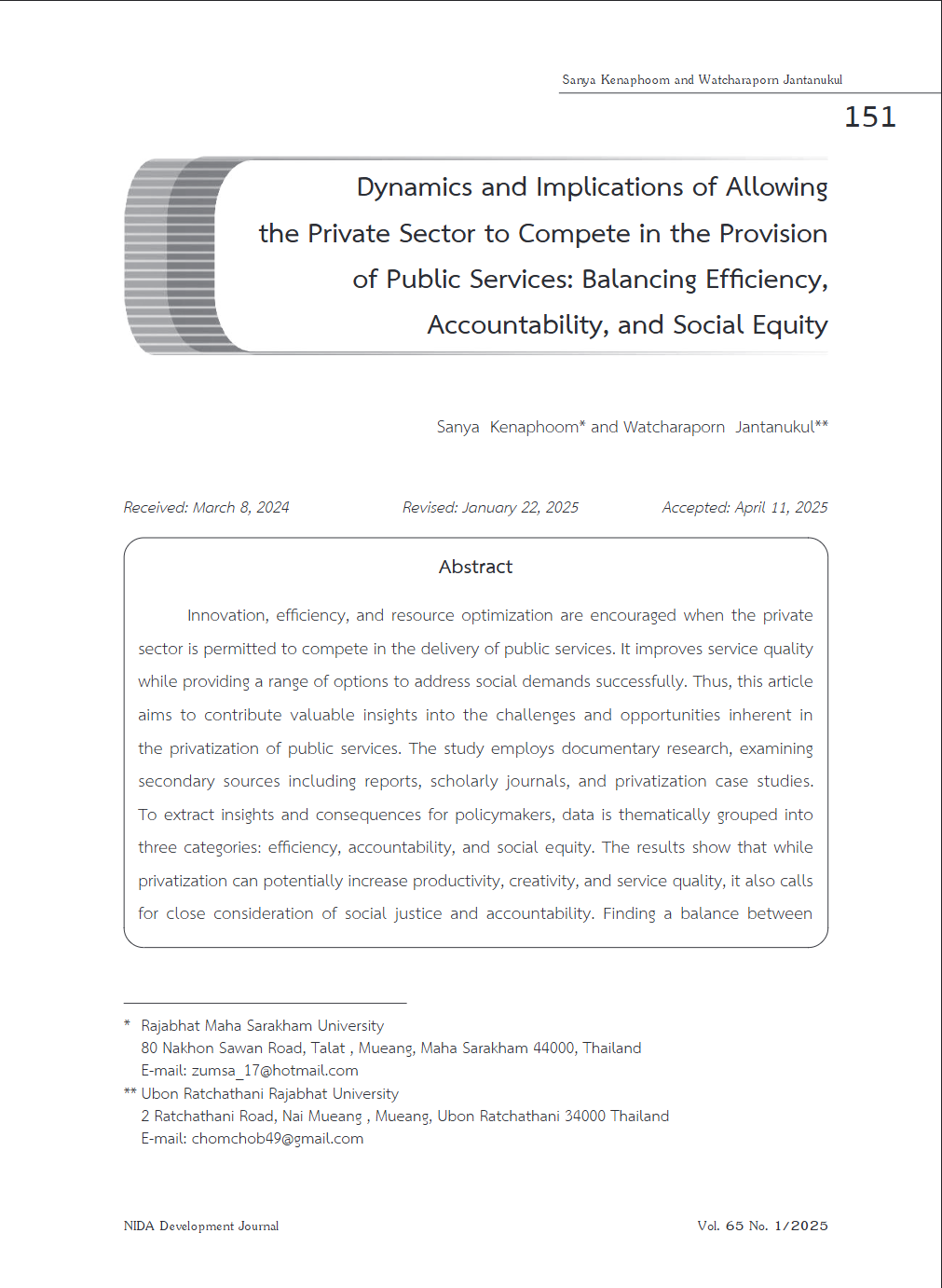
Dynamics and Implications of Allowing the Private Sector to Compete in the Provision of Public Services: Balancing Efficiency, Accountability, and Social Equity
DOI:
https://doi.org/10.14456/ndj.2025.6Keywords:
Dynamics and Implications, Private Sector, Public Services, Balancing Efficiency, Accountability, Social EquityAbstract
Innovation, efficiency, and resource optimization are encouraged when the private sector is permitted to compete in the delivery of public services. It improves service quality while providing a range of options to address social demands successfully. Thus, this article aims to contribute valuable insights into the challenges and opportunities inherent in the privatization of public services. The study employs documentary research, examining secondary sources including reports, scholarly journals, and privatization case studies.To extract insights and consequences for policymakers, data is thematically grouped into three categories: efficiency, accountability, and social equity. The results show that while privatization can potentially increase productivity, creativity, and service quality, it also calls for close consideration of social justice and accountability. Finding a balance between cost-effectiveness and maintaining service quality and accessibility is essential. Policymakers must create robust regulatory frameworks and processes for transparency and publicparticipation. Programs for privatization must be continuously evaluated and adjusted to ensure they align with social values and long-term sustainability. In conclusion, privatization may increase the effectiveness and creativity of public service delivery, but it also calls for stringent accountability and equality laws. Cost-effectiveness, quality, and inclusion must all be balanced for society to progress sustainably.
References
Boubakri, N., Cosset, J. C., & Guedhami, O. (2005). Postprivatization corporate governance: The role of ownership structure and investor protection. Journal of Financial Economics, 76(2), 369-399.
Boudreaux, D. J., & Holcombe, R. G. (1989). The coasian and knightian theories of the firm. Managerial and Decision Economics, 10(1), 17-22.
Bovaird, T., & Löffler, E. (2012). From engagement to co-production: The contribution of users and communities to outcomes and public value. Voluntas: International Journal of Voluntary and Nonprofit Organizations, 23(4), 1119-1138.
Carroll, A. B. (1991). The pyramid of corporate social responsibility: Toward the moral management of organizational stakeholders. Business Horizons, 34(4), 39-48.
Development Reimagined. (2022). Japan and the UK's Development priorities and potential for collaboration. Retrieved from: https://developmentreimagined.com/wp-content/uploads/2023/04/Japan-and-the-UKs-Development-Priorities-and-Potential-for-Collaboration.pdf
Domberger, S., Meadowcroft, S., & Thompson, D. J. (1986). Competitive tendering and efficiency: The case of refuse collection. Oxford Bulletin of Economics and Statistics, 48(1), 23-42.
Domberger, S., Meadowcroft, S., & Thompson, D. J. (1987). The Impact of competitive tendering on the costs of hospital domestic services. The Economic Journal, 97(385), 65-75.
Freeman, R. E., Harrison, J. S., Wicks, A. C., Parmar, B. L., & De Colle, S. (2004). Stakeholder theory: The state of the art. Cambridge University Press.
Grimsey, D., & Lewis, M. K. (2002). Evaluating the risks of public-private partnerships for infrastructure projects. International Journal of Project Management, 20(2), 107-118. https://doi.org/10.1016/S0263-7863(00)00040-5
Grimsey, D., & Lewis, M. K. (2004). Public private partnerships the worldwide revolution in infrastructure provision and project finance. Edward Elgar Publishing.
Gupta, N., Ham, J. C., & Svejnar, J. (2008). Priorities and sequencing in privatization: Theory and evidence from the Czech Republic. European Economic Review, 52(2), 183-208.
Hodge, G. A., & Greve, C. (2007). Public-private partnerships: An international performance review. Public Administration Review, 67(3), 545-558. https://doi.org/10.1111/j.1540-6210.2007.00736.x
Hodge, G. A., Greve, C., & Boardman, A. E. (2017). Public-private partnerships: The way they were and what they can become. Australian Journal of Public Administration, 76(3), 273-282. https://doi.org/10.1111/1467-8500.12260
Khalfan, A., & Gough, T.G. (2002), "Comparative analysis between the public and private sectors on the IS/IT outsourcing practices in a developing country: A field study", Logistics Information Management, 15(3), 212-222. https://doi.org/10.1108/09576050210426760.
Kurihara, Y. (2021). Ten years since the introduction of PPP concessions in Japan and the outlook for the future: Number of participating companies expected to increase with an expansion in market entry opportunities. Mitsui & Co. Global Strategic Studies Institute Monthly Report October 2021. Mitsui & Co. Global Strategic Studies Institute. https://www.mitsui.com/mgssi/en/report/detail/_icsFiles/afieldfile/2021/12/01/2110d_kurihara_e.pdf#page=4.72
Megginson, W. L., & Netter, J. M. (2001). From state to market: A survey of empirical studies on privatization. Journal of Economic Literature, 39(2), 321-389.
Nickson, A., & Vargas, C. (2002). The limitations of water regulation: The failure of the cochabamba concession in Bolivia. Bulletin of Latin American Research, 21(1), 99-120.
Nutt, P.C. (2006). Comparing public and private sector decision-making practices. Journal of Public Administration Research and Theory, 16, 289-318.
Rawls, J. (1971). A theory of justice. Harvard University Press.
Samuelson, P. A., & Nordhaus, W. D. (2009). Economics. McGraw-Hill.
Savas, E. S. (2000). Privatisation and Public-private partnerships. Chatham House
Sclar, E. (2000). You don't always get what you pay for the economics of privatization. Cornell University Press.
Sen, A. (1999). Development as freedom. Oxford University Press.
Stiglitz, J. E. (2003). Globalization and its discontents. NewYork: W.W. Norton & Company.
Tangcharoensathien, V., Patcharanarumol, W., Ir, P., Aljunid, S. M., Mukti, A. G., Akkhavong, K., Banzon, E., Huong, D. B., Thabrany, H., & Mills, A. (2011). Health-financing reforms in Southeast Asia: Challenges in achieving universal coverage. The Lancet, 377(9768), 863-873. http://doi.org/10.1016/S0140-6736(10)61890-9.
Wolmar, C. (2005). On the wrong line: How ideology and incompetence wrecked Britain's railways. Aurum Press.
Downloads
Published
How to Cite
Issue
Section
License
Copyright (c) 2025 NIDA Development Journal

This work is licensed under a Creative Commons Attribution-NonCommercial-NoDerivatives 4.0 International License.