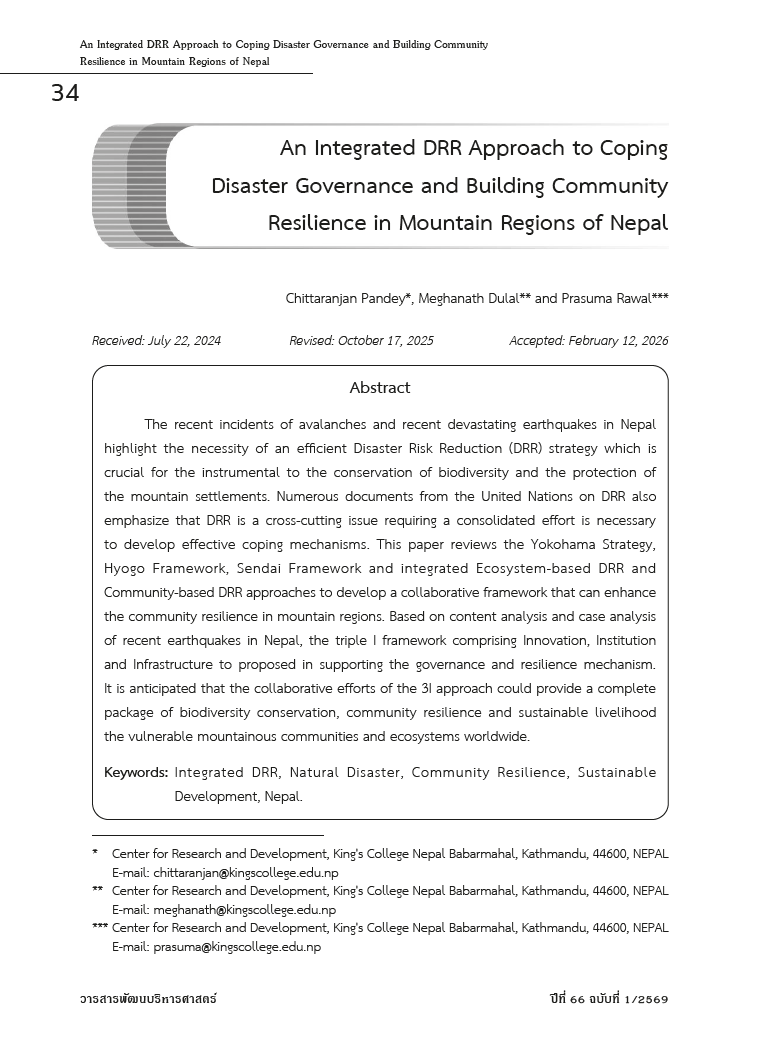
An Integrated DRR Approach to Coping Disaster Governance and Building Community Resilience in Mountain Regions of Nepal
DOI:
https://doi.org/10.14456/ndj.2026.2Keywords:
Integrated DRR, Natural Disaster , Community Resilience , Sustainable Development, NepalAbstract
The recent incidents of avalanches and recent devastating earthquakes in Nepal highlight the necessity of an efficient Disaster Risk Reduction (DRR) strategy which is crucial for the instrumental to the conservation of biodiversity and the protection of the mountain settlements. Numerous documents from the United Nations on DRR also emphasize that DRR is a cross-cutting issue requiring a consolidated effort is necessary to develop effective coping mechanisms. This paper reviews the Yokohama Strategy, Hyogo Framework, Sendai Framework and integrated Ecosystem-based DRR and Community-based DRR approaches to develop a collaborative framework that can enhance the community resilience in mountain regions. Based on content analysis and case analysis of recent earthquakes in Nepal, the triple I framework comprising Innovation, Institution and Infrastructure to proposed in supporting the governance and resilience mechanism. It is anticipated that the collaborative efforts of the 3I approach could provide a complete package of biodiversity conservation, community resilience and sustainable livelihood the vulnerable mountainous communities and ecosystems worldwide.
References
Anderson, G., & McClung, D. M. (2012). Snow avalanche penetration into mature forest in timber harvested terrain. Canadian Geotechnical Journal, 49(4), 477-484. https://doi.org/10.1139/t2012-018
Arnstein, S. (1969). A ladder of citizen participation. Journal of the American Institute of Planners, 35(4), 216-224. https://doi.org/10.1080/01944366908977225
Bankoff, G. (2004). The historical geography of disaster: ‘Vulnerability’ and ‘local in Western Discourse. Taylor & Francis Group. https://doi.org/10.4324/9781849771924
Basher, R. (2006). Global early warning systems for natural hazards: Systematic and peoplecentered. Philosophical Transactions of the Royal Society A, 364(1845), 2167-2182. https://doi.org/10.1098/rsta.2006.1819
Bathurst, J. C., Bovolo, C. I., & Cisneros, F. (2010). Modelling the effect of forest cover on shallow landslides at the river basin scale. Ecological Engineering, 36(3), 317-327. https://doi.org/10.1016/j.ecoleng.2009.05.001
Baudoin, M.-A., & Wolde-Georgis, T. (2015). Disaster risk reduction efforts in the Greater Horn of Africa. International Journal of Disaster Risk Science, 6(1), 49-61. https://doi.org/10.1007/s13753-015-0041-x
Beniston, M. (2003). Climatic change in mountain regions: A review of possible impacts. Climatic Change, 59, 5-31. https://doi.org/10.1023/A:1024458411589
Beniston, M. (2003). Climatic change in mountain regions: A review of possible impacts. In H. F. Diaz (Ed.), Climate variability and change in high elevation regions: Past, present & future Advances in Global Change Research, 15, pp. 5-31. Springer.
Borsje, B. W., van Wesenbeeck, B. K., Dekker, F., Paalvast, P., Bouma, T. J., van Katwijk, M. M., & de Vries, M. B. (2011). How ecological engineering can serve in coastal protection. Ecological Engineering, 37(2), 113-122. https://doi.org/10.1016/j.ecoleng.2010.11.027
Carr, E. R. (2014). From description to explanation: Using the livelihoods as intimate government (LIG) approach. Applied Geography, 52, 110-122. https://doi.org/10.1016/j.apgeog.2014.04.012
Carr, E. R., & Owusu-Daaku, K. N. (2016). The shifting epistemologies of vulnerability in climate services for development: The case of Mali’s agrometeorological advisory programme. Area, 48(1), 7-17. https://doi.org/10.1111/area.12179
Central Bureau of Statistics. (2006). Statistical Pocket Book Nepal 2006.
Central Bureau of Statistics. (2019). Statistical Pocket Book Nepal 2019.
Chambers, R. (2008). Revolutions in development inquiry. Earthscan. https://doi.org/10.4324/9781849772426
Chhotray, V. (2004). The negation of politics in participatory development projects, Kurnool, Andhra Pradesh. Development and Change, 35(2), 327-352. https://doi.org/10.1111/j.1467-7660.2004.00354.x
Cooke, B., & Kothari, U. (2001). Participation: The new tyranny? Zed Books.
Copper, J., & McKenna, J. (2008). Working with natural processes: The challenge for coastal protection strategies. Geographical Journal, 174(4), 315-331. https://doi.org/10.1111/j.1475-4959.2008.00302.x
Cornwall, A., & Brock, K. (2005). What do buzzwords do for development policy? A critical look at ‘‘participation’’, ‘‘empowerment’’ and ‘‘poverty reduction’’. Third World Quarterly, 26(7), 1043-1060. http://www.jstor.org/stable/4017803
Doruk, Ö. T., & Söylemezoğlu, E. (2014). The constraints of innovation in developing countries: Too many barriers to start ups? Procedia - Social and Behavioral Sciences, 150, 944-949. https://ssrn.com/abstract=2541065
Earthquake Engineering Research Institute. (2006). The Kashmir earthquake of October 8, 2005: Impacts in Pakistan. www.eeri.org/lfe/pdf/kashmir_eeri_2nd_report.pdf
Espizua, L. E., & Bengochea, J. D. (2002). Landslide hazard and risk zonation mapping in the Rı´o Grande Basin, Central Andes of Mendoza, Argentina. Mountain Research and Development, 22(2), 177-185. https://doi.org/10.1659/0276-4741(2002)022[0177:LHARZM]2.0.CO;2
Estrella, M., & Saalismaa, N. (2013). Ecosystem-based DRR: An overview. In F. Renaud, K. Sudmeier- Rieux, & M. Estrella (Eds.), The Role of Ecosystems in Disaster Risk Reduction (pp. 26-47). United Nations University Press.
Food and Agriculture Organization of the United Nations. (2015). Mapping the Vulnerability of Mountain Peoples to Food Security. http://www.fao.org/resources/infographics/infographics-details/en/c/358116/
Forbes, K., & Broadhead, J. (2007). The role of coastal forests in tsunami mitigation. Food and Agriculture Organization of the United Nations.
Gardner, J., & Dekens, J. (2012). Mountain hazards and the resilience of social ecological-systems: Examples from India and Canada. In D. Etkin & C. Haque (Eds.), Disaster Risk and Vulnerability: Mitigation Through Mobilizing Communities and Partnerships (pp. 108-132). McGill-Queen’s University Press.
Glantz, M., Baudoin, M.-A., de la Poterie, A., Naranjo, L., & Pierce, G. (2014). Working with a changing climate, not against it—Hydro-meteorological disaster risk reduction: A survey of lessons learned for resilient adaptation to a changing climate. Consortium for Capacity Building.
Gregory, P. J., Ingram, J. S., & Brklacich, M. (2005). Climate change and food security. Philosophical Transactions of the Royal Society B: Biological Sciences, 360(1464), 2139-2148. https://doi.org/10.1098/rstb.2005.1745
Guha-Sapir, D., Hoyois, P., & Below, R. (2014). Annual disaster statistical review 2013: The numbers and trends. Centre for Research on the Epidemiology of Disasters. http://www.cred.be/sites/default/files/ADSR_2013.pdf
Hellmuth, M. E., Moorhead, A., Thompson, M. C., & Williams, J. (Eds.). (2007). Climate risk management in Africa: Learning from practice. Columbia University’s International Research Institute for Climate and Society.
Hickey, S., & Mohan, G. (2004). Toward participation as transformation: Critical themes and challenges. In S. Hickey, & G. Mohan (Eds.), Participation—From tyranny to transformation? (pp. 3-24). Zed Books.
Holloway, A. (2003). Disaster risk reduction in Southern Africa. African Security Review, 12(1), 29-38. https://doi.org/10.1080/10246029.2003.9627568
Intergovernmental Panel on Climate Change. (2012). Special report on managing the risks of extreme events and disasters to advance climate change adaptation. Cambridge University Press.
Intergovernmental Panel on Climate Change. (2007). Climate change 2007: The physical science basis. Contribution of Working Group I to the Fourth Assessment Report of the Intergovernmental Panel on Climate Change. Cambridge University Press.
Intergovernmental Panel on Climate Change. (2018). Summary for policymakers. In Global warming of 1.50°C: An IPCC special report on the impacts of global warming of 1.50°C above pre-industrial levels and related global greenhouse gas emission pathways, in the context of strengthening the global response to the threat of climate change, sustainable development, and efforts to eradicate poverty. IPCC. https://www.ipcc.ch/sr15/chapter/spm/
Jones, J., & Perkins, R. (2010). Extreme flood sensitivity to snow and forest harvest, western Cascades, Oregon, United States. Water Resources Research, 46(12). https://doi.org/10.1029/2009WR008632
Kappes, M., Keiler, M., & Glade, T. (2010). From single- to multi-hazard risk analysis: A concept addressing emerging challenges. In J. Malet, T. Glade, & N. Casagli (Eds.), Mountain risks: Bringing science to society (pp. 351-356). CERG Editions.
Keiler, M., Knight, J., & Harrison, S. (2010). Climate change and geomorphological hazards in the eastern European Alps. Philosophical Transactions of the Royal Society A: Mathematical, Physical and Engineering Sciences, 368(1919), 2461-2479.
https://doi.org/10.1098/rsta.2010.0047
Keiler, M., Sailer, R., Jorg, P., Weber, C., Fuchs, S., Zischg, A., & Sauermoser, S. (2006). Avalanche risk assessment: A multi-temporal approach, results from Galtur, Austria. Natural Hazards and Earth System Sciences, 6(4), 637-651. https://doi.org/10.5194/nhess-6-637-2006
Kelman, I. (2015). Climate change and the Sendai framework for disaster risk reduction. International Journal of Disaster Risk Science, 6(2), 117-127. https://doi.org/10.1007/s13753-015-0046-5
Kelman, I., Gaillard, J., & Mercer, J. (2015). Climate change’s role in disaster risk reduction’s future: Beyond vulnerability and resilience. International Journal of Disaster Risk Science, 6(1), 21-27. https://doi.org/10.1007/s13753-015-0038-5
Krippendorff, K. (2019). Content analysis: An introduction to its methodology (4th ed.). SAGE Publications. https://doi.org/10.4135/9781071878781
Klein, J. A., Tucker, C. M., Steger, C. E., Nolin, A., Reid, R., Hopping, K. A., Yeh, E. T., Pradhan, M. S., Taber, A., Molden, D., Ghate, R., Choudhury, D., Alcántara-Ayala, I., Lavorel, S., Müller, B., Grêt-Regamey, A., Boone, R. B., Bourgeron, P., Castellanos, E., Chen, X., Dong, S., Keiler,
M., Seidl, R., Thorn, J., & Yager, K. (2019). An integrated community and ecosystem-based approach to disaster risk reduction in mountain systems. Environmental Science and Policy, 94, 143-152. https://doi.org/10.1016/j.envsci.2018.12.034
Kohler, T., Wehrli, A., & Jurek, M. (Eds.). (2014). Mountains and climate change: A global concern. Centre for Development and Environment (CDE), Swiss Agency for Development and Cooperation (SDC), & Geographica Bernensia.
Leal, A. (2007). Participation: The ascendancy of a buzzword in the neo-liberal era. Development in Practice, 17(4-5), 539-548. http://www.jstor.org/stable/25548251
Maikhuri, R. K., Nautiyal, A., Jha, N. K., Rawat, L. S., Maletha, A., Phondani, P. C., Bahuguna, Y. M., & Bhatt, G. C. (2017). Socio-ecological vulnerability: Assessment and coping strategy to environmental disaster in Kedarnath valley, Uttarakhand, Indian Himalayan Region. International Journal of Disaster Risk Reduction, 25, 111-124. https://doi.org/10.1016/j.ijdrr.2017.09.002
Manikutty, S. (1997). Community participation: So what? Evidence from a comparative study of two rural water supply and sanitation projects in India. Development Policy Review, 15(2), 115-140. https://doi.org/10.1111/1467-7679.00029
Mercer, J., Kelman, I., Lloyd, K., & Suchet-Pearson, S. (2008). Reflections on use of participatory research for disaster risk reduction. Area, 40(2), 172-183. http://www.jstor.org/stable/40346112
MOHA & DPNet-Nepal. (2015). Nepal disaster report 2015. Ministry of Home Affairs (MOHA), Government of Nepal & Disaster Preparedness Network-Nepal (DPNet-Nepal).
MOHA-GoN. (2017). Nepal disaster report 2017: The road to Sendai. Ministry of Home Affairs, Government of Nepal. http://drrportal.gov.np/uploads/document/1144.pdf
Moos, C., Bebi, P., Schwarz, M., Stoffel, M., Sudmeier-Rieux, K., & Dorren, L. (2018). Ecosystem-based disaster risk reduction in mountains. Earth-Science Reviews, 177, 497-513. https://doi.org/10.1016/j.earscirev.2017.12.011
Mosse, D. (2004). Is good policy unimplementable? Reflections on the ethnography of aid policy and practice. Development and Change, 35(4), 639-671. https://doi.org/10.1111/j.0012-155X.2004.00374.x
Murti, R., & Buyck, C. (Eds.). (2014). Safe havens: Protected areas for disaster risk reduction and climate change adaptation. International Union for Conservation of Nature.
Neuendorf, K. A. (2017). The content analysis guidebook (2nd ed.). SAGE Publications.
Nicholson, S. E. (2014). A detailed look at the recent drought situation in the Greater Horn of Africa. Journal of Arid Environments, 103, 71-79. https://doi.org/10.1016/j.jaridenv.2013.12.003
Olowu, D. (2010). The Hyogo Framework for Action and its implications for disaster management and reduction in Africa. Jàmbá: Journal of Disaster Risk Studies, 3(1), 303-320. https://doi.org/10.4102/jamba.v3i1.22
Parfitt, T. (2004). The ambiguity of participation: A qualified defence of participatory development. Third World Quarterly, 25(3), 537-555. https://doi.org/10.1080/0143659042000191429
Pretty, J. (1995). Participatory learning for sustainable agriculture. World Development, 23(8), 1247-1263. https://doi.org/10.1016/0305-750X(95)00046-F
Roncoli, C., Jost, C., Kirshen, P., Sanon, M., Ingram, K. T., Woodin, M., ...Hoogenboom, P. (2008). From accessing to assessing forecasts: An end-to-end study of participatory climate forecast dissemination in Burkina Faso (West Africa). Climatic Change, 92(3-4), 433-460. https://doi.org/10.1007/s10584-008-9445-6
Sakals, M. E., Innes, J. L., Wilford, D. J., Sidle, R. C., & Grant, G. E. (2006). The role of forests in reducing hydrogeomorphic hazards. Forest Snow and Landscape Research, 80(1), 11-22.
Schwarz, M., Lehmann, P., & Or, D. (2010). Quantifying lateral root reinforcement in steep slopes - from a bundle of roots to tree stands. Earth Surface Processes and Landforms, 35(3), 354-367. http://dx.doi.org/10.1002/esp.1927
Teich, M., Bartelt, P., Grêt-Regamey, A., & Bebi, P. (2012). Snow avalanches in forested terrain: Influence of forest parameters, topography, and avalanche characteristics on runout distance. Arctic, Antarctic, and Alpine Research, 44(4), 509-519. https://doi.org/10.1657/1938-4246-44.4.509
Temmerman, S., Meire, P., Bouma, T. J., Herman, P. M., Ysebaert, T., & de Vriend, H. J. (2013). Ecosystem-based coastal defence in the face of global change. Nature, 504(7478), 79-83. https://doi.org/10.1038/nature12859
United Nations Office for Disaster Risk Reduction. (2016). UNISDR strategic framework 2016-2021. https://www.preventionweb.net/files/51557_strategicframework.pdf
United Nations Office for Disaster Risk Reduction. (2020). About UNDRR: Our impact. https://www.undrr.org/about-undrr/our-impact
United Nations International Strategy for Disaster Reduction. (2005). Hyogo framework for action 2005-2015: Building the resilience of nations and communities to disasters. https://www.undrr.org/publication/hyogo-framework-action-2005-2015
United Nations International Strategy for Disaster Reduction. (2011). Hyogo framework for action 2005-2015 mid-term review. http://www.unisdr.org/we/inform/publications/18197
United Nations International Strategy for Disaster Reduction. (2012). Disaster reduction in Africa: UNISDR informs–special issue on drought risk reduction 2012. https://www.unisdr.org/files/26438_isdrafricainformsspecialissuesondro.pdf
United Nations International Strategy for Disaster Reduction. (2015). Sendai framework for disaster risk reduction 2015-2030. https://www.undrr.org/publication/sendai-frameworkdisaster-risk-reduction-2015-2030
United Nations International Strategy for Disaster Reduction. (2015). The economic and human impact of disasters in the last 10 years. https://www.unisdr.org/files/42862_economichumanimpact20052014unisdr.pdf
Upadhayaya, P. K., & Upreti, B. R. (2011). Mountain tourism in Nepal: An overview on the sustainable inclusion of local communities. https://www.researchgate.net/publication/254201664_Mountain_tourism_in_Nepal_An_overview_on_the_sustainable_inclusion_of_local_communities
Upadhayaya, P., & Upreti, B. (2008). Enhancing women’s participation in mountain tourism, prospects and challenges. https://lib.icimod.org/records/a6hc5-wzk84
United States Agency for International Development. (2012). Building resilience to recurrent crisis: USAID policy and program guidance.
Vermaak, J., & van Niekerk, D. (2004). Disaster risk reduction initiatives in South Africa. Development Southern Africa, 21(3), 555-574. https://doi.org/10.1080/0376835042000265487
White, S. (1996). Depoliticising development: The uses and abuses of participation. Development in Practice, 6(1), 6-15. https://doi.org/10.1080/0961452961000157564
Wisner, B., Gaillard, J. C., & Kelman, I. (2012). Framing disasters: Theories and stories seeking to understand hazards, vulnerabilities and risks. In B. Wisner, J. C. Gaillard, & I. Kelman (Eds.), Handbook of Hazards and Disaster Risk Reduction and Management (pp. 18-34). Routledge.
World Bank. (2012). Disaster risk financing and insurance in Sub-Saharan Africa: Review and options for consideration. The World Bank. https://doi.org/10.1596/26769
Yao, T., Thompson, L., Yang, W., Yu, W., Gao, Y., Guo, X., Yang, X., Duan, K., Zhao, H., Xu, B., Pu, J., Lu, A., Xiang, Y., Kattel, D. B., & Joswiak, D. (2012). Different glacier status with atmospheric circulations in Tibetan Plateau and surroundings. Nature Climate Change 2, 663-667. https://doi.org/10.1038/nclimate1580
Zia, A., & Wagner, C. H. (2015). Mainstreaming early warning systems in development and planning processes: Multilevel implementation of Sendai framework in Indus and Sahel. International Journal of Disaster Risk Science, 6(2), 189-199. https://doi.org/10.1007/s13753-015-0048-3
Zimmermann, M., & Keiler, M. (2015). International frameworks for disaster risk reduction: Useful guidance for sustainable mountain development? Mountain Research and Development, 35(2), 195-202. https://doi.org/10.1659/MRD-JOURNAL-D-15-00006.1
Downloads
Published
How to Cite
Issue
Section
License
Copyright (c) 2026 NIDA Development Journal

This work is licensed under a Creative Commons Attribution-NonCommercial-NoDerivatives 4.0 International License.