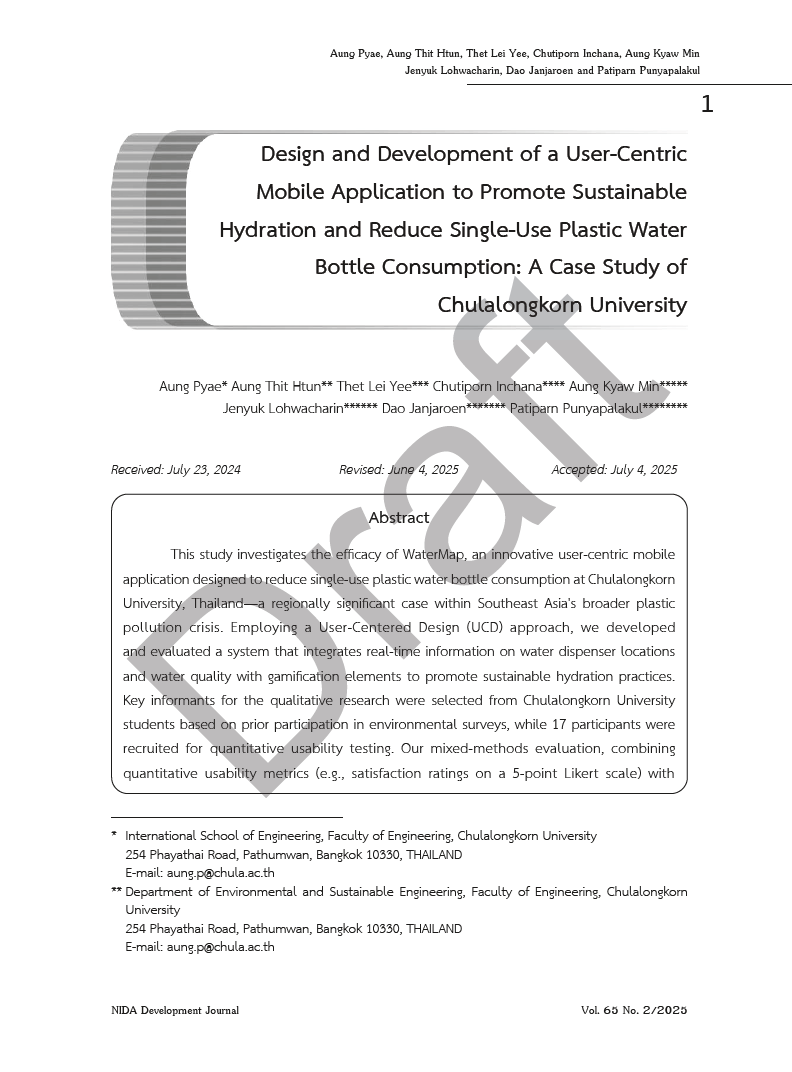
Design and Development of a User-Centric Mobile Application to Promote Sustainable Hydration and Reduce Single-Use Plastic Water Bottle Consumption: A Case Study of Chulalongkorn University
DOI:
https://doi.org/10.14456/ndj.2025.8Keywords:
sustainability, internet of things, mobile technology, user interface, user expereince, usability, environmentAbstract
This study investigates the efficacy of WaterMap, an innovative user-centric mobile application designed to reduce single-use plastic water bottle consumption at Chulalongkorn University, Thailand-a regionally significant case within Southeast Asia's broader plastic pollution crisis. Employing a User-Centered Design (UCD) approach, we developed and evaluated a system that integrates real-time information on water dispenser locations and water quality with gamification elements to promote sustainable hydration practices. Key informants for the qualitative research were selected from Chulalongkorn University students based on prior participation in environmental surveys, while 17 participants were recruited for quantitative usability testing. Our mixed-methods evaluation, combining quantitative usability metrics (e.g., satisfaction ratings on a 5-point Likert scale) with qualitative thematic analysis, revealed high user satisfaction and a strong perceived potential for reducing plastic waste. Users appreciated the app's ease of use and its role in promoting sustainable behaviors. Notably, 76.5% of participants expressed moderate to high trust in the app's water quality data, while 70.6% reported consistent use of reusable bottles. Areas for enhancement, such as multi-language support and improved gamification engagement, were also identified. This research contributes significantly to the growing body of literature on technological interventions for sustainability, offering valuable insights for developing similar initiatives in other educational institutions-particularly in Southeast Asian contexts facing acute plastic pollution challenges. Our findings demonstrate the potential of combining mobile technology, loT, and gamification to foster behavioral change toward environmental sustainability in higher education settings, with implications for broader public spaces.
References
Abras, C., Maloney-Krichmar, D., & Preece, J. (2004). User-centered design. Bainbridge, W. Encyclopedia of Human-Computer Interaction. Thousand Oaks: Sage Publications, 37(4), 445-456.
Bibri, S. E., Krogstie, J., Kaboli, A., & Alahi, A. (2024). Smarter eco-cities and their leading-edge artificial intelligence of things solutions for environmental sustainability: A comprehensive systematic review. Environmental Science and Ecotechnology, 19(1), Article 100330. https://doi.org/10.1016/j.ese.2023.100330
Chiu, M.-C., Chang, S.-P., Chang, Y.-C., Chu, H.-H., Chen, C. C.-H., Hsiao, F.-H., & Ko, J.-C. (2009). Playful bottle: A mobile social persuasion system to motivate healthy water intake. UbiComp '09: Proceedings of the 11th International Conference on Ubiquitous Computing, 185-194. https://doi.org/10.1145/1620545.1620574
Chulalongkorn University. (n.d.). Chula Zero Waste. Retrieved July 8, 2024, from http://www.chulazerowaste.chula.ac.th/activity/
Chulalongkorn University. 2018. Say No to Plastic Bottled Water. Retrieved July 8, 2024 from http://www.sustainability.chula.ac.th/report/317/#:~:text=The%20Guardian%20newspaper%2C%20meanwhile%2C%20reports,contributor%20of%20plastic%20ocean%20waste.
Coskun, A., Yildiz, M., Yilmazer, H., & Genç, H. U. (2021). A study into designing an ambient water bottle that supports users’ water-intake tracking practices. Proceedings of the Design Society, 1, 241–252. https://doi.org/10.1017/pds.2021.25
Di Paolo, R., & Pizziol, V. (2024). Gamification and sustainable water use: The case of the BLUTUBE educational program. Simulation & Gaming, 55(3), 391-417. https://doi.org/10.1177/10468781231181652
Enviliance Asia. (n.d.). Thailand on INC on Plastic Pollution. Retrieved July 8, 2024, from https://enviliance.com/regions/southeast-asia/th/th-waste/th-inc-plastic-pollution
Environmental Protection Agency [EPA]. (2024). Impacts of Plastic Pollution. Retrieved July 8, 2024 from https://www.epa.gov/plastics/impacts-plastic-pollution
Gibbons, S. (2018). Empathy mapping: The first step in design thinking. Retrieved July 12, 2024, from https://www.nngroup.com/articles/empathy-mapping/#:~:text=Definition%3A%20An%20empathy%20map%20is,2)%20aid%20in%20decision%20making.
Helms, M. M., & Nixon, J. (2010). Exploring SWOT analysis – where are we now? A review of academic research from the last decade. Journal of Strategy and Management, 3(3), 215-251. https://doi.org/10.1108/17554251011064837
Htun, A. T., Gushiken, E., Tsuruno, H., Mangkornsaksit, T., & Jinmin, Y. (2023). Understanding Plastic Bottle Usage Behavior among Students at Chulalongkorn University: An SEM Analysis of Influential Factors and Strategies for Sustainable Consumption [PowerPoint slides]. Collaborative research project between Chulalongkorn University and University of Tokyo.
Interaction Design Foundation - IxDF. (2024, June 5). What is User Centered Design (UCD)?. Interaction Design Foundation - IxDF. Retrieved July 8, 2024 from https://www.interaction-design.org/literature/topics/user-centered-design
Jeanpakdeesombat, S. (2021). Study of key success factors and barriers to reduce single-use plastics in Thailand (Master's thesis). College of Management, Mahidol University. Retrieved July 8, 2024, from https://archive.cm.mahidol.ac.th/bitstream/123456789/4050/1/TP%20FM.012%202020.pdf
Julius, B., & Trajano, C. (2022). Plastic pollution in Southeast Asia: Wasted opportunity? Singapore: RSIS.
Kamsook, S., Phongphiphat, A., Towprayoon, S., & Vinitnantharat, S. (2023). Investigation of plastic waste management in Thailand using material flow analysis. Waste management & research : the journal of the International Solid Wastes and Public Cleansing Association, ISWA, 41(4), 924–935. https://doi.org/10.1177/0734242X221126376
Koh, Y. Y., Kok, C. L., Ibraahim, N., & Lim, C. G. (2024). Smart water ATM with Arduino integration, RFID authentication, and dynamic dispensing for enhanced hydration practices. Electronics, 13(9), 1657. https://doi.org/10.3390/electronics13091657
Krisanaraj, J. (2023). Coca-Cola targets Thai plastic waste crisis with recyclable bottles. The Nation. Retrieved July 8, 2024, from https://www.nationthailand.com/business/corporate/40032037
Lewrick, M., Link, P., & Leifer, L. (2020). The design thinking toolbox: A guide to mastering the most popular and valuable innovation methods (Design thinking series). Wiley.
Lowdermilk, T. (2023). User-centered design: A developer's guide to building user-friendly applications. O'Reilly.
Mendes, J., Curralo, A., Curado, A., & Lopes, S. I. (2021). Fostering Sustainability on Campus: Design of an IoT-Enabled Smartbottle for Plastic Reduction in the Academic Environment. In D. Raposo, N. Martins, & D. Brandão (Eds.), Advances in Human Dynamics for the Development of Contemporary Societies (AHFE 2021, Lecture Notes in Networks and Systems, Vol. 277). Springer, Cham. https://doi.org/10.1007/978-3-030-80415-2_3
Meng, J., Lin, Y.-P., & Tsai, H.-J. (2023). Environmental activism in the platform society: Spatial agency in digital maps. New Media & Society. https://doi.org/10.1177/14614448231162581
Pratap, A., Joshy, M., Mathew, M., John, E., & James, J. T. (2019). IoT Based Design for a Smart Plastic Waste Collection System. Proceedings of International Conference on Sustainable Computing in Science, Technology and Management (SUSCOM), Amity University Rajasthan, Jaipur - India, February 26-28, 2019. https://doi.org/10.2139/ssrn.3356267
Rujivanarom, P. (2021). Thailand’s Plastic Waste Conundrum. HEINRICH-BÖLL-STIFTUNG Southeast Asia. Retrieved July 8, 2024, from https://th.boell.org/en
Sedtha, S., Nitivattananon, V., Ahmad, M. M., & Cruz, S. G. (2023). The First Step of Single-Use Plastics Reduction in Thailand. Sustainability, 15(1), 45. https://doi.org/10.3390/su15010045
UN Environment Programme. (2021). Clean Seas: Turn the Tide on Plastic. Retrieved from https://www.cleanseas.org/
United Nations. (2015). Goal 14: Life Below Water. Retrieved from https://sdgs.un.org/goals/goal14
United Nations. (2015). Transforming our world: the 2030 Agenda for Sustainable Development. Retrieved from https://sdgs.un.org/2030agenda
United Nations. (2023). Fast Facts – What is Plastic Pollution?. Sustainable Development Summit. Retrieved July 8, 2024, from https://www.un.org/sustainabledevelopment/blog/2023/08/explainer-what-is-plastic-pollution/
United Nations Environment Programme [UNEP]. (2021). Drowning in Plastics – Marine Litter and Plastic Waste Vital Graphics. Retrieved July 8, 2024 from https://www.unep.org/resources/report/drowning-plastics-marine-litter-and-plastic-waste-vital-graphics
van Trotsenburg, A., & Lim, J. H. (2022). Turning the tide on plastic pollution through regional collaboration in Southeast Asia. World Bank Blogs. Retrieved July 8, 2024, from https://blogs.worldbank.org/en/eastasiapacific/turning-tide-plastic-pollution-through-regional-collaboration-southeast-asia
Vithanage, J., et al. (2019). SmartOne: IoT-based Smart Platform to Manage Personal Water Usage. 2019 International Conference on Advancements in Computing (ICAC), Malabe, Sri Lanka, 398-403. https://doi.org/10.1109/ICAC49085.2019.9103373
Wichai-utcha, N., & Chavalparit, O. (2019). 3Rs Policy and plastic waste management in Thailand. Journal of Material Cycles and Waste Management, 21(1), 10–22. https://doi.org/10.1007/s10163-018-0781-y
World Bank Group. (2022). Plastic Waste Material Flow Analysis for Thailand. Retrieved July 8, 2024, from https://www.worldbank.org/en/country/thailand/publication/plastic-waste-material-flow-analysis-for-thailand
WWF-Australia. (2018). The lifecycle of plastics. Retrieved from https://www.wwf.org.au/news/blogs/the-lifecycle-of-plastics#gs.hpfz55
Yablonski, J. (2020). Laws of UX: Using psychology to design better products & services. O'Reilly Media.
Yildiz, M., & Coskun, A. (2019). Wwall: A public water dispenser system to motivate regular water intake in the office environment. In DIS '19 Companion: Companion Publication of the 2019 on Designing Interactive Systems Conference 2019 Companion (pp. 347-352). https://doi.org/10.1145/3301019.3323890
Downloads
Published
How to Cite
Issue
Section
License
Copyright (c) 2025 NIDA Development Journal

This work is licensed under a Creative Commons Attribution-NonCommercial-NoDerivatives 4.0 International License.