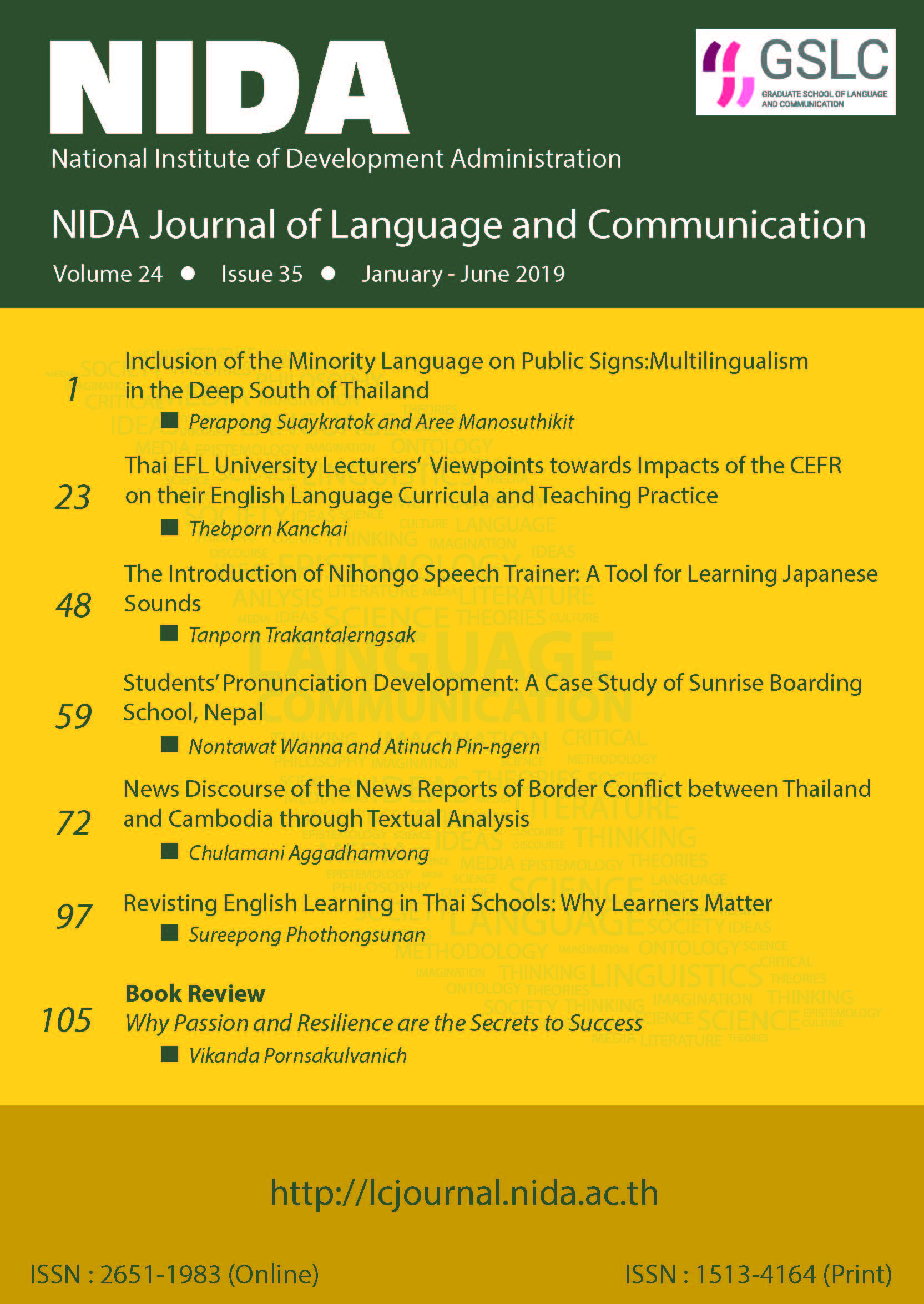
Thai EFL University Lecturers’ Viewpoints towards Impacts of the CEFR on their English Language Curricula and Teaching Practice
Keywords:
Common European Framework of References (CEFR), CEFR Descriptors, Common European Levels of Language Proficiency, CEFR in ThailandAbstract
The Common European Framework of Reference for Languages: Learning, Teaching and Assessment (CEFR) provides a basis for foreign language education, policies and practices. The CEFR influences English language teaching in Europe and beyond. In Thailand, since 2014, the CEFR has been applied to its English curriculum for all levels of education. However, little research has investigated teachers’ understandings of the CEFR and their viewpoints towards its use. This qualitative interview study aimed to investigate university instructors’ viewpoints of the CEFR and their applications of this framework in their English language classrooms. Thirty-three Thai English as a Foreign Language (EFL) university lecturers (20 females and 13 males) participated in this research project, using semi-structured interviews. The findings indicated that Thai EFL university lecturers had a reasonably good understanding of the CEFR, particularly the domains of assessment, the Common Reference Levels of language proficiency and language teaching and learning applications. However, Thai EFL lecturers have little insight into the approach underlying the CEFR, an action-oriented approach. The use of the CEFR in Thai EFL classrooms appeared to be associated with their understanding. Lecturers’ perceptions towards the influences of the CEFR on English education in Thailand were found to be the combination of the positive evaluations and concerns. The current study further suggests that CEFR-related training programs to bring more practical impact on classroom teaching are required for Thai EFL lecturers and school teachers in general.
Downloads
Published
How to Cite
Issue
Section
License

This work is licensed under a Creative Commons Attribution-NonCommercial-NoDerivatives 4.0 International License.
By submitting a manuscript, the author transfers the copyright for the article to School of Language and Communication, National Institute of Development Administration (NIDA), if and when the manuscript is accepted for publication. Though the journal is an open-access, reproduction of any material published in NIDA Journal of Language and Communication for non-personal and/or commercial purpose requires a written permission from School of Language and Communication, National Institute of Development Administration (NIDA).



