
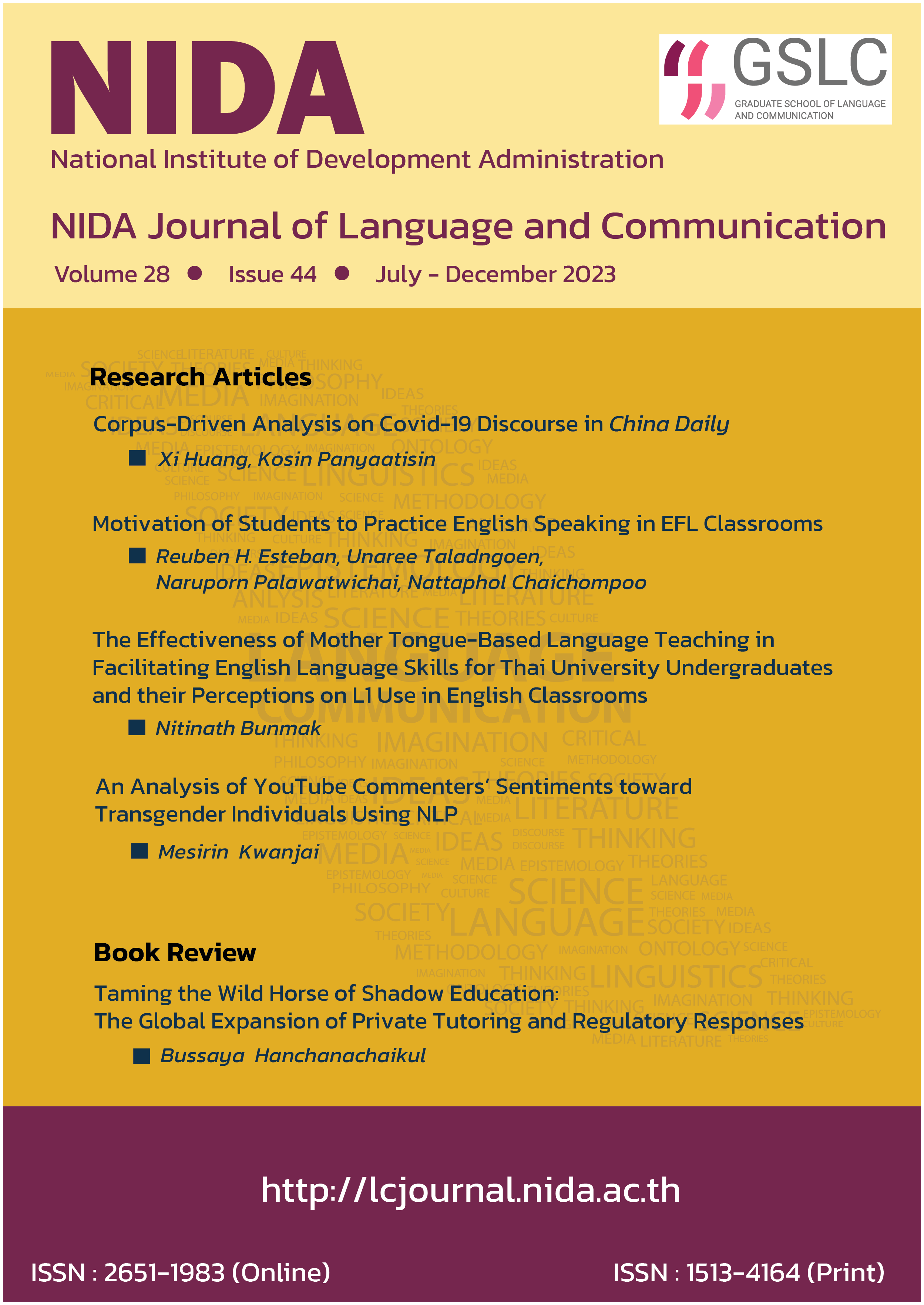
Motivation of Students to Practice English Speaking in EFL Classrooms
Keywords:
integrative motivation, instrumental motivation, Thai university students, EFL students, English speakingAbstract
This study aimed to investigate the integrative and instrumental motivation of students at a university in Phitsanulok when they practice English speaking in their English as Foreign Language (EFL) classes. There were 75 undergraduate students who agreed to be participants in the study which included 25 students from each of the Faculty of Business Administration and Liberal Arts (BALA), the Faculty of Science and Agricultural Technology (SAT), and the Faculty of Engineering (ENG). The participants were selected using a purposive sampling method to complete a 20-item questionnaire evaluating their motivation in practicing their English speaking. The results showed that the participants from the three faculties have a high level of motivation (x̄=4.04, SD=0.13) to practice English speaking. Instrumental motivation (x̄=4.13, SD=0.20) had a significantly higher mean than integrative motivation (x̄=3.94, SD=0.09). It could be said that students of a university in Phitsanulok are highly motivated to practice speaking in English. Furthermore, students seem to believe that practicing speaking in English can help them find a job in the future and Englishspeaking experience could help them when they go abroad. Also, they tend to be more confident when they speak in English. The results of this study indicate that the motivation to practice speaking English among students at a university in Phitsanulok needs to be nurtured.
References
Al Mamun, A., Rahman, M., Rahman, A. R., & Hossaim, A. A. (2012). Students’ attitudes towards English: The case of life science school of Khulna University. International Review of Social Sciences and Humanities, 3, 200-209.
Balog, A., & Pribeanu, C. (2010). The role of perceived enjoyment in the students’ acceptance of an augmented reality teaching platform: A structural equation modelling approach, Studies in Informatics and Control, 19(3), 319-330. https://sic.ici.ro/the-role-of-perceived-enjoyment-in-the-students-acceptance-ofan-augmented-realityteaching-platform-a-structural-equation-modellingapproach/
Best, J. W. (1981). Research in education (5th Ed.). Prentice Hall. Boonkit, K. (2010). Enhancing the development of speaking skills for non-native speakers of English. Procedia Social and Behavioral Science, 2(2), 1305-1309.
Brown, D. (2000). Principles of language learning & teaching (4th Ed.). Longman.
Chaney, A. L., & Burk T. L. (1998). Teaching oral communication in grades K-8. Allyn & Bacon.
Choomthong, D., & Chaichompoo, C. (2015). English language learning motivation of Thai undergraduate students in the globalized era. Suranaree Journal of Social Science, 9(2), 23-25.
Crookes, G., & Schmidt, R. W. (1991). Motivation: Reopening the research agenda. Language Learning, 41(4), 469-512.
Degang, M. (2010). Motivation toward English language learning of the second year undergraduate Thai students majoring in Business English at an English-medium university [Unpublished master’s thesis, Srinakarinwirot University].
Ditual, R.C. (2012). The motivation for and attitude towards learning English. Asian EFL Journal, 63. 4-21.
Dörnyei, Z. (2005). The psychology of the language learner: Individual differences in second language acquisition. Routledge.
Dörnyei, Z. (1996). Moving language learning motivation to a larger platform for theory and practice. In R. L. Oxford (ed.), Language teaming motivation: Pathways to the new century, 89-101.
Dörnyei, Z. (1998) Motivation in second and foreign language learning. Language Teaching, 31(3), 117-135. http://dx.doi.org/10.1017/S026144480001315X
Gardner, R. C. (1977). Social factors in second language acquisition and bilinguality. Invited Chapter in Individual, Language and Society, 103-148. The Canada Council.
Gardner, R. C. (1985a). Social psychology in second language learning: The role of attitudes and motivation. Edward Arnold Ltd.
Gardner, R. C. (1985b). The attitude motivation test battery. [Technical Report]. University of Western Ontario.
Gardner, R. C., & Lambert, W. E. (1972). Attitudes and motivation in second language learning. Newbury House.
Gilakjani, A., Leong, L., & Saburi, N. (2012). Study on the role of motivation in foreign language learning and teaching. I.J. Modern Education and Computer Science, 7, 9-16.
Guay, F., Chanal, J., Ratelle, C. F., Harsh, H. W., Larose, S., & Boivin, M. (2010). Intrinsic identified and controlled types of motivation for school subjects in young elementary school students. British Journal of Educational Psychology, 80, 711- 735. https://doi.org/10.1348/000709910X499084
Hussain, S. (2017). Teaching speaking skills in communication classroom. International Journal of Media, Journalism and Mass Communications, 3(3), 14- 21. http://dx.doi.org/10.20431/2454-9479.0303003
Islam, N. (1999). A few aspect of motivation: An overview of concepts, theories and techniques. Khulna University Studies, 1(1), 91-96. https://doi.org/10.53808/KUS.1999.1.1.103-108-mb
Kassim, S. A., & Ghaith G. (2008). Student motivation to learn English as a Foreign Language. Foreign Language Annals, 33(6), 632-644. DOI:10.1111/j.1944-9720.2000.tb00932.x
Khamkhien. A. (2011). Quantitative and qualitative views of Thai EFL learners’ learning oral communications skills. Academic Research International, 1(1), 90-103.
Kitjaroonchai, N., & Kitjaroonchai, T. (2012). Motivation toward English language learning of students in secondary and high schools in education server area office 4, Saraburi, Thailand. International Journal Language and Linguistics, 1(1), 22-23.
LaRock, H. (2019, May 1). Advantage of speaking English. The Classroom. https://www.theclassroom.com/advantages-speaking-english-8208325.html
Liu, M. (2005) Reading behavior in the digital environment: Changes in reading behavior over the past ten years. Journal of Documentation, 61(6), 700-712.
Liu, M. (2007). Chinese students’ motivation to learn English at the tertiary level. Asia EFL Journal, 9(1), 126-146.
Lyons, D. (2017, July 26). How many people speak English, and where is it spoken? Babbel Magazine. https://www.babbel.com/en/magazine/how-many-peoplespeak-english-and-where-is-it-spoken
Muftah, M., & Rafix-Galea, S. (2013). Language learning motivation among Malaysian pre-university students. English Language Teaching, 6(3), 92-103.
Nurmala, Y. (2012). The use of multimedia teaching aids to improve the quality of the speaking teaching and learning process at the English grade class of SMP N6 Yogyakarta in the academic year of 2011/2012 [Master’s thesis, Yogyakarta State University]. http://eprints.uny.ac.id/9431/1/1-08202244056.pdf
Nuchnoi, R. (2008). A survey of the motivation of the Rangsit University English major students toward learning English. Journal of Humanities and Social Science, 5(9), 93-116.
Pintrich, P. R., & Schunk, D. H. (1996). Motivation in education: Theory, research, and applications. Prentice Hall.
Quadir, M. (2011). A comparative study of English and non-English major university students’ motivation to learn English oral communication. East West Journal of Humanities, 2(2), 91-111.
Ur, P. (1996). A course in language teaching: Practice and theory. Cambridge University Press. Vaezi, Z. (2008). Language learning motivation among Iranian undergraduate students. World Applied Sciences Journal, 5(1), 54-61.
Wanich, W. (2014). The relationship between the CLT approach and Thai EFL students’ attitudes and motivation in leaning speaking. Language Education and Acquisition Research Network Journal, 7(1), 106-124.
Wimolmas, R. (2012). A survey study of motivation in English language learning of first year undergraduate students at Sirindhorn International Institute of Technology (SIIT), Thammasat University [Master’s thesis, Thammasat University]. https://www.academia.edu/29551061/A_Survey_Study_of_Motivation_in_English_Language_Learning_of_First_Year_Undergraduate_Students_at
Downloads
Published
How to Cite
Issue
Section
License

This work is licensed under a Creative Commons Attribution-NonCommercial-NoDerivatives 4.0 International License.
By submitting a manuscript, the author transfers the copyright for the article to School of Language and Communication, National Institute of Development Administration (NIDA), if and when the manuscript is accepted for publication. Though the journal is an open-access, reproduction of any material published in NIDA Journal of Language and Communication for non-personal and/or commercial purpose requires a written permission from School of Language and Communication, National Institute of Development Administration (NIDA).



