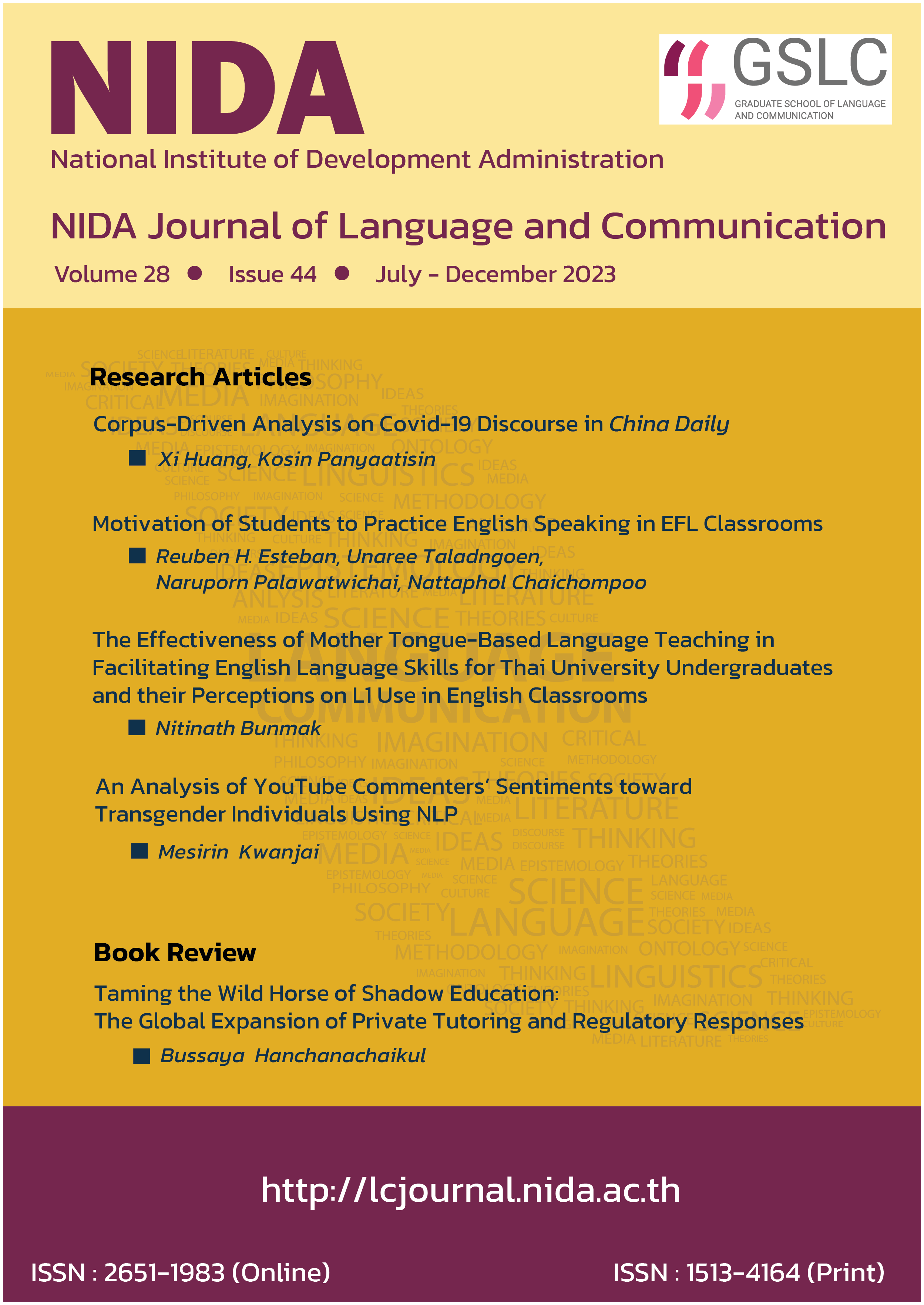
The Effectiveness of Mother Tongue-Based Language Teaching in Facilitating English Language Skills for Thai University Undergraduates and their Perceptions on L1 Use in English Classrooms
Keywords:
English language skills, Mother tongue-based language teaching, Perceptions, Thai university undergraduatesAbstract
This research study investigates the effectiveness of mother tongue-based language education in facilitating English language skills among Thai university undergraduates and explores how Thai university undergraduates perceived using mother tongue-based language teaching in English classrooms. The participants were 100 private university undergraduate students in Chiang Mai, Thailand selected by purposive sampling. Based on the data collected via an experimental study, a questionnaire, and a semi-structured interview, the findings were statistically significant. The results demonstrated a significant increase in the mean scores of the post-tests in the experimental group and the control group. The mean scores of the changes of the tests in the experimental group were also greater than those of the control group. Therefore, the findings indicated that the method could generate a higher level of achievement in English language learning skills among the experimental group. In addition, the participants perceived various advantages of using their native language (L1) in second language (L2) classrooms. First, employing students’ mother tongues allowed for better understanding of the content being taught. Second, this tactic increased motivation to participate in classroom activities and complete tasks. Third, it enabled teachers to clarify and explain some difficult concepts, including directions for classroom tasks and activities. Ultimately, the participants generally supported use of their mother tongue in an English classroom to enhance their foreign language skills, citing particular benefits in explaining English grammatical rules and the meanings of difficult or confusing terms.
References
Alptekin, C. (2002). Towards intercultural communicative competence in ELT. ELT Journal, 56(1), 57-64.
Aurbach, E. (1993). Reexamining English only in the ESL classroom. TESOL Quarterly, 27(1), 9-32.
Bozorgian, H., & Fallahpour, S. (2015). Teachers’ and students’ amount and purpose of L1 use: English as foreign language (EFL) classrooms in Iran. Iranian Journal of Language Teaching Research, 3(2), 67-81.
Çelik, S. (2008). Opening the door: An examination of mother tongue use in foreign language classrooms. Hacettepe University Journal of Education, 34(1), 75-85.
Cole, S. (1998). The use of L1 in communicative English classrooms. JALT Journal, 39(2), 95-101.
Cook, V. (2000). Second language learning and language teaching. Foreign Language Teaching and Research Press and Edward Arnold Limited. Cook, V. (2001). Using the first language in the classroom. Canadian Modern Language Review, 57, 402-423.
Cummins, J. (1979). Linguistic interdependence and the educational development of bilingual children. Review of Educational Research, 49(2), 222-251.
Cummins, J. (2000). Linguistic interdependence and the educational development of bilingual children. Review of Educational Research, 156(1), 124-314.
Espada, J. P. (2012). The native language in teaching kindergarten mathematics. Journal of International Education Research, 8(4), 359-366.
Ford, K. (2009). Principles and practices of L1/L2 use in the Japanese university EFL classroom. JALT Journal, 31(1), 63-80.
Fuente, M. J., & Goldenberg, C. (2022). Understanding the role of the first language (L1) in instructed second language acquisition (ISLA): Effects of using a principled approach to L1 in the beginner foreign language classroom. Language Teaching Research, 26(5), 943-962.
Gardner, R. C., & Lambert, W. E. (1972). Attitudes and motivation in second language learning. Newbury House Publishers.
Greene, J. (1997). A meta-analysis of the Rossell and Baker review of bilingual education research. Bilingual Research Journal, 21(1), 103-22.
Hopkins, D. (2003). Evaluation for school development. Open University Press. Kang, H. S. (2012). English-only instruction at Korean universities: Help or hinderance to higher learning? English Today, 109, 29-34.
Kayaoğlu, M. N. (2012). The use of mother tongue in foreign language teaching from teachers’ practice and perspective. Pamukkale University Journal of Education, 32, 25-35.
Khejeri, M. (2014). Teachers’ attitudes towards the use of mother tongue as a language of instruction in lower primary schools in Hamisi district, Kenya. International Journal of Humanities and Social Science, 4(1), 75-85.
Khodareza, M., & Kaviani M. (2016). A survey on the effectiveness of mother tongue on learning L2 vocabulary by Iranian pre-intermediate EFL learners. International Journal of English Linguistics, 6(7). 113-119.
Kim, Y., & Petraki, E. (2009). Students’ and teachers’ use of and attitudes to L1 in the EFL classrooms. Asian EFL Journal, 11(4), 58-89.
Krashen, S. D. (1987). Principles and practice in second language acquisition. Prentice Hall.
Krashen, S. D. (1989). We acquire vocabulary and spelling by reading: Additional evidence for the input hypothesis. Modern Language Journal, 73, 440-464.
Li, V. W. K., & Majhanovich S. E. (2010). A review of the effectiveness of the mothertongue education policy in post-colonial Hong Kong. Education and Learning Research Journal, 4, 10-29.
Loewen, S., & Sato, M. (2017). The Routledge handbook of instructed second language acquisition. Taylor & Francis.
Macaro, E. (2001). Analyzing student teachers’ code-switching in foreign language classrooms: Theories and decision making. Modern Language Journal, 85(4), 531-548.
Malone, D. (2008, July). Knowing what we see: Research and evaluation in mother tongue-based multilingual education programs in ethnolinguistic minority communities [Paper presentation]. The 2nd International Conference on Language Development, Language Revitalization, and Multilingual Education in Ethnolinguistic Communities. Bangkok, Thailand.
Malone, S., & Paraide, P. (2011). Mother tongue-based bilingual education in Papua New Guinea. International Review of Education, 57, 705-720.
Mangubhai, F. (2005). What can EFL teachers learn from immersion language teaching? Asian EFL Journal, 7(4), 203-212.
Miles, R. (2004). Evaluating the use of L1 in the English language classroom [Unpublished doctoral dissertation]. University of Birmingham.
Mukattash, L. (2003). Towards a new methodology for teaching English to Arab learners. International Journal of Arabic English Studies, 4, 211-234.
Nation, P. (2003). The role of the first language in foreign language learning. Asian EFL Journal, 5(2), 1-8.
Nilubol, K., & Sitthitikul, P. (2017). The L1-based integration towards the in-class support in an international classroom of Thailand. Turkish Online Journal of Language Teaching, 2(1), 53-69.
Nilubol, K. (2020). The impacts of l1 integration towards general English classroom of Thai public university undergraduate students: An account of learning motivation perspective. LEARN Journal, 13(2), 426-444.
Nunan, D., & Lamb, C. (1996). The self-directed teacher. Cambridge University Press.
Obod, M. M., Remirez, M. N. V., Satria, E., Asmoni, A., & Indriani, D. E. (2019). Effectiveness on the use of mother tongue in teaching concepts of fraction among second grade of elementary school pupils. Journal for the Education of Gifted Young Scientists, 8(1), 291-304.
Prodromou, L. (2002). From mother tongue to other tongue. TESOL Greece Newsletter, 67, 7-8.
Ricablanca, J. D. (2014). Effectiveness of mother tongue-based instruction on pupils’ achievement in mathematics [Unpublished master’s thesis]. Central Mindanao University.
Riches, C., & Genesee, F. (2006). Literacy: Crosslinguistic and crossmodal issues. In F. Genesee, K. Lindholm-Leary, W. M. Saunders & D. Christian (Eds.), Educating English language learners: A synthesis of research evidence. Cambridge University Press, pp. 64-108.
Saiwongpanya, P., & Sengsri, S. (2015). The development of electronic courseware entitled “English vocabulary” by using mother tongue-based for Prathom Suksa 4 students in the multicultural school, Proceedings of INTED 2015, pp. 4885- 4894.
Schweers, C. W., Jr. (1999). Using L1 in the L2 classroom. English Teaching Forum, 37(2), 6-9.
Seng, G. H., & Hashim, F. (2006). Use of L1 in L2 reading comprehension among tertiary ESL learners. Reading in a Foreign Language, 18(1), 29-54.
Slavin, R. E. & Cheung, A. (2005). A synthesis of research on language of reading instruction for English language learners. Review of Educational Research, 75(2), 247-84.
Spada, N. (2014). Instructed second language acquisition research and its relevance for L2 teacher education. Education Matters, 2(1), 41-54.
Tang, J. (2002). Using L1 in the English classroom. English Teaching Forum, 40(1), 36-43.
Thornbury, S. (1999). How to teach grammar. Longman. Türker, E. (2018). The influence of L1 frequency in instructed second language learning of L2 idioms. Journal of Second Language Studies, 1(2), 333-356.
Ueasiriwatthanachai, J. (2020). Factors affecting effectiveness of communicative English language teaching in Thailand. Academic Journal for the Humanities and Social Sciences, 3(1), 79-91.
UNESCO. (2003). Education in a multilingual world: UNESCO education position paper. http://unesdoc.unesco.org/images/0012/001297/129728e.pdf
Vygotsky, L. S. (1976). Play and its role in the mental development of the child. In J. Bruner, A. Jolly & K. Sylva (Eds.), Play: Its role in development and evolution. Basic Books.
Walter, S., & Dekker, D. (2011) Mother tongue instruction in Lubuagan. International Review of Education, 57(5-6), 667-683.
Wa-Mbaleka, S. (2014). English teachers’ perceptions of the mother tongue-based education policy in the Philippines. European Journal of Research and Reflection in Educational Sciences, 2(4), 17-32.
Wigglesworth, G., & Simpson, J. (2008). The language learning environment of preschool children in indigenous communities. In S. May (Ed.), Critical multiculturalism: Rethinking multicultural and antiracist education (pp.13-29). Falmer Press.
Wiriyachitra, A. (2001). A Thai university English scenario in the coming decade. Thai TESOL, 14(1), 4-7. Willis, J. (1996). A framework for task-based language learning. Longman.
Wongsothorn, A., Hiranburana, K., & Chinnawongs, S. (2002). English language teaching in Thailand today. Asia Pacific Journal of Education, 22(2), 107-116.
Yamane, T. (1973). Statistics: An introduction analysis. Harper & Row.
Downloads
Published
How to Cite
Issue
Section
License

This work is licensed under a Creative Commons Attribution-NonCommercial-NoDerivatives 4.0 International License.
By submitting a manuscript, the author transfers the copyright for the article to School of Language and Communication, National Institute of Development Administration (NIDA), if and when the manuscript is accepted for publication. Though the journal is an open-access, reproduction of any material published in NIDA Journal of Language and Communication for non-personal and/or commercial purpose requires a written permission from School of Language and Communication, National Institute of Development Administration (NIDA).



