
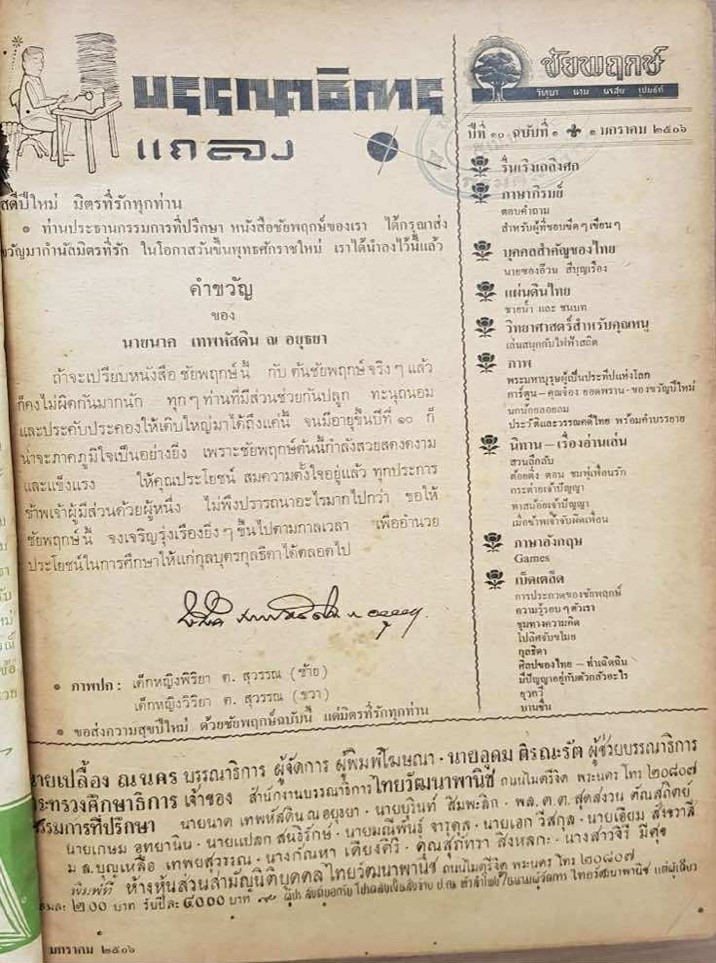
Chaiyaphruek: A mirror of a “happiness” perspective between the Thai state and people, 1958 -1963
Article Sidebar
Main Article Content
Abstract
Background and objective (s): Among the emotions and sentiments of interest within Thai historiography, “happiness” stands out because of close relationship with Thai society, especially in the early 1960s. Despite recent disciplinary focus, this research significantly contributed to expanding the frontiers of Thai history through the analysis of a Thai magazine (Chaiyaphruek) by spotlighting the role of individuals as historical agents. The research for this article aimed to analyze the emergence of people in Thai society, beginning in the early 1960s. This phenomenon is linked to the subsequent economic expansion, which precipitated a paradigm shift in the connotation of happiness.
Study method: This article is a historical academic paper that utilizes Chaiyaphruek magazine from Vol. 5 No. 1 January 1958 to Vol. 10 No. 24 December 1963. All the data are represented and analyzed in descriptive research.
Main result: The context of Thai society during the Cold War significantly influenced Thai people's understanding and perception of happiness. A number of changes occurred, including the end of the threat from World War II, the rise of anti-communist sentiment,rapid economic expansion and the spread of education to local communities. All these factors contributed to people becoming laborers supporting national development. Because of other conditions, such as a lack of social capital, status by birth or limited economic means, people were compelled to define happiness in a tangible form. This often meant evaluating happiness through monetary value because money could guarantee livelihoods and raise social status. This affected Thai people’s life patterns and behaviors, shifting in line with this new definition. According to the results of this research, people tended to put emphasis on the value of work, which was one of the few ways to earn a monetary income.
Relevance to Thai Studies: This article tries to fill a gap in Thai historiography on the Cold War in two levels; concentrating on emotion and feeling through a case of happiness and second analyzing people’s experience and their historical evidence that appeared in a magazine.
Conclusion: The Thai social context and the populace's experiences in the 1960s resulted in a perspective and meaning of happiness significantly different from other periods. Because this group lacked the economic advantages and "good backgrounds" of the middle class, the people unsurprisingly tended to define happiness based on the cost of living and their family's social status.
Downloads
Article Details

This work is licensed under a Creative Commons Attribution-NonCommercial-NoDerivatives 4.0 International License.
Journal of Thai studies is licensed under a Creative Commons Attribution-Noncommercial-NoDerivatives4.0 Intenational (CC BY-NC-ND 4.0) licence, unless otherwise stated. Plese read our Policies page for more information on Open Access, copyright and permissions.
References
Anderson, B. (2010). In the mirror: Literature and politics of Siam in the American era. Samnakphim An. Bangkok: Read Publishing.
Ampai, P. (2022). Factors Determining Happiness in Life Compared Between Agricultural and Non-Agricultural Workers. Social Research, 45(2), 59-96. https://so04.tci-thaijo.org/index.php/socialresearchjournal/article/view/269185
Boonyarit, N. (Ed.). (1961, July 1). Chao Krung Magazine, 10(10).
Chan-iam, C.(1962, January 1). Wicha Pen Sap An Prasoet [Wisdom is the True Wealth]. Chaiyaphruek Magazine, 9(1), 4.
Charoensin-o-larn, C. (2012). Wathakam kan Phatthana: Amnat Khwam Ru Khwam Ching Ekkalak Lae Khwam Pen Uen [Development Discourse: Power, Knowledge, Truth, Identity and Otherness]. (5 th ed.). Bangkok: Wiphasa Printing.
Chiangjan, J. (2020). History of Happiness from the Perspective of the Thai State and Media,1958-1972. [Master's thesis, Chiang Mai University]. http://cmuir.cmu.ac.th/jspui/handle/6653943832/69607
Chu-arun, A. (1963, July 1). Santhana wisasa Chaiyaphruek. [Chaiyaphruek’s Casual Talks]. Chaiyaphruek Magazine, 10(13), 46.
Conklin, C. N. (2015). The origins of the pursuit of happiness. Washington University Jurisprudence Review, 7(1), 195-244. https://openscholarship.wustl.edu/cgi/viewcontent.cgi?article=1123&context=law_jurisprudence
Daengphan, A. (1963, July 1). Santhana wisasa Chaiyaphruek [Chaiyaphruek's Casual Talks]. Chaiyaphruek Magazine, 10(13), 46.
Department of Teacher Education. (1962). Thai Index Magazine 1962. Bangkok: Ministry of Education.
Kiccakaro, N. (2019). Happiness in Buddhist Philosophy. MCU Buddhist Review 3(2), 93-104. https://so06.tcithaijo.org/index.php/jmb/article/download/240382/163807/
Kongkirati, P. (2013). Laeo tae khwam khlueanwai ko prakot [And then the movement appeared]. Nonthaburi: Samnakphim Fa Diaokan.
McMahon, D. M. (2006). Happiness: A history (1st ed.). New York: Grove Press.
Na Nakhon, P. (Ed.). (1959a, November 15). Na Bannathikan [Editor's Note]. Chaiyaphruek Magazine, 6(22).
Na Nakhon, P. (Ed.). (1959b, December 15). Na Bannathikan [Editor's Note] Chaiyaphruek Magazine, 6(24).
Na Nakhon, P. (Ed.). (1962a, February 15). Chaiyaphruek Magazine, 9(4).
Na Nakhon, P. (Ed.). (1962b, September 15). Chaiyaphruek Magazine, 9(19).
Naksing, P., Chawathanakun, K., Bundhuwong, C. & Hongkanaukraw, A. (2017). Transitional communities and farmers' adaptation in livelihood. Journal of Social Research, 40(2), 77–106. https://so04.tci -thaijo.org/index.php/socialresearchjournal/article/view/91069/91675
Narin, W. (Ed.). (1995, May). Yi Sip Ha Pi Chak Jai Kong Bannathikan. [25 Years: From the Editor's Heart]. Chaiyaphruek Science Magazine, (No. 299), 17–19.
Phanarat, C. (2022). Bon Thang Su Aranya: Sangkhom Witthaya Lae Prawattisat Nai Thatsana Khong Noebaet Elai-at. [On the path to civilization: Sociology and history in the perspective of Norbert Elias]. Bangkok: Illuminations Editions.
Phithakwong, C. (1984). Capitalism and the transformation of Thai peasant society. Journal of Political Economy, 3(4), 1–39. https://cuir.car.chula.ac.th/handle/123456789/4761/simple-search?query=&sort
Phuchadapirom, P. (2007). Wattanatham Banthoeng Nai Chat Thai. [Entertainment culture in the Thai nation]. Bangkok: Matichon Publishing House.
Potjanalawan, P. (2015). Kamnoet "Prathet Thai" Phai Tai Phedetkan. [The birth of "Thailand" under dictatorship]. Bangkok: Matichon Publishing House.
Prayuksilp, P. (1991). Children’s Magazines: A New Phenomenon in Children’s Books. [Undergraduate’s thesis, Thammasat University]. https://digital.library.tu.ac.th/tu_dc/frontend/Info/item/dc:50394
Reddy, W. M. (2001). The navigation of feeling: A framework for the history of emotions. New York: Cambridge University Press.
Roongcharoen, S. (1983). The role of journalists in Thai politics between 1947–1958 [Master’s thesis, Chulalongkorn University]. https://cuir.car.chula.ac.th/handle/123456789/29743
Rueangnarong, P. (1999, October). Chaiyaphruek lae Witthayasan, Yuk Plueang Na Nakhon.[Chaiyaphruek and Witthayasan in the Plueang Na Nakhon’s Era.] Arts and Culture Magazine, 20(12), 154–159.
Saejang, A. (1963, July 1). Santhana wisasa Chaiyaphruek [Chaiyaphruek's Casual Talks]. Chaiyaphruek Magazine, 10(13), 46.
Saetang, S. (1962, January 1). Khatiphot Khong Rongrian Khaphachao Khue 'Sue Sat Mana Otthon Kla Han Nam Ma Su Khwam Samret'. [My school's motto is 'Honesty, diligence, patience, courage leading to success']. Chaiyaphruek Magazine, 9(1), 3.
Sattayanurak, S. (2007). Kheukrit gap bpra di sohtgam khwaam bepen thai [Kukrit and the Construct of "Thainess"]. Bangkok: Matichon Publishing House.
Sattayanurak, S. (2014). Sip bpanyaat noht yam [Ten Intelligences in Siam]. Bangkok: Openbook.
Sattayanurak, S. (Ed.). (2021, November). Humanities Journal, 22 (Supplementary Issue).https://so03.tci-thaijo.org/index.php/JHUMANS/issue/view/16993
Siddhisara, B. (2019). Thai Elite and the Management of Thai Education: M.L. Pin MalaKul and Education Project during 1947 – 1969 [Master’s thesis, Thammasat University]. http://ethesisarchive.library.tu.ac.th/thesis/2019/TU_2019_6006030032_12749_12989.pdf
Sipraphan, S. (1962, April 1). (Yuwakawi [Young Poets]. Chaiyaphruek Magazine, 9(7), 20.
Suwannakij, S. (2020). Navigating the ocean of feeling: William Reddy and the history of emotions. In Witthiwitthaya nai kan sueksa prawattisat [Methodology in Historical Studies] (p. 521–567). Bangkok: Sayam Paritas Publishing Co., Ltd.
Thanakhom, T. (1960a, April 1). Ngan khue ngoen: Rueang lek thi pen rueang yai [Work is Money: Small Things Become Big Problems.]. Chaiyaphruek Magazine, 7(7), 29–31.
Thanakhom, T. (1960b, April 15) Ngan khue ngoen (to): Rueang lek thi pen rueang yai [Work is Money (cont.): Small Things Become Big Problems.]. Chaiyaphruek Magazine, 7(8), 14–17.
Thanakhom, T. (1960c, June 1) Ngan khue ngoen (to): Rueang lek thi pen rueang yai [Work is Money (cont.): Small Things Become Big Problems.]. Chaiyaphruek Magazine, 7(11), 12–15, 29–30.
Thanomsasana, S. (2015). The intellectual transformation of the Thai middle class and modern Thai “leisure reading” in the 1920s–1940s. [Doctoral dissertation, Chulalongkorn University]. https://cuir.car.chula.ac.th/handle/123456789/50162
Thapmongkhon, C. (1962, January 1). Lok ni pen sombat khong khon khayan. [This World Belongs to the Diligent]. Chaiyaphruek Magazine, 9(1), 3.
Thawornsuk, S. (1960). Thai monetary standard [Master’s thesis, Thammasat University]. https://digital.library.tu.ac.th/tu_dc/frontend/Info/item/dc:142235
White, N. (2006). A brief history of happiness. Oxford: Blackwell Pub.
Wongyannava, T. (2015). Patiwat Boriphok: Chak Sing Khong Fumpheuy Ma Su Sing Champen. [Consumer revolution: From luxury goods to necessities] (2nd ed.). Bangkok: Sayam Publishing.
Wongyannava, T. (2017). On Happiness. Bangkok: Sammat Publishing.
