
From Cultural Heritage to Emerging Economic Crop: State Agricultural Policy and Local Hemp Development in Khiri Rat Subdistrict, Phop Phra District, Tak Province, Thailand
Article Sidebar
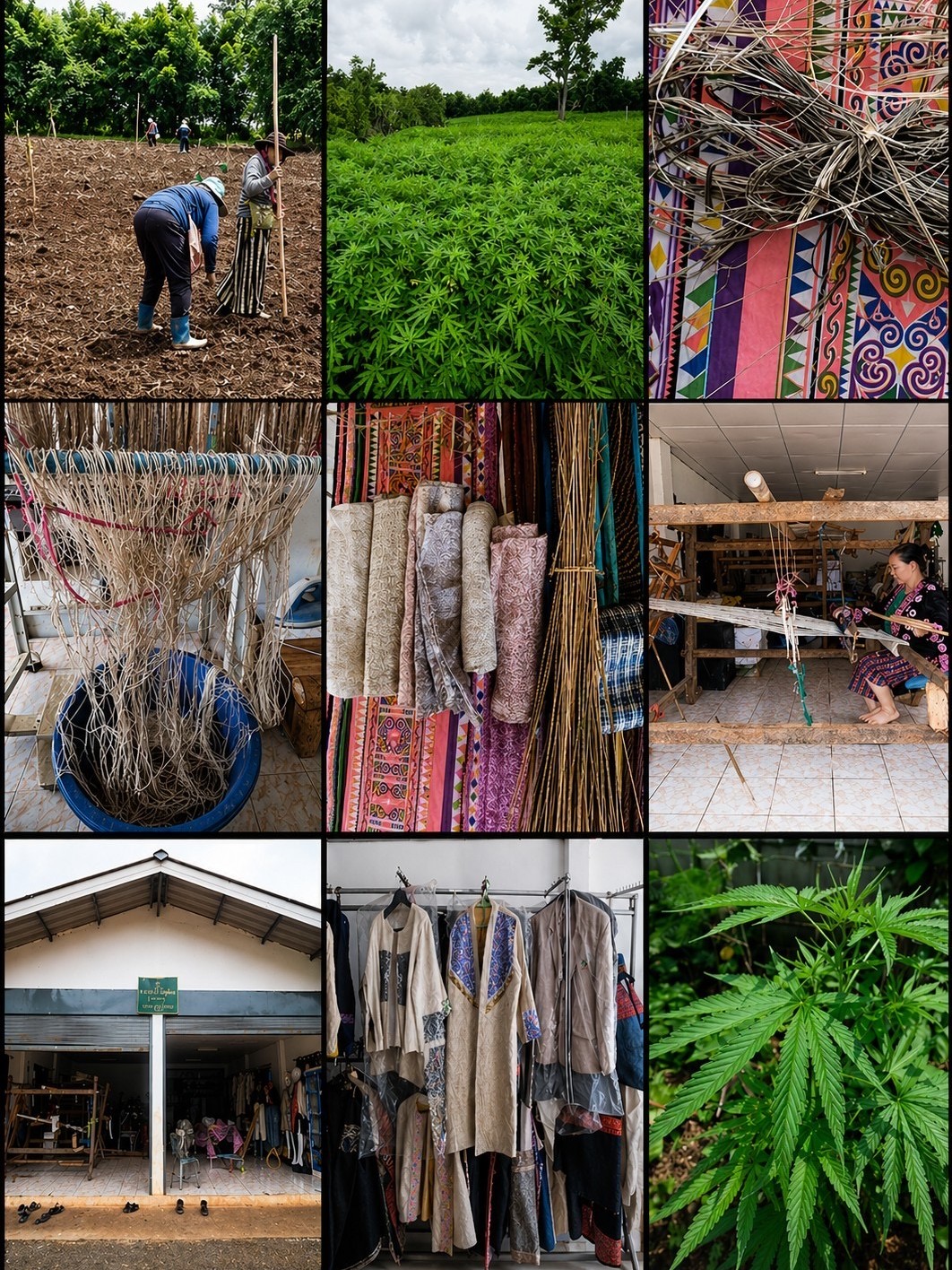
Main Article Content
Abstract
Background and objective (s): Hemp (Cannabis sativa L.) has been an integral part of the cultural heritage, domestic economy, and textile practices of Hmong communities in northern Thailand. Recently, hemp has been repositioned within Thailand’s Bio-Circular-Green (BCG) policy framework as a strategic economic crop. This study aimed to achieve two objectives: (1) to analyze the agricultural policies of the Thai government regarding the promotion of hemp as a developing economic crop in Khiri Rat Sub-district, Phop Phra District, Tak Province; and (2) to investigate the impact of these policies on sustainable capacity building, collective strengthening, and market development among hemp-growing farmer groups in the area of study.
Methodology: This study used a qualitative case study approach, combining the analysis of existing documents with fieldwork. The sources for this documentary analysis came from a variety of places. These included policy documents, legal and regulatory texts, district and provincial development plans, official reports, research reports, academic books, journal articles, and publications from relevant public and private organizations. Fieldwork was carried out from April to July 2025 following the ethics approval granted by the Human Research Ethics Committee of Pibulsongkram Rajabhat University (COA No. 023/2025). The final sample included thirteen participants, chosen purposefully from three groups: those involved in policy and institutions, those in network and community enterprises, and those who grew hemp or were involved in community enterprises. Data collection involved semi- structured, in-depth interviews, field notes , pho tographs, an d site observati ons. Thematic content analysis and methodological triangulation were used to analyze the data.
Main result: The findings show that Thailand’s hemp policy, particularly under the Action Plan for the Development of the Hemp Industry toward Commercialization, 2023–2027, reflects a developmental and policy-coordination approach through targeted regulation, institutional support, and value-chain planning. In Khiri Rat, hemp development is supported by favorable geography, agro-ecological suitability, and longstanding Hmong expertise. However, implementation remains incomplete. Major constraints include complex licensing procedures, uneven access to technical and regulatory knowledge, limited processing infrastructure, fragmented inter-agency coordination, and unstable market channels.
Relevance to Thai Studies: This study contributes to Thai Studies by demonstrating how hemp has shifted from a culturally embedded Hmong plant to a state-promoted economic crop within contemporary Thailand’s BCG regime. This research links cultural capital, public policy, and borderland development, and shows how state strategy, ethnic livelihoods, and market rationalities are negotiated in a peripheral yet strategically significant region.
Conclusion: The study concludes that Thailand has made progress in establishing a strategic framework for hemp development, but its effectiveness remains constrained by uneven state capacity, fragmented institutional mechanisms, limited infrastructure, and uncertain market formation. Sustainable hemp development in border ethnic communities requires not only legal liberalization, but also accessible licensing, stronger community enterprises, integrated value-chain governance, and the strategic integration of traditional Hmong knowledge with modern standards, branding, and market innovation.
Downloads
Article Details

This work is licensed under a Creative Commons Attribution-NonCommercial-NoDerivatives 4.0 International License.
Journal of Thai studies is licensed under a Creative Commons Attribution-Noncommercial-NoDerivatives4.0 Intenational (CC BY-NC-ND 4.0) licence, unless otherwise stated. Plese read our Policies page for more information on Open Access, copyright and permissions.
References
Alexander, D. E. (2013). Resilience and disaster risk reduction: An etymological journey. Natural Hazards and Earth System Sciences, 13(11), 2707–2716. https://doi.org/10.5194/nhess-13-2707-2013
Aroonsrimorakot, S., Laiphrakpam, M., & Metadilogkul, O. (2019). Social, religious, recreational and medicinal usage of cannabis in India and Thailand. Interdisciplinary Research Review, 14(4), 43–50. https://ph02.tci-thaijo.org/index.php/jtir/article/view/221554
Bakir, C., & Gunduz, K. A. (2017). When, why and how institutio nal change takes place: A systematic review and a future research agenda on the importance of policy entrepreneurship in macroeconomic bureaucracies. Policy and Society, 36(4), 479–503. https://doi.org/10.1080/14494035.2017.1369676
Biesbroek, R., & Candel, J. J. (2020). Mechanisms for policy (dis)integration: Explaining food policy and climate change adaptation policy in the Netherlands. Policy Sciences, 53(1), 61–84. https://doi.org/10.1007/s11077-019-09354-2
Bowman, A. (2020). Parastatals and economic transformation in South Africa: The political economy of the Eskom crisis. African Affairs, 119(476), 395–431. https://doi.org/10.1093/afraf/adaa013
Butollo, F., & ten Brink, T. (2018). A great leap? Domestic market growth and local state support in the upgrading of China’s LED lighting industry. Global Networks, 18(2), 285–306. https://doi.org/10.1111/glob.12160
Cameron, J. (2000). Asbestos cloth and elites in Southeast Asia. Bulletin of the Indo-Pacific Prehistory Association, 19(3), 47–51. https://journals.lib.washington.edu/index.php/BIPPA/article/view/11719/10348
Cameron, J. (2011). Iron and cloth across the Bay of Bengal: Ne w data from Tha Kae, central Thailand. Antiquity, 85(328), 559–567. Chatjenkit, O., & Sarnnoi, E. (2021). Hemp legal status issues in the Narcotics Act, B.E. 2522. Journal of Humanities and Social Sciences Loei Rajabhat University, 3(2), 35–46. https://so01.tci-thaijo.org/index.php/husolru/article/view/249154
Cheang, B. (2024). What can industrial policy do? Evidence from Singapore. The Review of Austrian Economics, 37(1), 1–34. https://doi.org/10.1007/s11138-022-00589-6
Chen, G. C., & Lees, C. (2016). Growing China’s renewables sector: A developmental state approach. New Political Economy, 21(6), 574–586. https://doi.org/10.1080/13563467. 2016.1183113
Clark, C., & Jung, C. (2002). Implications of the Asian flu for developmental state theory: The cases of South Korea and Taiwan. Asian Affairs: An American Review, 29(1), 16–42. https://doi.org/10.1080/00927670209598874
Cowie, A. L., Orr, B. J., Castillo Sanchez, V. M., Chasek, P., Crossman, N. D., Erlewein, A., Louwagie, G., Maron, M., Metternicht, G. I., Minelli, S., Tengberg, A. E., Walter, S., & Welton, S. (2018). Land in balance: The scientific conceptual framework for Land Degradation Neutrality. Environmental Science & Policy, 79, 25–35. https://doi.org/10.1016/j.envsci.2017.10.011
Cummings, S. L. (2001). Community economic development as progressive politics: Toward a grassroots movement for economic justice. Stanford Law Review, 54(3), 399–493. https://doi.org/10.2307/1229464
De Marchi, V., & Alford, M. (2022). State policies and upgradin g in global value chains: A systematic literature review. Journal of International Business Policy, 5(1), 88–111. https://doi.org/10.1057/s42214-021-00107-8
Deininger, K. W. (2003). Land policies for growth and poverty reduction (World Bank Policy Research Report). World Bank.
Dejene, M., & Cochrane, L. (2019). Ethiopia’s developmental sta te: A building stability framework assessment. Development Policy Review, 37, O161–O178. https://doi.org/10.1111/dpr.12414
Deng, X., & Bai, X. (2014). Sustainable urbanization in western China. Environment: Science and Policy for Sustainable Development, 56(3), 12–24. https://doi.org/10.1080/00139157.2014.901836
Dent, C. M. (2018). East Asia’s new developmentalism: State capacity, climate change and low-carbon development. Third World Quarterly, 39(6), 1191–1210. https://doi.org/10.1080/01436597.2017.1388740
Dent, C. M. (2020). East Asia’s new developmentalism: State capacity, climate change and low-carbon development. In J. T. Nem Singh & J. S. Ovadia (Eds.), Developmental states beyond East Asia (pp. 159–178). Routledge. https://doi.org/10.4324/9780429055645-9
Eller, W., & Krutz, G. (2009). Policy process, scholarship, and the road ahead: An introduction to the 2008 policy shootout! Policy Studies Journal, 37(1), 1–4. https://doi.org/10.1111/j.1541-0072.2008.00290.x
Eversole, R. (2003). Value-adding community? Community economic development in theory and practice. Rural Society, 13(1), 72–86. https://doi.org/10.5172/rsj.351.13.1.72
Fischer, F. (2003). Reframing public policy: Discursive politics and deliberative practices. Oxford University Press.
Fischer, F., & Miller, G. J. (Eds.). (2017). Handbook of public policy analysis: Theory, politics, and methods. Routledge.
Fleckenstein, T., & Lee, S. C. (2017). Democratization, post-industrialization, and East Asian welfare capitalism: The politics of welfare state reform in Jap an, South Korea, and Taiwan. Journal of International and Comparative Social Policy, 33(1), 36–54. https://doi.org/10.1080/21699763.2017.1288158
Giddings, B., Hopwood, B., & O’Brien, G. (2002). Environment, economy and society: Fitting them together into sustainable development. Sustainable Development, 10(4), 187–196. https://doi.org/10.1002/sd.199
Greenberg, G. D., Miller, J. A., Mohr, L. B., & Vladeck, B. C. (1977). Developing public policy theory: Perspectives from empirical research. American Political Science Review, 71(4), 1532–1543. https://doi.org/10.2307/1961494
Hariram, N. P., Mekha, K. B., Suganthan, V., & Sudhakar, K. (2023). Sustainalism: An integrated socio-economic-environmental model to address sustainable development and sustainability. Sustainability, 15(13), 10682. https://doi.org/10.3390/su151310682
Hayward, T. (2009). International political theory and the global environment: Some critical questions for liberal cosmopolitans. Journal of Social Philosophy, 40(2), 276–295. https://doi.org/10.1111/j.1467-9833.2009.01451.x
Hennessey Lavery, S., Smith, M. L., Esparza, A. A., Hrushow, A., Moore, M., & Reed, D. F. (2005). The community action model: A community-driven model designed to address disparities in health. American Journal of Public Health, 95(4), 611–616. https://doi.org/10.2105/AJPH.2004.047704
Hoppe, R. (2010). Cultures of public policy problems. In The governance of problems (pp. 91–120). Policy Press. https://doi.org/10.51952/9781847426307.ch004
Javanmardi, E., Liu, S., & Xie, N. (2023). Exploring the challenges to sustainable development from the perspective of grey systems theory. Systems, 11(2), 70. https://doi.org/10.3390/systems11020070
Johnson, C. (1999). The developmental state: Odyssey of a concept. In M. Woo-Cumings (Ed.), The developmental state (pp. 32–60). Cornell University Press. https://doi.org/10.7591/9781501720383-004
Kim, S.-Y. (2007). Consolidating the authoritarian developmental state in the 1970s Korea: Chosen strategies. International Review of Public Administration, 12(1), 119–132. https://doi.org/10.1080/12294659.2007.10805096
Kothari, A. (2014). Radical ecological democracy: A path forward for India and beyond. Development, 57(1), 36–45. https://doi.org/10.1057/dev.2014.43
Langhout, R. D., & Thomas, E. (2010). Imagining participatory action research in collaboration with children: An introduction. American Journal of Community Psychology, 46, 60–66. https://doi.org/10.1007/s10464-010-9321-1
Li, J., Zhan, G., Dai, X., Qi, M., & Liu, B. (2022). Innovation and optimization logic of grassroots digital governance in China under digital empowerment and digital sustainability. Sustainability, 14(24), 16470. https://doi.org/10.3390/su142416470
Mahattanachai, B., Mahattanachai, C., Tharapitakwong, J., Takran, T., & Chaibut, D. (2021). Applying digital technology to transfer the local wisdom of hemp woven fabric production. Buriram Rajabhat University Science and Technology Journal (Online), 5(2), 71–85. https://ph02.tci-thaijo.org/index.php/scibru/article/view/245287
Mahattanachai, C., Chum-un, M., Mahattanachai, B., Tharapitakwong, J., Takran, T., Santiteerakul, W., & Wongchomphu, P. (2018). The development of a digital commerce system to promote the marketing of One Tambon One Product (OTOP) products in Mae Rim District, Chiang Mai Province. National Research Council of Thailand. http://www.cmruir.cmru.ac.th/handle/123456789/1155?mode=full
Massi, E., & Nem Singh, J. T. (2020). Industrial policy and state-making: Brazil’s attempt at oil-based industrial development. In J. T. Nem Singh & J. S. Ovadia (Eds.), Developmental states beyond East Asia (pp. 101–118). Routledge. https://doi.org/10.4324/9780429055645-6
Meckling, J. (2018). The developmental state in global regulation: Economic change and climate policy. European Journal of International Relations, 24(1), 58–81. https://doi.org/10.1177/1354066117700966
Mensah, J. (2019). Sustainable development: Meaning, history, principles, pillars, and implications for human action—Literature review. Cogent Social Sciences, 5(1), 1653531. https://doi.org/10.1080/23311886.2019.1653531
Office of Industrial Economics, Ministry of Industry. (2023). Action plan for the development of the industrial hemp sector toward commercialization (2023–2027). https://surl.li/yhvulk
Ovadia, J. S., & Wolf, C. (2018). Studying the developmental state: Theory and method in research on industrial policy and state-led development in Africa. Third World Quarterly, 39(6), 1056–1076. https://doi.org/10.1080/01436597.2017.1368382
Parasee, A. (2006). Integrated development of good management for community enterprise groups producing textile products in Mae Rim District, Chiang Mai Province. Chiang Mai Rajabhat University Institutional Repository. http://www.cmruir.cmru.ac.th/handle/123456789/782?locale=th
Paudel, N. R. (2009). A critical account of policy implementati on theories: Status and reconsideration. Nepalese Journal of Public Policy and Governance, 25(2), 36–54.
Pelling, M., & Manuel-Navarrete, D. (2011). From resilience to transformation: The adaptive cycle in two Mexican urban centers. Ecology and Society, 16(2). https://doi.org/10.5751/ES-04038-160211
Pettit, J. (2000). Strengthening local organisation: “Where the rubber hits the road.” IDS Bulletin, 31(3), 57–67. https://doi.org/10.1111/j.1759-5436.2000.mp31003006.x
Phop Phra District Agricultural Office, Tak Province. (2023). District-level agricultural development plan for Phop Phra District, 2023–2027. https://www.loengnokta.com/attachments/view/?attach_id=403395
Raworth, K. (2017). A doughnut for the Anthropocene: Humanity’s compass in the 21st century. The Lancet Planetary Health, 1(2), e48–e49. https://doi.org/10.1016/S2542-5196(17)30028-1
Rietig, K. (2021). Multilevel reinforcing dynamics: Global climate governance and European renewable energy policy. Public Administration, 99(1), 55–71. https://doi.org/10.1111/padm.12674
Rispoli, F., Ciarla, R., & Pigott, V. C. (2013). Establishing the prehistoric cultural sequence for the Lopburi region, central Thailand. Journal of World Prehistory, 26(2), 101–171. https://doi.org/10.1007/s10963-013-9064-7
Rueangpankan, S., Chantachon, S., & Sirisamphan, R. (2022). A study of indigenous knowledge in producing hemp fiber for the community textile industry. Dhammasuksa Research Journal, 5(2), 17–27. https://so07.tci-thaijo.org/index.php/dsr/article/view/2172
Saepae, P. (2022, April 21). Understanding cannabis: Thai cannabis varieties and medical uses. SIMPLE SCIENCE, Faculty of Science, Mahidol University. https://science.mahidol.ac.th/simple-science/2022/04/21/know-about-thai-cannabis/
Sengloung, T., Kaveeta, L., & Nanakorn, W. (2009). Effect of so wing date on growth and development of Thai hemp (Cannabis sativa L.). Agriculture and Natural Resources, 43(3), 423–431. https://li01.tci-thaijo.org/index.php/anres/article/view/244687
Singh, J. N., & Ovadia, J. S. (2018). The theory and practice o f building developmental states in the Global South. Third World Quarterly, 39(6), 1033–1055. https://doi.org/10.1080/01436597.2018.1455143
Singh, S. H., Maiyar, L. M., & Bhowmick, B. (2020). Assessing the appropriate grassroots technological innovation for sustainable development. Technology Analysis & Strategic Management, 32(2), 175–194. https://doi.org/10.1080/09537325.2019.1646420
Smith, K. B., & Larimer, C. W. (2018). The public policy theory primer. Routledge.
Sukcharoen, M., & Sampanpanish, P. (2019). An introduction to hemp that is not cannabis [in Thai]. Thai Environment, 23(3), 1–12. https://digital.car.chula.ac.th/cuej/vol23/iss3/2/
Suksanapat, R., & Sirikanchanarak, D. (2021, January 15). Brewing hemp from a narcotic into a new economic crop. Bank of Thailand. https://www.bot.or.th/th/research-andpublications/articles-and-publications/articles/regional-articles/reg-article-2021-01.html
Suthat Na Ayutthaya, B., Mekphat, S., & Tajumpa, N. (2023). Development of hemp fiber products for value addition through storytelling, creative design, and digital marketing promotion among community enterprises in Chiang Mai Province. Journal of Cannabis, Hemp and Herbs, 2, 88–102. https://he01.tci-thaijo.org/index.php/JCHH/article/view/262808
Tak Agricultural Occupation Promotion and Development Center (Highland Agriculture). (2017). Basic information on the Royal Project–based highland development project in Khiri Rat Subdistrict, Phop Phra District, Tak Province. Highland Research and Development Institute (Public Organization). https://www.hrdi.or.th/public/files/Areas-Profile/33-Areas/PobPra.pdf
Thangruang, T., & Panturee, W. (2024). Hemp products development: Cultural landscape of the Hmong ethnic group, Phop Phra District, Tak Province. Pathumthani University Academic Journal, 16(1), 54–68. https://so05.tci-thaijo.org/index.php/ptujournal/article/view/271192
Tipparat, P., Kunkaew, W., Julsrigival, S., Pinmanee, S., & Natakankitkul, S. (2014). Classification of cannabis plants grown in northern Thailand using physico-chemical properties. Journal of Natural Sciences Research, 4(4), 46–54. https://www.iiste.org/Journals/index.php/JNSR/article/view/11178
Trubek, D. M. (2008). Developmental states and the legal order: Towards a new political economy of development and law (University of Wisconsin Law School Legal Studies Research Paper No. 1075). Social Science Research Network. https://doi.org/10.2139/ssrn.1349163
Uduma, K., & Arciszewski, T. (2010). Sustainable energy development: The key to a stable Nigeria. Sustainability, 2(6), 1558–1570. https://doi.org/10.3390/su2061558
Upan, C. (2018). The legal status and measures to control for the use of cannabis plants in Thailand [Doctoral dissertation, National Institute of Development Administration].NIDA Wisdom Repository. https://doi.org/10.14457/NIDA.the.2018.100
Uppanya, C. (2018). Legal status and regulatory measures for the utilization of cannabis and hemp in Thailand. Assumption University Law Journal, 9(2), 126–150. https://auojs.au.edu/index.php/LawJournal/article/view/3669
Valenzuela, H. (2016). Agroecology: A global paradigm to challenge mainstream industrial agriculture. Horticulturae, 2(1), 2. https://doi.org/10.3390/horticulturae2010002
Van Kerkhoff, L., & Lebel, L. (2006). Linking knowledge and action for sustainable development. Annual Review of Environment and Resources, 31(1), 445–477. https://doi.org/10.1146/annurev.energy.31.102405.170850
Vaughan, O. (1995). Assessing grassroots politics and community development in Nigeria. African Affairs, 94(377), 501–518. http://www.jstor.org/stable/723605
Weed Review. (2023, July 31). Cannabis seeds: Basics, types, legality, how to choose. https://weed.review/cannabis-seeds/
Wheeler, F., & Laing, J. (2008). Tourism as a vehicle for liveable communities: Case studies from regional Victoria, Australia. Annals of Leisure Research, 11(1–2), 242–263. https://doi.org/10.1080/11745398.2008.9686795
Whungthun, C., & Assapaporn, N. (2018). Professional development guidelines for women farmer groups producing hemp embroidery in line with the Suffici ency Economy Philosophy. Nakhon Lampang Buddhist College Journal, 7(1), 115–124. https://so04.tcithaijo.org/index.php/NBJ/article/view/252985
Wongrerkdee, C. (2025). The design and development of hemp products by community enterprises in Ban Seree Rat, Chong Kheap Subdistrict, Phop Phra District, Tak Province. Pathumthani University Academic Journal, 17(1), 23–36. https://so05.tci-thaijo.org/index.php/ptujournal/article/view/276649
Wongrerkdee, C., Naknarin, T., Pongwiritthon, K., & Wongwilairat, S. (2021). The promotion and development of electronic marketing of hemp fabric for community enterprise in Khirirat Sub-district, Phop Phra District, Tak Province. Journal of Legal Entity Management and Local Innovation, 7(5), 1–15. https://so04.tci-thaijo.org/index.php/jsa-journal/article/view/246662
Wongwilairat, S., & Punture, W. (2024). Development of hemp products: A case study of the hemp community enterprise group in Phop Phra District, Tak Province. Journal of Local Management and Development Pibulsongkram Rajabhat University, 4(1), 70–84. https://so06.tci-thaijo.org/index.php/jclmd_psru/article/view/273638
