
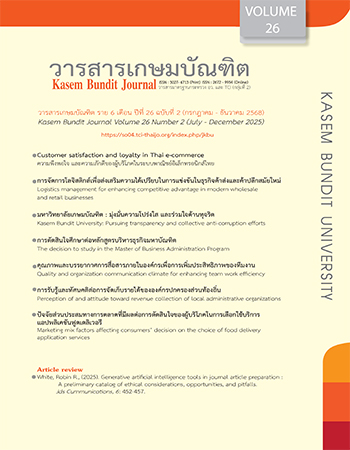
Quality of communication and organization climate for enhancing team work efficiency
Keywords:
Organization communication, team performance, beverage companyAbstract
PURPOSES: This study aimed to examine internal communication patterns that influenced team performance in an energy drink manufacturing and distribution company. METHODS: A purposive sample survey of a quota of 415 employees in various departments of the company whereby the data was collected using a structured questionnaire developed from related research. The instrument was validated for content validity and reliability before data collection. Descriptive statistics, including frequency, percentage, mean, and standard deviation, were used, along with inferential statistics through partial least squares structural equation modeling (PLS-SEM). RESULTS: Internal communication patterns that influenced team performance included quality of communication, communication atmosphere, information about the organization, feedback, horizontal communication and direct communication with supervisors respectively. Among these, communication quality had the strongest influence, followed by communication climate and organizational information, while direct communication with supervisors had the weakest influence but remained statistically significant for teamwork efficiency. THEORETICAL/POLICY IMPLICATIONS: The findings confirm that the quality and climate of internal communication are crucial for developing effective teams. This expands the body of knowledge in organizational behavior and internal communication and offers policy implications for business organizations in highly competitive industries to develop comprehensive communication systems that enhance operational capacity and long-term sustainability.
References
Ab Hamid, M. R., Sami, W., & Sidek, M. M. (2017). Discriminant validity assessment: Use of Fornell & Larcker criterion versus HTMT criterion. Journal of Physics: Conference Series, 890(1), 012163. https://doi.org/10.1088/1742-6596/890/1/012163
Clampitt, P. G. (2017). Communicating for managerial effectiveness. Routledge.
Dhone, S., & Sarwoko, E. (2022). Internal communication and employee performance: The mediating role of motivation. Journal of Asian Finance, Economics and Business, 9(5), 197–205. https://doi.org/10.21067/jem.v18i2.6079
Euromonitor. (2024). Energy drinks in Thailand. Euromonitor International. https://www.euromonitor.com/energy-drinks-in-thailand/report
Gehrau, V., Lührmann, J., Stehle, H., & Röttger, U. (2024). The impact of internal communication on individual empowerment: Findings of a representative employee survey in Germany. International Journal of Strategic Communication, 18(3), 208-227.
https://doi.org/10.1080/1553118X.2024.2312859
GourmetPro. (2023). The top 5 trends in the Thailand beverage market. https://www.gourmetpro.co/blog/the-top-5-trends-in-the-thailand-beverage-market
Grand View Research. (2024). Thailand energy drinks market size, share & trends analysis report 2030.
https://www.grandviewresearch.com/horizon/outlook/energy-drinks-market/thailand
Hair Jr., J. F., Howard, M. C., & Nitzl, C. (2020). Assessing measurement model quality in PLS-SEM using confirmatory composite analysis. Journal of business research, 109, 101-110. https://doi.org/10.1016/j.jbusres.2019.11.069
Keyton, J., Caputo, J. M., Ford, E. A., Fu, R., Leibowitz, S. A., Liu, T., & Wu, C. (2013). Investigating verbal workplace communication behaviors. Journal of Business Communication, 50(2), 152–169.
Kim, Y. (2021). Building organizational resilience through strategic internal communication and organization–employee relationships. Journal of Applied Communication Research, 49(5), 589-608.
https://doi.org/10.1080/00909882.2021.1910856
Marlow, S. L., Lacerenza, C. N., Paoletti, J., Burke, C. S., & Salas, E. (2018). Does team communication represent a one-size-fits-all approach? A meta-analysis of team communication and performance. Organizational Behavior and Human Decision Processes, 144, 145–170.
Mazzei, A. (2014). Internal communication for employee enablement: Strategies in American and Italian companies. Corporate Communications: An International Journal, 19(1), 82-95.
McDonald, N. M. (2022). Learning from highly effective teams: What can we apply to the gastrointestinal endoscopy unit team?. ACG Case Reports Journal, 9(2), e00745. https://doi.org/10.14309/crj.0000000000000745
Men, L. R., O’Neil, J., & Ewing, M. (2020). Examining the effects of internal social media usage on employee engagement. Public Relations Review, 46(2), 101880. https://doi.org/10.1016/j.pubrev.2020.101880
Mushtaq, M., Ahmad, N., & Ahmad, M. (2024). The Impact of Communication on Organizational Performance. International Journal of Applied Service Marketing Perspectives, 13(1), 40-61.
Okunade, J. K. (2025). Exploring the Impact of Effective Internal Communication Strategies on Employee Morale, Productivity, and Organizational Culture. Lakhomi Journal Scientific Journal of Culture, 6(1), 1-11. https://doi.org/10.33258/lakhomi.v6i1.1272
Paredes-Saavedra, M., Vallejos, M., Huancahuire-Vega, S., Morales-García, W. C., & Geraldo-Campos, L. A. (2024). Work team effectiveness: Importance of organizational culture, work climate, leadership, creative synergy, and emotional intelligence in university employees. Administrative Sciences, 14(11), 280. https://doi.org/10.3390/admsci14110280
Romero-Rodríguez, L. M., & Castillo-Abdul, B. (2024). Internal communication from a happiness management perspective: State-of-the-art and theoretical construction of a guide for its development. BMC Psychology, 12(1), 644. https://doi.org/10.1186/s40359
Thanaseth, T., & Thinkweb, N. (2022). Beverage sector report. Thanachart Securities. https://tnsthinkwebcontent.thanachartsec.com/wp-content/uploads/2022/03/Beverage220321E.pdf
Tkalac Verčič, A., Sinčić Ćorić, D., & Pološki Vokić, N. (2021). Measuring internal communication satisfaction: Validating the internal communication satisfaction questionnaire. Corporate Communications: An International Journal, 26(3), 589-604. https://doi.org/10.1108/CCIJ-01-2021-0006
Tourish, D. (2020). The dark side of transformational leadership: A critical perspective. Routledge.
Verčič, A. T., & Verčič, D. (2025). The internal communication paradox: Balancing digital convenience with face-to-face satisfaction. Public Relations Review, 51(3), 102587. https://doi.org/10.1016/j.pubrev.2025.102587
Zajac, S., Woods, A., Tannenbaum, S., Salas, E., & Holladay, C. L. (2021). Overcoming challenges to teamwork in healthcare: A team effectiveness framework and evidence-based guidance. Frontiers in Communication, 6, 606445. https://doi.org/10.3389/fcomm.2021.606445
Downloads
Published
How to Cite
Issue
Section
License
Copyright (c) 2025 KASEM BUNDIT JOURNAL

This work is licensed under a Creative Commons Attribution-NonCommercial-NoDerivatives 4.0 International License.
ทัศนคติ ความคิดเห็นใด ๆ ที่ปรากฏในวารสารเกษมบัณฑิตฉบับนี้เป็นของผู้เขียน โดยเฉพาะ มหาวิทยาลัยเกษมบัณฑิตและบรรณาธิการ ไม่จำเป็นต้องมีความเห็นพ้องด้วย




