
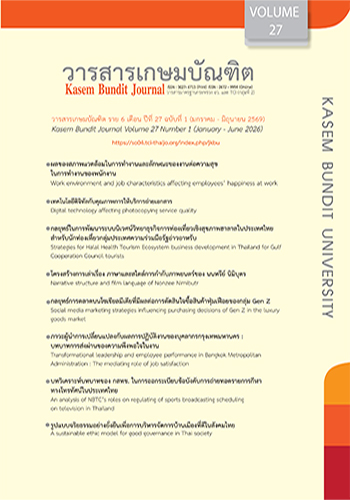
Strategies for Halal Health Tourism Ecosystem business development in Thailand for Gulf Cooperation Council tourists
Keywords:
Halal Health Tourism Ecosystem, Gulf Cooperation Council (GCC), business development strategiesAbstract
PURPOSES: To study development strategies for Thailand’s Halal Health Tourism Eco system business, analyze behavior and factors influencing choice of Thailand, and provide guidelines for integrated strategic approaches for Halal Health Tourism Ecosystem business development of Thailand among Gulf Cooperation Council tourists. METHODS: A qualitative methodology was employed, utilizing in-depth interviews with key stakeholders, including healthcare providers, policymakers, and tour operators from public and private sectors. Data collected involved documentary data and a review of related literature, followed by content and comparative analysis of data from the in-depth interviews. RESULTS: Main strategies should focuse on restructuring, linguistic and cultural personnel development, and proactive marketing. Gulf Cooperation Council (GCC) tourists prioritized religious compliance alongside wellness promotion. Key decision-making factors included services adhering to Islamic principles, post-pandemic safety and hygiene, international medical standards, and effective communication in Arabic and English. THEORY/POLICY IMPLICATIONS: Four strategic pillars consist of restructuring services for halal integration, enhancing advanced medical care combined with wellness services, leveraging digital technology to build trust and facilitate services, and fostering inter-agency collaboration. Furthermore, the policies emphasize the necessity of developing Thailand Halal Health Tourism Ecosystem that integrates medicine, tourism, culture, and religion. By implementing these strategies and maintaining cooperation between government, private, and religious sectors, Thailand can sustain its position as a global leader and a hub for halal health tourism.
References
Battour, M., & Ismail, M. N. (2016). Halal tourism: Concepts, practices, challenges, and future. Tourism Management Perspectives, 19, 150–154.
Connell, J. (2022, July 8). Innovation in the outdoor visitor economy: Towards inclusivity for older people living with cognitive impairment [Symposium presentation]. British Society of Gerontology Annual Conference, London, United Kingdom. https://thaimedhub.hss.moph.go.th/background-medicalhub/
Davis, F. (1989). Perceived usefulness, perceived ease of use, and user acceptance of information technology. MIS Quarterly, 319-339.
Freeman, R. E. (1984). Strategic management: A stakeholder approach. Cambridge University Press.
Gozzoli, C. P. (2022). Medical tourism, medical hub and Thailand 4.0 https://www.researchgate.net/publication/359893585_Medical_Tourism_Medical_Hub_and_Thailand_40
Han, H., Hyun, S. (2015) Customer retention in the medical tourism industry: Impact of quality, satisfaction, trust, and price reasonableness. Tourism Management, 46, 20–29. https://doi.org/10.1016/j.tourman.2014.06.003.
Jabbari, A., Ferdosi, M., Keyvanara, M., & Agharahimi, Z. (2013). Stakeholders’ analysis of the medical tourism industry: Development strategies in Isfahan. Journal of Education and Health Promotion, 2, 44. https://doi.org/10.4103/2277-9531.117410.
Kaewkitipong, L. (2018). The Thai medical tourism supply chain: Its stakeholders, their collaboration and information exchange. Thammasat Review, 21(2), 60–90.
Khan, A. Z., & Zafar, M. N. (2024). Technology Adoption and consumer trust in halal healthcare services: A UTAUT perspective. International Journal of Medical Tourism and Health Care, 8(3), 201–218.
Maulida, S. (2022). Halal medical tourism: A sentiment analysis. Halal Tourism and Pilgrimage, 2(2), 1–8. https://doi.org/10.58968/htp.v2i2.178
Rachmiatie, A., Setiawan, E., Zakiah, K., Saud, M., & Martian, F. (2023). Halal tourism ecosystem: networks, institutions and implementations in Indonesia. Journal of Islamic Marketing, 15(11), 3247-3265. https://doi.org/10.1108/JIMA-09-2023-0286
Rahman, M. S., & Ahmad, J. (2023). The impact of digital platforms on the promotion of halal medical tourism: A study on key performance indicators. Journal of Tourism and Hospitality Management, 12(4), 310–325.
Smith, M., & Puczkó, L. (2014). Health and wellness tourism (2nd ed.). Routledge. https://api.pageplace.de/preview/DT0400.9781136439452_A23846598/preview-9781136439452_A23846598.pdf
Stephen, F., (2014). Thailand revises visa rules by Bangkok International Associates https://www.eabc-thailand.org/thailand-revises-visa-rules-by-stephen-frost-bangkok-international-associates/.
Thojampa, S., Klankhajhon, S., Kumpeera, K., Mongkholkham, C., & Mawn, B. E. (2023). The development of a wellness tourism program in Thailand: A community based participatory action research approach with an empowerment theoretical framework. Journal of Nursing, 18(3), 291–298. https://doi.org/10.20473/jn.v18i3.46271.
UNWTO. (2024). World tourism barometer 2024: Global recovery trends. https://www.unwto.org.
Downloads
Published
How to Cite
Issue
Section
License
Copyright (c) 2026 KASEM BUNDIT JOURNAL

This work is licensed under a Creative Commons Attribution-NonCommercial-NoDerivatives 4.0 International License.
ทัศนคติ ความคิดเห็นใด ๆ ที่ปรากฏในวารสารเกษมบัณฑิตฉบับนี้เป็นของผู้เขียน โดยเฉพาะ มหาวิทยาลัยเกษมบัณฑิตและบรรณาธิการ ไม่จำเป็นต้องมีความเห็นพ้องด้วย




