
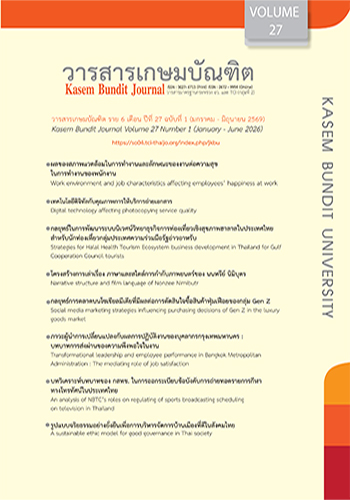
A sustainable ethic model for good governance in Thai society
Keywords:
Sustainable ethic model, good governance, Thai societyAbstract
PURPOSES: To create a sustainable ethic model for good governance in Thai society. METHODS: Documentary research to analyze data and synthesize content. RESULTS: A sustainable ethic for good governance in Thai society requires a holistic approach that integrates moral development at all levels—individuals, families, educational institutions, religion, organizations, and the society as a hold. This must be carried out in parallel with improving quality of life, enhancing the role of teachers, and promoting moral education. Leaders must serve as role models, while organizations need transparent recruitment systems. Moreover, society must establish strong and fair mechanisms for oversighting to foster sustainable values and ethical managerial behavior. THEORY/POLICY IMPLICATIONS: This article presents a holistic approach to foster ethics and morality in Thai society, which can lead to the development of effective ethical policies. It not only proposes idealistic principles but also points out concrete practical guidelines. These include the reform of fundamental factors, the promotion of ethics and morality within families, the education system, religious principles, criteria for selecting and screening personnel, processes of internal organizational cultivation, and social structures that support the creation of a sustainable “moral society.”
References
Asawachaichan, S. (2019). Cultivating morality in Thai society. A Publisher.
Bandura, A. (1977). Social learning theory. Englewood Cliffs, Prentice Hall.
Buddhadasa Bhikkhu. (2527). Guidelines for studying the Abhidhamma for mental development. Dhamma Council.
Christians, C. G., Glasser, T. L., McQuail, D., Nordenstreng, K., & White, R. A. (2015). Normative theories of the media: Journalism in democratic societies. University of Illinois Press.
Chalethorn, B. (2568). Feasibility of developing a welfare state in Thai society. Western University Research Journal of Humanities and Social Sciences, 11(2), 155–166.
Department of Mental Health. (2562). Report on the mental health situation among adolescents in Thailand. Ministry of Public Health.
Department of Children and Youth Affairs. (2561). Guidelines for promoting and developing children and youth in families. Ministry of Social Development and Human Security.
Fox, J. A. (2015). Social accountability: What does the evidence really say? World Development, 72, 346–361.
Hanushek, E. A. (2011). The economic value of higher teacher quality. Economics of Education Review, 30(3), 466–479.
Kaptein, M. (2015). The effectiveness of ethics programs: The role of scope, composition, and sequence. Journal of Business Ethics, 132(2), 415-431.
Klitgaard, R. (1988). Controlling Corruption. University of California Press.
Lickona, T. (1991). Educating for character: How our schools can teach respect and responsibility. Bantam Books.
Likhitphornsawan, T. (2560). Religion and moral development in Thai society. Journal of Buddhist Studies, 4(1), 45–56.
Makawanpur Multiple Campus. (2022). Exploring the Prominent Role of Social Institutions in Society. International Research Journal of MMC. https://doi.org/10.3126/irjmmc.v4i2.56015.
McKinsey & Company. (2007). How the world's best-performing school systems come out on top. https://mckinsey.com.
McQuail, D. (2010). McQuail's mass communication theory (6th ed.). SAGE Publications.
Nasawaeng, B. (2022). Integrating Buddhist teachings into social studies: A transformative approach to education in Thailand. Insights into Modern Education, 5(2), 45–58.
National Office of Buddhism. (2562). The role of religion in promoting morality and ethics. National Office of Buddhism.
OECD. (2015). Citizen participation and open government. OECD Publishing. https://www.oecd.org.
Office of the Basic Education Commission. (2562). Report on the moral and ethical status of students. Ministry of Education.
Office of the Civil Service Commission. (2021). Manual for promoting morality and ethics in the civil service.Office of the Civil Service Commission.
Office of the Civil Service Commission. (2563). Guidelines for recruiting and selecting personnel with quality and morality. Office of the Civil Service Commission.
Office of National Anti-Corruption Commission. (2566). Report on the corruption situation in Thailand.
Office of the Education Council. (2018). Education and the development of morality and ethics among youth. Bangkok, Thailand: Ministry of Education.
Phra Dhammapitaka. (2543). Buddhadhamma (revised and expanded edition). Mahachulalongkornrajavidyalaya University.
Pornsima, D. (2554). Teacher quality development: A key factor toward educational quality. Northeastern Teacher Development Institute.
Rockoff, J. E. (2004). The impact of individual teachers on student achievement: Evidence from panel data. American Economic Review, 94(2), 247–252.
Samakoses, W. (2010). Teacher quality and educational quality. Chulalongkorn University Press.
Skinner, B. F. (1953). Science and human behavior. Macmillan.
Thammabutsadee, S. (2567). Economic blueprint and current Thai welfare state policy. https://www.Pridi.or.th.
Thai Institute of Directors. (2018). Moral and ethical leadership in Thai schools. IOD Press.
Transparency International. (2021). Building accountability: A toolkit for citizen engagement. https://www.transparency.org. o
Transparency International. (2022). Global corruption report: Strengthening integrity systems. https://www.transparency.org.
Tyler, T. R. (2006). Why people obey the law (2nd ed.). Princeton University Press.
UNDP. (2016). Fostering social accountability: From principle to practice. https://www.undp.org.
UNODC. (2020). Citizen engagement in anti-corruption: A practical guide. https://www.unodc.org.
UNODC (2020). Strengthening the rule of law and integrity in the justice system. https://www.unodc.org. .
UNODC. (2021). Good practices in the selection and training of public officials.https://www.unodc.org.
UNESCO. (2021). World trends in freedom of expression and media development. https://unesco.org.
UNICEF. (2019). Parenting and early childhood development: Guidance for nurturing care. https://www.unicef.org.
Vegas, E., & Ganimian, A. J. (2013). What are the teacher policies of top-performing and rapidly improving education systems?. SABER Working Paper Series; No. 9. World Bank.
World Bank. (2017). World development report 2017: Governance and the law. https://www.worldbank.org.
Downloads
Published
How to Cite
Issue
Section
License
Copyright (c) 2026 KASEM BUNDIT JOURNAL

This work is licensed under a Creative Commons Attribution-NonCommercial-NoDerivatives 4.0 International License.
ทัศนคติ ความคิดเห็นใด ๆ ที่ปรากฏในวารสารเกษมบัณฑิตฉบับนี้เป็นของผู้เขียน โดยเฉพาะ มหาวิทยาลัยเกษมบัณฑิตและบรรณาธิการ ไม่จำเป็นต้องมีความเห็นพ้องด้วย




