
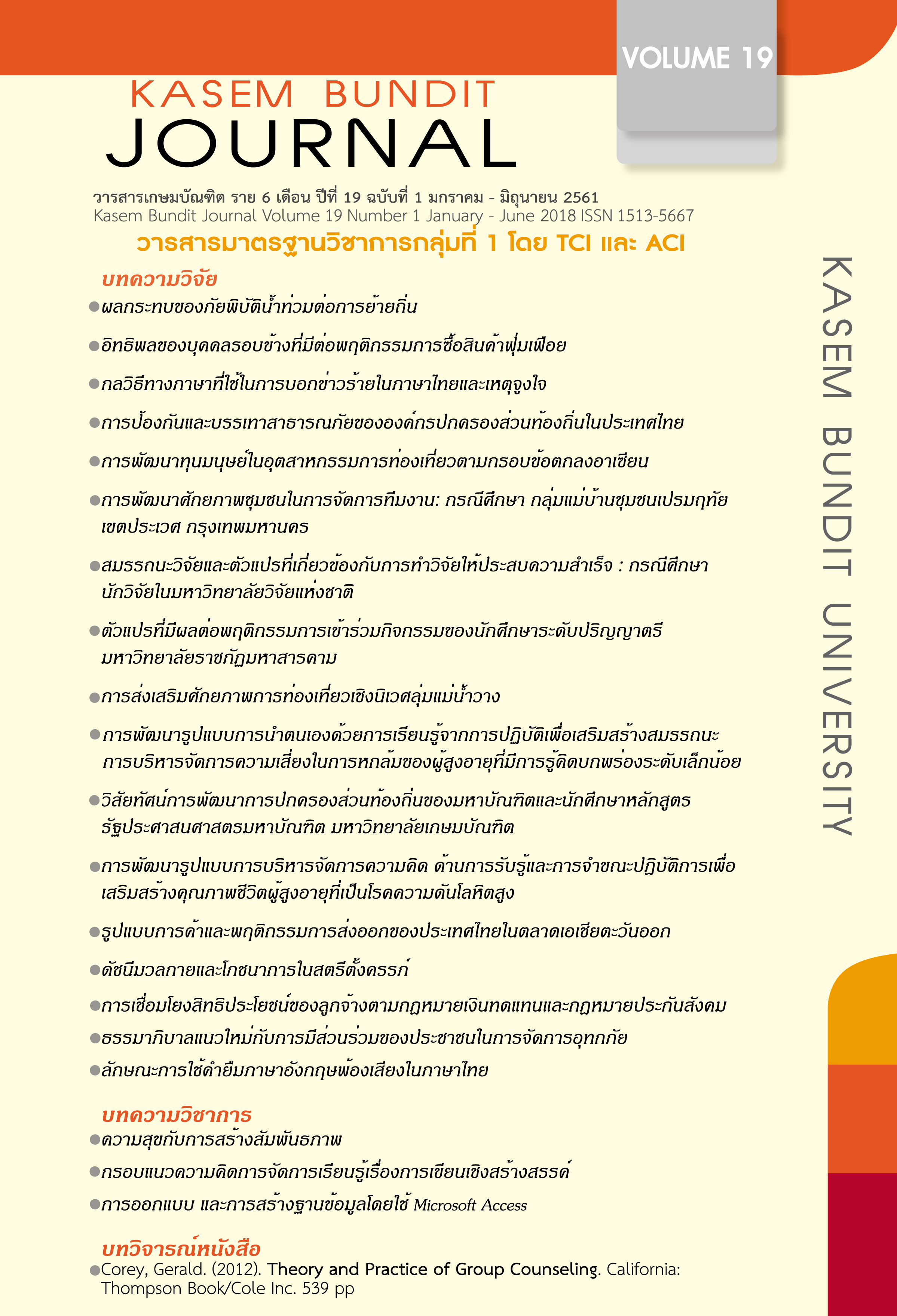
ธรรมาภิบาลแนวใหม่กับการมีส่วนร่วมของประชาชนในการจัดการอุทกภัย
คำสำคัญ:
ธรรมาภิบาลแนวใหม่ การมีส่วนร่วมของประชาชน การจัดการอุทกภัยบทคัดย่อ
การให้ความสำคัญกับการมีส่วนร่วมของประชาชนเป็นส่วนหนึ่งของแนวคิดธรรมาภิบาลแนวใหม่ ในปัจจุบันการส่งเสริมการมีส่วนร่วมของประชาชนมีความสำคัญอย่างยิ่งต่อประสิทธิผลในการแก้ไขปัญหาอุทกภัยในหลายประเทศในโลก บทความวิจัยนี้มีวัตถุประสงค์เพื่อรวบรวมทฤษฎีและแนวความคิดของการมีส่วนร่วมของประชาชน และนำเสนอรายละเอียดและขั้นตอนของการปฏิบัติ เพื่อเจ้าหน้าที่ขององค์การภาครัฐจะได้ประยุกต์เป็นแนวทางในการสร้างความร่วมมือกับประชาชน ในการแก้ไขปัญหาอุทกภัยในเขตกรุงเทพมหานคร ผลการวิจัยพบว่าแนวทางที่ดีในการสร้างการมีส่วนร่วมควรดำเนินการโดย การนิยามจุดมุ่งหมายของกระบวนการมีส่วนร่วม การกำกับดูแลหลายระดับ การนิยามผู้มีส่วนได้ส่วนเสียและสาธารณชน การวิเคราะห์ผู้มีส่วนได้ส่วนเสีย ระดับความเข้มข้นของการมีส่วนร่วม วิธีการมีส่วนร่วม การจัดการความคาดหวัง และการให้ข้อมูลย้อนกลับ
เอกสารอ้างอิง
Arnstein, Sherry R. 1969. “A Ladder of Citizen Participation”, JAIP. Vol. 35, No. 4 July, 216-224.
Berner, Maureen M., Amos, Justin M. and Morse, Ricardo S. (2011). “What Constitutes Effective Citizen Particiaption in Local Government? Views from City Stakeholders,” PAQ. Spring: 128-163.
Bingham, Lisa Blomgren, Tina Nabatchi, and Rosemary O’Leary. (2005). “The New Governance: Practices and Processes for Stakeholder and Citizen Participation in the Work of Government,” Public Administration Review. Sep/Oct; 65,(5).
Bradford, R.A. et al. (2012). “Risk Perception – Issues on Flood Management in Europe,” Natural Hazards and Earth System Sciences. 2299-2309.
Burke, E.M. (1979). A Participatory Approach to Urban Planning. New York: Human Science Press.
Day, D. (1997). “Citizen Participation in the Planning Process: An Essentially Contested Concept?” Journal of Planning Literature. 11(3), 421-434.
Fagence, M. (1977). Citizen Participation in Planning. Oxford: Pergamon.
Fainstein, S.S. & N.I. Fainstain. (1985). “Citizen Participation in Local Government”. In D.R. Judd.ed. Public Policy Across States and Communities. Greenwich, CT: JAI Press.
Firus et al. (2011). The Participation of the Public and Stakeholders in Flood Risk Management. EUIPA 2010 Twinning Project.
Frederickson, H. George. (1991). “Toward a Theory of the Public for Public Administration”. Administration and Society. 22(4): 395-417.
----------. (1999). “The Repositioning of American Public Administration”. PS: Political Science and Politics. 32(4): 701-11.
Irvin, Renee and Stansbury, John. (2004). “Citizen Participation in Decision Making: Is It Worth the Effort?” Public Administration Review.
Kettl, Donald F. (2002). The Transformation of Governance: Public Administration for Twenty-First Century America. Baltimore: Johns Hopkins University Press.
King, Cheryl Simrell, Feltey, Kathryn M. and Susel, Bridget O’Neil. (1998). “The Question of Participation: Toward Authentic Public Participation in Public Administration,” Public Administration Review. Vol. 58, No. 4. July-August: 317-326.
Rowe, Gene and Frewer, Lynn J. (2004). “Evaluating Public Participation Exercises: A Research Agenda,” Science, Technology & Human Values. 29(4): 512-556.
Salamon, Lester, ed. (2002). The Tools of Government: A Guide to the New Governance. New York: Oxford University Press.
Smith, Steven Rathgeb and Ingram, Helen. (2002). “Policy Tools and Democracy.” in The Tools of Government: A Guide to the New Governance, edited by Lester Salamon. New York: Oxford University Press. 56-84.
Stivers, Camilla. (1991). “Some Tensions in the Notion of “The Public as Citizen,”: Rejoinder to Frederickson,” Administration and Society. 22(4): 418-23.
Webler, Thomas and Tuler, Seth. (2000). “Fairness and Competence in Citizen Participation: Theoretical Reflections from a Case Study,” Administration and Society. November.
Wondolleck, J. and S. Yaffee. (2000). Making Collaboration Work: Lessons from Innovation in Natural Resource Management. Washington, DC: Island Press.
ดาวน์โหลด
เผยแพร่แล้ว
รูปแบบการอ้างอิง
ฉบับ
ประเภทบทความ
สัญญาอนุญาต
Any views or opinions expressed in this issue of the Kasem Bundit University Journal are those of the authors alone and do not necessarily reflect the views or opinions of Kasem Bundit University or the editors.




