
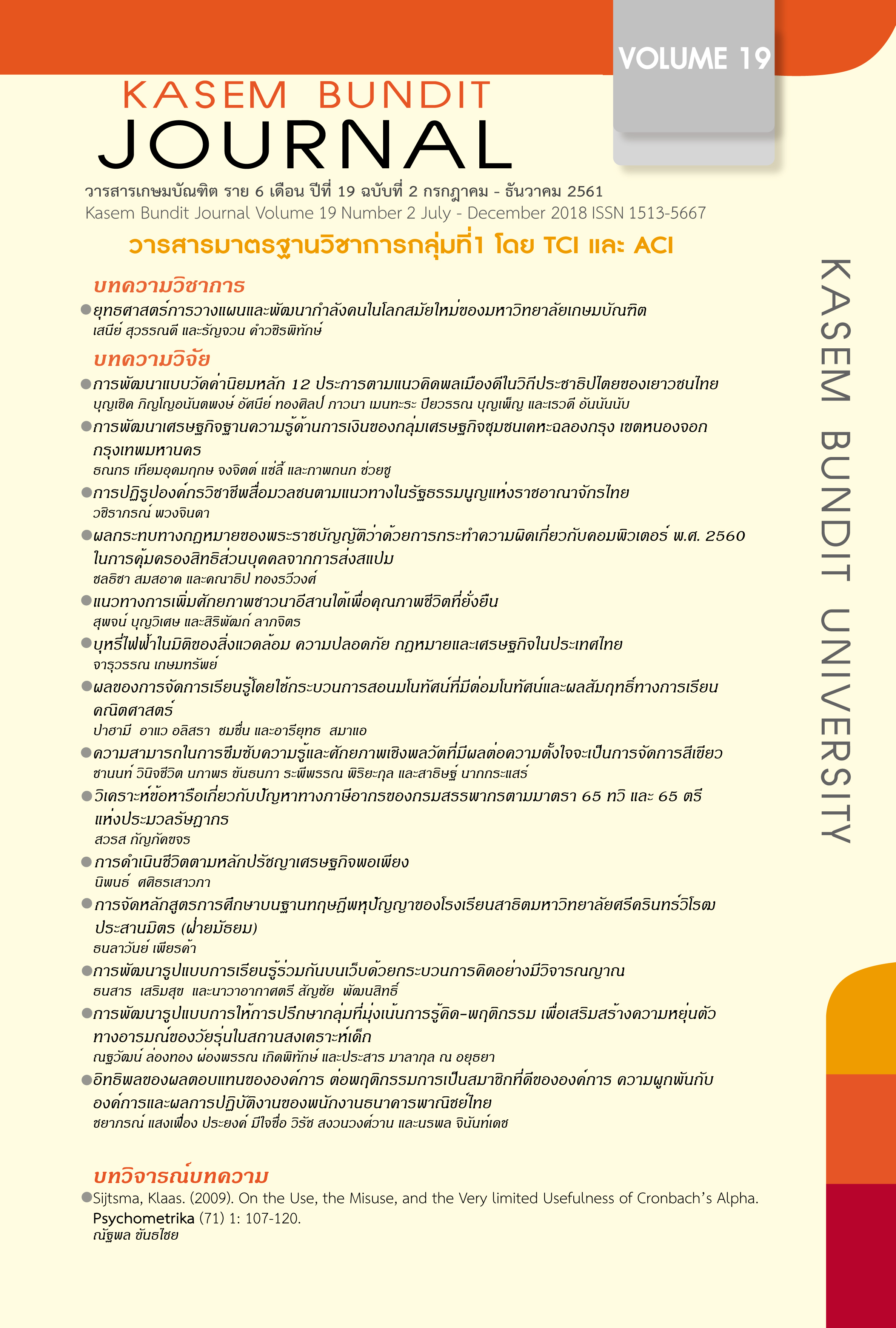
ความสามารถในการซึมซับความรู้และศักยภาพเชิงพลวัตที่มีผลต่อความตั้งใจจะเป็นการจัดการสีเขียว
คำสำคัญ:
ความสามารถในการซึมซับความรู้ ศักยภาพเชิงพลวัต การจัดการสีเขียวบทคัดย่อ
การวิจัย เรื่องนี้ มีวัตถุประสงค์เพื่อศึกษาระดับการรับรู้ ของบุพปัจจัย ได้แก่ แรงกดดันจากลูกค้า ปทัสถานทางสังคม และความผู้พันของผูกบริหารสีเขียว ที่ส่งผ่านความสามารถในการซึมซับความรู้และศักยภาพเชิงพลวัต ไปสู่ความตั้งใจจะเป็นการจัดการสีเขียว ซึ่งประกอบด้วย การจัดการสีเขียวแบบฉับพลัน และ การจัดการสีเขียวแบบค่อยเป็นค่อยไป เพื่อสร้างและหาจุดอ่อน เพื่อการแข่งขันในโลกธุรกิจควบคู่ไปกับเป็นส่วนหนึ่งในการพัฒนาสังคมและสิ่งแวดล้อม ซึ่งเป็นประเด็นสำคัญในการสร้างศักยภาพในการแข่งขันยุคปัจจุบัน ด้วยตัวแบบเชิงสาเหตุ โดยใช้ข้อมูลจากแบบสอบถาม ซึ่งตอบโดยผู้ประกอบการในอุตสาหกรรมผลิตกระดาษสำหรับบรรจุภัณฑ์ จำนวน 400 แห่ง โดยผลการวิจัยตัวแบบสมการโครงสร้างในรูปแบบสมการที่ปรับแก้แล้ว มีความสอดคล้องกับข้อมูลเชิงประจักษ์ โดยมีค่าความเหมาะสมดังนี้ Chi-square = 763.832; df = 719; p = .120; GFI .914; AGFI; .902; RMR = .017; RMSEA = .013
เอกสารอ้างอิง
Andreason, A. R., & Kotler, P. (2003). Strategic marketing for nonprofit organizations (6th ed.). London: Pearson Education.
Bandura, A. (1977). Self-efficacy: Toward a unifying theory of behavioral change. Psychological Review, 84(2), 191-215
Bandura, A. (1999). Social cognitive theory of personality. In L. Pervin & O. John (Eds.), Handbook of personality: Theory and research (2nd ed.,
pp. 154-196). New York: The Guilford.
Barney, J. B. (1991). Firm resources and sustained competitive advantage. Journal of Management, 7, 99-120.
Bicchieri, M., Tardone, M., Pappalardo, G., Pappalardo, L., Romano, F. P., Russo, P. A. et al. (2006). Analisi non distruttive pixe-alfa, Xrf e micro-Raman.
In R. Carrarini & C. C. Brach (Eds.), Libri & Carte-restauri e analisi diagnostiche: IL codice Incompiuto del museo diocesano di salerno (pontificale 492) (pp. 73-93). Rome, Italia: Gangemi.
Bergin-Seers, S., & Mair, J. (2009). Emerging green tourists in Australia: Their behaviours and attitudes. Tourism and Hospitality Research, 9(2), 109-119
Bohn, M. (2002). Erythropoietin therapy for acute stroke is both safe and beneficial. Molecular Medicine, 8(8), 495-505.
Clarkson, M. E. (1995). A stakeholder framework for analyzing and evaluating corporate social performance. Academy of Management Review, 20(1), 92-117.
Coddington, W. (1993). Environmental marketing: Positive strategies for reaching the green consumer. New York: McGraw-Hill.
Coleman, S. M., Loscalzo, J., & Dzau, V. J. (1990). Impaired vasodilation of forearm resistance vessels in hypercholesterolemic humans. Journal of Clinical Investigation, 86(1), 22-234
Crothers, L. M., Hughes, T. L., & Morine, K. A. (2008). Theory and cases in school-based consultation. New York: Routledge.
Daghfous, A. (2004) Organizational learning, knowledge and technology transfer:
A case study. The Learning Organization, 11(1), 67-83.
Drucker, P. (1954). The principles of management. New York: McGraw-Hill.
Fahy, J., & Smithee, A. (1999). The strategic marketing and the resource based view of the firm. Academy of Marketing Science Review, 10, 1-20.
Filbeck, G., & Gorman, R. F. (2004). The stock price reaction to environmentally-related company news. Journal of Business and Public Affairs, 31, 25-31.
Gentile, R., Tesei, S., & Pezzoli, G. (2007). Valvular heart disease and the use of dopamine agonists for Parkinson’s disease. New England Journal of Medicine, 356(1), 39-46.
Gilley, K. M., & Rasheed, A. (2000). Making more by doing less: An analysis of outsourcing and its effects on firm performance. Journal of Management, 26(4), 763-790.
Gist, M. E. (1987). Self-efficacy: Implications for organizational behavior and human resource management. Academy of Management Review, 12(3), 472-485
Gist, M. E., & Mitchell, T. R. (1992). Self-efficacy: A theoretical analysis of its determinants and malleability. Academy of Management Review, 17(2),183-211.
Grant, R. M. (1991). Porter’s competitive advantage of nations’: An assessment. Strategic Management Journal, 12(7), 535-548.
Holbrook, A., Krosnick, J. A., & Pfent, A. (2007). The causes and consequences of response rates in surveys by the news media and government contractor survey research firms. In J. M. Lepkowski, C. Tucker, J. M. Brick, E. D. De Leeuw, L. Japec, P. J. Lavrakas, M. W. Limk, & R. L. Sangster (Eds.), Advances in telephone survey methodology (pp. 499-678). Hoboken, NJ: Wiley.
Hopkins, E. (2002). Learning, information, and sorting in market entry games: Theory and evidence. Games and Economic Behavior, 51(1), 31-62.
Hu, L. T., & Bentler, P. M. (1999). Cutoff criteria for fit indexes in covariance structure analysis: Conventional criteria versus new alternatives. Structural Equation Modeling, 6(1), 1-55
Iansiti, M., & Clark, K. B. (1994). Integration and dynamic capability: Evidence from product development in automobiles and mainframe computers. Industrial and Corporate Change, 3(3), 557-605.
Jung, D. I., & Sosik, J. J. (2003). Impression management strategies and performance in information technology consulting the role of self-other rating agreement on charismatic leadership. Management Communication Quarterly, 17(2), 233-268.
Klassen, R. D., & McLaughlin, C. P. (1996). The impact of environmental management on firm performance. Management Science, 42(8), 1199-1214
Kotler, P. (1994). Analysis, planning, implementation and control. Upper Saddle River, NJ: Prentice Hall.
Mahdavi, A. (2001). Simulation-based control of building systems operation. Building and Environment, 36(6), 789-796.
Maranto-Vargas, D., & Rangel, R. G. T. (2007). Development of internal resources and capabilities as sources of differentiation of SME under increased global competition: A field study in Mexico. Technological Forecasting and Social Change, 74(1), 90-99.
McKinsey, D. S., Ratts, T. E., & Bisno, A. L. (1987). Underlying cardiac lesions in adults with infective endocarditis: The changing spectrum. The American Journal of Medicine, 82, 681-688.
Ottman, J. A. (1993). Green marketing: Challenges and opportunities for the new marketing age. Lincolnwood, IL: NTC Business Books
Priem, R. L., & Butler, J. E. (2001). Is the resource-based “view” a useful perspective for strategic management research? Academy of Management Review, 26(1), 22-40.
Porter, M. E., & Kramer, M. R. (2006). Strategy and society: The link between competitive advantage and corporate social responsibility. Harvard Business Review, 84(12), 78-92.
Reiners, A., & Schmitt, J. H. M. M. (2003). Differential rotation in rapidly rotating
f-stars. Astronomy & Astrophysics, 412(3), 813-819.
Rousseau, D. M., Stikin, S. B., Burt, R. S., & Camerer, C. (1998). Not so different after all: A cross-discipline view of trust. Academy of Management Review, 23(3), 393-404.
Senge, P. (1990). The fifth discipline. New York: Double Day.
Shaw, C., & Ivens, J. (2005). Building great customer experiences. Hampshire, England: Palgrave Macmillan.
Tasa, K., & Whyte, G. (2005). Collective efficacy and vigilant problem solving in group decision making: A non-linear model. Organizational Behavior and Human Decision Processes, 96(2), 119-129.
The Oxford English Dictionary OUP. (2006). Customer experience management:
A critical review of an emerging idea. Journal of Services Marketing, 24(3), 196-208.
Winer, R. S. (2001). A framework for customer relationship management. California Management Review, 43(4), 89-105
Wood, R., Bandura, A., & Bailey, T. (1990). Mechanisms governing organizational performance in complex decision-making environments. Organizational Behavior and Human Decision Processes, 46(2), 181-201.
Wu, G.-C., Cheng, Y.-H., & Huang, S.-Y. (2010). The study of knowledge transfer and green management performance in green supply chain management. African Journal of Business Management, 4(1), 44-48.
Zellars, K. L., & Perrewé, P. L. (2001). Affective personality and the content of emotional social support: Coping in organizations. Journal of Applied Psychology, 86(3), 459
ดาวน์โหลด
เผยแพร่แล้ว
รูปแบบการอ้างอิง
ฉบับ
ประเภทบทความ
สัญญาอนุญาต
Any views or opinions expressed in this issue of the Kasem Bundit University Journal are those of the authors alone and do not necessarily reflect the views or opinions of Kasem Bundit University or the editors.




