
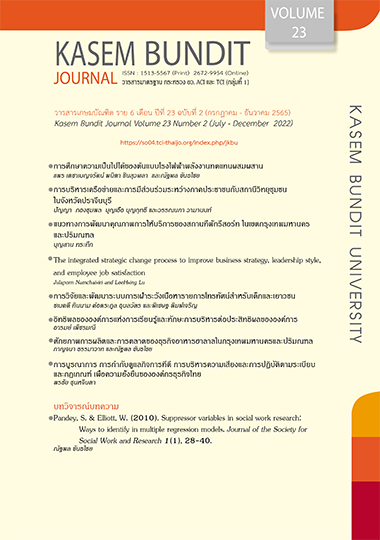
Pandey, S. & Elliott, W. (2010). Suppressor variables in social work research: Ways to identify in multiple regression models. Journal of the Society for Social Work and Research 1(1), 28-40.
คำสำคัญ:
Suppressor variable, multiple regression analysis, classic suppressor variableบทคัดย่อ
PURPOSES: To illustrate, define, classify and analyse suppressor variables in multiple regression analysis. METHODS: Documentary research was employed. RESULTS: Suppressor variables are often ignored by researchers in social sciences in multiple regression analysis. A suppressor variable is correlated with predator variable, but is not correlated with outcome variable. Suppressor variables could be classified into 4 types, i.e. classic suppression, negative suppression, reciprocal suppression, and absolute and relative suppression. Suppression analysis could be performed by means of the simple correlation analysis and regression analysis. THEORY/POLICY IMPLICATIONS: Researchers in social sciences are advised to include suppression analysis in multiple regression analysis for better understanding of the relationship among variables in multiple regression analysis.
เอกสารอ้างอิง
Buripakdi, C. & Khanthachai, N. (1977). The value of children: Thailand. East-west Population Institute, East-west Center, Honolulu and the Institute of Population Studies, Chulalongkorn University, Bangkok.
Hayes, A. F. (2018). Introduction to mediation, moderation and conditional process analysis: A regression-based approach. The Guilford Press.
Hoyle, R. H. (Ed.). (1995). Structural equation modeling: Concepts, issues, and applications. Sage Publications.
Pandey, S. & Elliott, W. (2010). Suppressor variables in social work research: Ways to identify in multiple regression models. Journal of the Society for Social Work and Research 1(1), 28-40.
ดาวน์โหลด
เผยแพร่แล้ว
รูปแบบการอ้างอิง
ฉบับ
ประเภทบทความ
สัญญาอนุญาต
ลิขสิทธิ์ (c) 2022 วารสารเกษมบัณฑิต

อนุญาตภายใต้เงื่อนไข Creative Commons Attribution-NonCommercial-NoDerivatives 4.0 International License.
Any views or opinions expressed in this issue of the Kasem Bundit University Journal are those of the authors alone and do not necessarily reflect the views or opinions of Kasem Bundit University or the editors.




