
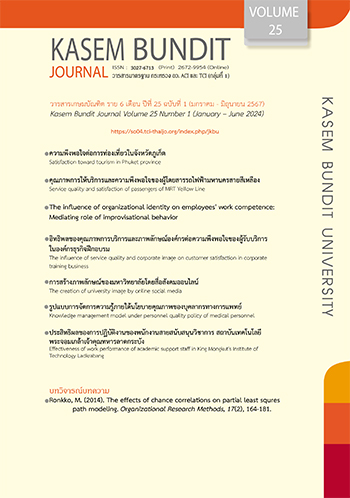
The influence of organizational identity on employees' work competence: Mediating role of improvisational behavior
คำสำคัญ:
Organizational identity, improvisational behavior, employees’ work competenceบทคัดย่อ
PURPOSES: To explore the direct influence of organizational identity on employees' work competence and the mediating role of improvisational behavior among employees in the Chinese art education industry. METHODS: This study used qualitative research methods to interview eight leaders in the Chinese art education industry. RESULTS: Organizational identity had a positive influence on employees' work competence, and it had an indirect influence on it through improvisational behavior. THEORY/POLICY IMPLICATIONS: The leaders in the art education industry should provide training and development opportunities for employees, create a positive cultural climate to strengthen employees’ organizational identity, and improve work competence.
เอกสารอ้างอิง
Albert, A., & Dutton, J. E. (2000). Organizational identity and identification: Charting new waters and building new bridges. The Academy of Management Review, 25(1), 13-17.
Angmalisang, P. A. (2011). The effect of teacher personality on teaching performance. Elektormatika 11(1), 28-32.
Baer, M. (2012). Putting creativity to work: The implementation of creative ideas in organizations. Academy of Management Journal, 55(5), 1102-1119.
Cable, D. M., & DeRue, D. S. (2002). The convergent and discriminant validity of subjective fit perceptions. Journal of Applied Psychology, 87(5), 875.
Fredrickson, B. L. (2001). The role of positive emotions in positive psychology: The broaden-and-build theory of positive emotions. American Psychologist, 56(3), 218.
Gamache, S. (1998). The process of improvisation. Organization Science. 9(5), 560-561.
Haidong, Z. L. (2011). Organizational improvisation: A field that needs further research. The Management Journal (Academic Edition), 3(12), 45-58.
Haixia, W. (2020). Research on teachers' core literacy educational competency curriculum. Teaching Methods, 40(2), 132-138.
Hakim, A. (2015). Contribution of competence, teacher pedagogical, personality, and professional competence on the performance of learning. The International Journal of Engineering and Science, 4(2), 1-12.
Haslam, S. (2001). Psychology in organizations: The social identity approach. Sage.
Hmieleski, C. (2008). The contrasting interaction effects of improvisational behavior with entrepreneurial self-efficacy on new venture performance and entrepreneur work satisfaction. Journal of Business Venturing, 23(4), 482-496.
Hmieleski, K. M., Corbett, A. C. & Baron, R. A. (2013). Entrepreneurs improvisational behavior and firm performance: A study of dispositional and environmental moderators. Strategic Entrepreneurship Journal, 7(2), 138-150.
Hu, B. (2014). Linking business models with technological innovation performance through organizational learning. European Management Journal, 32(4), 587-595.
Huang, L. (2019). A study on the mechanism of work security's influence on employees' work engagement - The mediating role of organizational identity and the moderating role of work complexity. Knowledge Economy, (28), 111-115.
Issa, H. E. (2020). The impact of improvisation and financial bootstrapping strategies on business performance. EuroMed Journal of Business, 16(2), 171-194.
Jeffrey, C. (2004). Teaching creatively and teaching for creativity: Distinctions and relationships. Educational Studies, 30(1), 77-87.
Jiankun, C. (2023). Connotation interpretation, value clarification and practice suggestions of improvisation teaching curriculum. Teaching Methods, 43(6), 62-68.
Karanika, M., Pontes, D., & Griffiths, M.D. (2015). Organizational identification, work engagement, and work satisfaction. Journal of Managerial Psychology, 30(8), 1019-1033.
Kyriakopoulos, K. (2011). lmprovisation in product innovation: The contingent role of market information sources and memory types. Organization Studies, 32(8), 1051-1078.
Ma, H. (2018). The formation mechanism of improvisational behaviors to practices in start-ups: Based on entrepreneurial learning perspective. Foreign Economy and Management, 40(11), 116-128.
Pratt, R., & Kaufman, B. (2006). Constructing professional identity: The role of work and identity learning cycles in the customization of identity among medical residents. Academy of Management Journal, 49(2), 235-262.
Ribeiro, C., & Gomes, J. F. S. (2011). HRM strength, situation strength and improvisation behavior. Management Research : The Journal of the Euromerican Academy of Management, 9(2), 118-136.
Seham, A. E. (2001). Whose improv is it anyway? Beyond second city. Press of Mississippi.
Tammy, T. (2015). Developing the theater of leadership. Human Resources, 17(3), 337 -347
Wiesenfeld, B., & Garud, R. (2001). Organizational identification among virtual workers: The role of need for affiliation and perceived work-based social support. Journal of Management, 27(2), 213-229.
Zhang, Q. (2020). The effect of values matching on work engagement: A double mediating effect based on organizational identity and job satisfaction. Journal of Liaoning University, 48(2), 59-68.
Zheng, Q. (2019). The relationship between improvisation behavior and innovation performance based on AMO theory. Modern Enterprise, 8, 77-78.
Zingheim, S. (2009). Competencies replacing jobs as the compensation-HR foundation. World Work 18(6), 20.
ดาวน์โหลด
เผยแพร่แล้ว
รูปแบบการอ้างอิง
ฉบับ
ประเภทบทความ
สัญญาอนุญาต
ลิขสิทธิ์ (c) 2024 วารสารเกษมบัณฑิต

อนุญาตภายใต้เงื่อนไข Creative Commons Attribution-NonCommercial-NoDerivatives 4.0 International License.
Any views or opinions expressed in this issue of the Kasem Bundit University Journal are those of the authors alone and do not necessarily reflect the views or opinions of Kasem Bundit University or the editors.




