
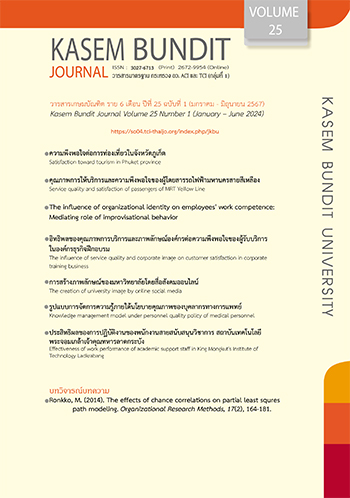
Ronkko, M. (2014). The effects of chance correlations on partial least squres path modeling. Organizational Research Methods, 17(2), 164-181.
คำสำคัญ:
Chance correlations, Partial Least Squase path modeling, Covariance-Based SEMบทคัดย่อ
PURPOSES: To present the comparison between Partial Least Squre path modeling and Covariance-Based Structural Equation Modeling. METHODS: A critical review. RESILTS: The popularity of Partial Least Square path modeling over Covariance-Based Structural Equation Modeling because the former requires a smaller sample size is based on fallary. This is due to the fact that small sample size is associated with less reliable estimates of parameters, for example, correlation and path coefficients, due to chance correlations. THEORETICAL/POLICY IMPLICATIONS: Researchers are advised to use an appropriate sample size in their research.
เอกสารอ้างอิง
Hair, J.F., Sarstedt, M., Ringle, C.M., & Mena, J.A. (2012). An assessment of the use of partial least squares structural equation modeling in marketing research. Journal of the Academy of Marketing Science, 40(3), 414-433.
Hole, G. (2020). Eight things you need to know about interpreting correlations.
http://users.suss-es.ac.uk>-grahamh>Eight thing.
Kline, R.B. (2010). Principles and Practice of Structural Equation Modeling, 3rd edition. Guilford Press.
Ronkko, M. (2014). The effects of chance correlations on partial least squares path modeling. Organizational Research Methods, 17(2), 164-181.
ดาวน์โหลด
เผยแพร่แล้ว
รูปแบบการอ้างอิง
ฉบับ
ประเภทบทความ
สัญญาอนุญาต
ลิขสิทธิ์ (c) 2024 วารสารเกษมบัณฑิต

อนุญาตภายใต้เงื่อนไข Creative Commons Attribution-NonCommercial-NoDerivatives 4.0 International License.
Any views or opinions expressed in this issue of the Kasem Bundit University Journal are those of the authors alone and do not necessarily reflect the views or opinions of Kasem Bundit University or the editors.




