
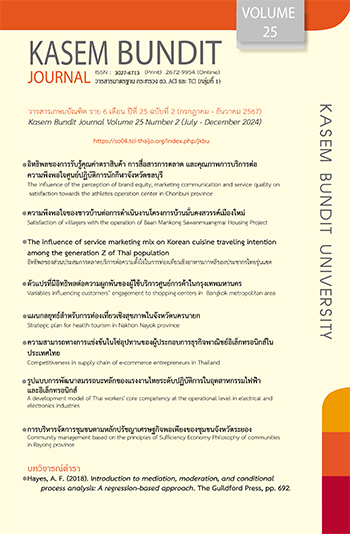
อิทธิพลของส่วนประสมการตลาดบริการต่อ ความตั้งใจในการท่องเที่ยวเชิงอาหารเกาหลีของประชากรไทยรุ่นแซด
คำสำคัญ:
ส่วนประสมการตลาดบริการ, การท่องเที่ยวเชิงอาหาร, ประชากรไทยรุ่นแซดบทคัดย่อ
วัตถุประสงค์ เพื่อศึกษาระดับความตั้งใจในการท่องเที่ยวเชิงอาหารเกาหลี เปรียบเทียบความตั้งใจในการท่องเที่ยวเชิงอาหารเกาหลีกับตัวแปรทางสังคม-เศรษฐกิจ และศึกษาอิทธิพลของส่วนประสมการตลาดกับความตั้งใจในการท่องเที่ยวเชิงอาหารเกาหลีของประชากรไทยรุ่นแซด วิธีการวิจัย การสำรวจจากตัวอย่าง เลือกตัวอย่างแบบหลายขั้นตอน จำนวน 709 คน เก็บข้อมูลด้วยแบบสอบถาม ผลการวิจัย ประชากรไทยรุ่นแซดตั้งใจท่องเที่ยวเชิงอาหารเกาหลีระดับสูง ประชากรไทยรุ่นแซดที่มีเพศแตกต่างกันตั้งใจท่องเที่ยวเชิงอาหารเกาหลีแตกต่างกัน อย่างมีนัยสำคัญ (p<0.05) และส่วนประสมการตลาดบริการมีอิทธิพลกับความตั้งใจท่องเที่ยวเชิงอาหารเกาหลีของประชากรไทยรุ่นแซดอย่างมีนัยสำคัญ (p<0.01) นัยทางทฤษฎี/นโยบาย หน่วยงานหรือผู้ที่เกี่ยวข้องกับธุรกิจการท่องเที่ยวสามารถนำผลการวิจัยเป็นแนวทางการจัดบริการการท่องเที่ยวเชิงอาหารเกาหลีกับประชากรไทยรุ่นแซดได้อย่างเหมาะสม
เอกสารอ้างอิง
Buchner, A. (2010). G*Power: Users guide-analysis by design. Heinrich-Heine-Universität.
Chakrapani, C. (2011). Statistical reasoning vs. magical thinking: Shamanism as statistical knowledge: Is a sample size of 30 all you need?
http://www.chuckchakrapani.com/articles/pdf/0411chakrapani.pdf
Chatterjee, S., & Suklabaıdya, P. (2020). Food image and travel intention: From New Delhi to New York. Journal of Gastronomy Hospitality and Travel, 3(1), 3-19.
Cronbach, L. J. (1990). Essential of psychological testing. Harper & Row.
Galati, A., Testa, R., Schifani, G., & Migliore, G. (2023). Tourists’ motivation toward culinary destination choice: Targeting Italian tourists. Journal of Food Service Business Research, 26(4), 647-668.
Kılıç, B., Bekar, A., & Yozukmaz, N. (2021). The new foodie generation: Gen Z. In Generation Z Marketing and Management in Tourism and Hospitality: The Future of the Industry (pp. 223-247). Springer International Publishing.
Kim, J. H., Kim, K. J., Park, B. T., & Choi, H. J. (2022). The phenomenon and development of K-Pop: The relationship between success factors of K-Pop and the national image, social network service citizenship behavior, and tourist behavioral intention. Sustainability, 14(6), 3200.
Kim, S., Kim, M., Agrusa, J., & Lee, A. (2012). Does a food-themed TV drama affect perceptions of national image and intention to visit a country? An empirical study of Korea TV drama. Journal of Travel & Tourism Marketing, 29(4), 313-326.
Korean Food Promotion Institute. (2024). Introduction to the institution. https://www.hansik.or.kr/contents/contentsDetail.do?cntntsSeq=58&menuSn=217
Martin, C. A., Izquierdo, C. C., & Laguna-Garcia, M. (2021). Culinary tourism experiences: The effect of iconic food on tourist intentions. Tourism Management Perspectives, 40, 100911.
National Statistical Office of Thailand. (2023). Population and housing census. http://statbbi.nso.go.th/staticreport/page/sector/th/01.aspx
Othman, B., Harun, A., Sadq, Z. M., Rashid, W. N., Abdullah, K. M., Mohammed, H. O., & Faeq, D. K. (2020). Effects of service marketing on umrah customer satisfaction: Empirical study on umrah traveling industry in Malaysia. TEST Engineering and Management, 83, 22895-22909.
Promsivapallop, P., & Kannaovakun, P. (2019). Destination food image dimensions and their effects on food preference and consumption. Journal of Destination Marketing & Management, 11, 89-100.
Pu, B., Du, C., & Phau, I. (2024). Effects of food experience on travel intention to the country of origin of food cuisine: A cross-national study. Journal of Hospitality and Tourism Management, 58, 476-494.
Rahman, M., Islam, M. S., Al Amin, M., Sultana, R., & Talukder, M. I. (2019). Effective factors of service marketing mix on tourist satisfaction: A case study. Asian Social Science, 15(7), 1-15.
Reisinger, Y., & Crotts, J. C. (2009). The influence of gender on travel risk perceptions, safety, and travel intentions. Tourism Analysis, 14(6), 793-807.
Rousta, A., & Jamshidi, D. (2020). Food tourism value: Investigating the factors that influence tourists to revisit. Journal of Vacation Marketing, 26(1), 73-95.
World Food Travel Association. (2024). State of the food & beverage tourism (SOTI) industry. https://www.worldfoodtravel.org/annual-industry-report
World Tourism Organization. (2012). Global report on food tourism.
https://webunwto.s3.eu-west-1.amazonaws.com/s3fs-public/2019-09/food_tourism_ok.pdf
World Tourism Organization. (2017). Second global report on gastronomy tourism. https://www.e-unwto.org/doi/abs/10.18111/9789284418701.
ดาวน์โหลด
เผยแพร่แล้ว
รูปแบบการอ้างอิง
ฉบับ
ประเภทบทความ
สัญญาอนุญาต
ลิขสิทธิ์ (c) 2024 วารสารเกษมบัณฑิต

อนุญาตภายใต้เงื่อนไข Creative Commons Attribution-NonCommercial-NoDerivatives 4.0 International License.
Any views or opinions expressed in this issue of the Kasem Bundit University Journal are those of the authors alone and do not necessarily reflect the views or opinions of Kasem Bundit University or the editors.




