
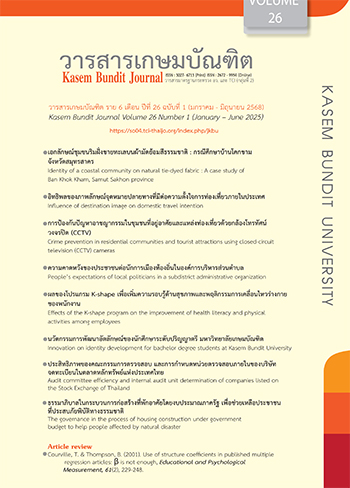
อิทธิพลของภาพลักษณ์จุดหมายปลายทางที่มีต่อความตั้งใจการท่องเที่ยวภายในประเทศ
คำสำคัญ:
ภาพลักษณ์จุดหมายปลายทางท่องเที่ยวภายในประเทศ, ภาพลักษณ์ด้านความรู้/ความเข้าใจ, ภาพลักษณ์ด้านความรู้สึก, ความตั้งใจการท่องเที่ยวภายในประเทศบทคัดย่อ
วัตถุประสงค์: เพื่อศึกษาการรับรู้ภาพลักษณ์จุดหมายปลายทางการท่องเที่ยวภายในประเทศของนักท่องเที่ยวชาวไทย และวิเคราะห์ความสัมพันธ์ระหว่างภาพลักษณ์จุดหมายปลายทางกับความตั้งใจการท่องเที่ยวในประเทศภายหลังการแพร่ระบาดของเชื้อ Covid-19 วิธีการวิจัย: เป็นการสำรวจจากตัวอย่าง โดยกลุ่มตัวอย่างได้แก่นักท่องเที่ยวชาวไทย อายุตั้งแต่ 20 ปี ขึ้นไป มีภูมิลำเนาอยู่ในภาคตะวันออก ประเทศไทย เคยเดินทางท่องเที่ยวภายในประเทศอย่างน้อย 1 ครั้ง ภายใน 12 เดือน ก่อนเกิดการแพร่ระบาดของเชื้อโควิด-19 จากการกลุ่มตัวอย่าง จำนวน 898 ราย โดยใช้การรวบรวมข้อมูล online ด้วย google form ผลการวิจัย: ภาพลักษณ์จุดหมายปลายทางมีอิทธิพลเชิงบวกต่อความตั้งใจการท่องเที่ยวอย่างมีนัยสำคัญทางสถิติ ทั้งสองมิติ ได้แก่ ภาพลักษณ์ด้านความรู้สึกและด้านความรู้/ความเข้าใจ ภาพลักษณ์ด้านความรู้สึกส่งผลต่อความตั้งใจการท่องเที่ยวมากที่สุด (β = 0.308) รองลงมาคือด้านความรู้/ความเข้าใจ (β = 0.247) ภาพลักษณ์จุดหมายปลายทางกับตั้งใจการท่องเที่ยวภายในประเทศ มีความสัมพันธ์กันระดับปานกลาง (R= 0.516) และอธิบายการแปรผันของตัวแปรตามได้ 26.4 % สัมพันธ์กับความตั้งใจพฤติกรรมการท่องเที่ยวปานกลาง (R = 0.516) และร่วมกันอธิบายความแปรปรวนตัวแปรตามได้ 26.4% (R²adj = 0.264 F = 160.899 และ Sig = .000) นัยทางทฤษฎี/นโยบาย: นักการตลาดและผู้กำหนดนโยบายด้านกลยุทธ์การตลาดอาจนำผลที่ได้จากการวิจัยไปประยุกต์ใช้เป็นแนวทางในการสร้างและรักษาภาพลักษณ์ที่ดีของจุดหมายปลายทางการท่องเที่ยว และส่งเสริมการสร้างประสบการณ์ที่ดีที่สอดคล้องกับภาพลักษณ์ของจุดหมายปลายทางเพื่อเพิ่มความพึงพอใจและความภักดีของนักท่องเที่ยว
เอกสารอ้างอิง
Afshardoost, M., & Eshaghi, M. S. (2020). Destination image and tourist behavioural intentions: A meta-analysis. Tourism Management, 81(10), 41-54
Bae, S. Y., & Chang, P. J. (2021). The effect of coronavirus disease-19 (COVID-19) risk perception on behavioral intention towards ‘untact’tourism in South Korea during the first wave of the pandemic (March 2020). Current Issues in Tourism, 24(7), 1017-1035.
Carballo, R. R., Leon, C. J., & Carballo, M. M. (2021). The impact of terrorist attacks in cities on the relationship between tourists' risk perception, destination image and behavioural intentions. Cities, 119, 138-182.
Carlsson-Szlezak, P., Reeves, M., & Swartz, P. (2020). What coronavirus could mean for the global economy. Harvard Business Review, 3(10), 1-10.
Chew, E. Y. T., & Jahari, S. A. (2014). Destination image as a mediator between perceived risks and revisit intention: A case of post-disaster Japan. Tourism Management, 40, 382-393.
Hair, J. F., Black, W. C., Babin, B. J., & Anderson, R. E. (2019). Multivariate data analysis (8th ed.). Cengage Learning.
Joo, Y., Seok, H., & Nam, Y. (2020). The moderating effect of social media use on sustainable rural tourism: A theory of planned behavior model. Sustainability, 12(10), 469-495
Kokkhangplu, A., & Kaewnuch, K. (2021). Importance and performance analysis on tourism components in the south of Thailand. Kasetsart Journal of Social Sciences, 42(2), 275-280.
Li, X., Gong, J., Gao, B., & Yuan, P. (2021). Impacts of COVID-19 on tourists' destination preferences: Evidence from China. Annals of Tourism Research, 90, 132-158.
Lin, C. H., Morais, D. B., Kerstetter, D. L., & Hou, J. S. (2007). Examining the role of cognitive and affective image in predicting choice across natural, developed, and theme-park destinations. Journal of Travel Research, 46(2), 183-194.
Liu, Y., Shi, H., Li, Y., & Amin, A. (2021). Factors influencing Chinese residents' post-pandemic outbound travel intentions: An extended theory of planned behavior model based on the perception of COVID-19. Tourism Review, 76(4), 871-891
Manosuthi, N., Lee, J. S., & Han, H. (2020). Predicting the revisit intention of volunteer tourists using the merged model between the theory of planned behavior and norm activation model. Journal of Travel & Tourism Marketing, 37(4), 510-532.
Marine-Roig, E., & Huertas, A. (2020). How safety affects destination image projected through online travel reviews. Journal of Destination Marketing & Management, 18, 146-169.
Perić, G., Dramićanin, S., & Conić, M. (2021). The impact of Serbian tourists' risk perception on their travel intentions during the COVID-19 pandemic. European Journal of Tourism Research, 27, 2705-2735.
Qiao, G., Zhao, X. L., Xin, L., & Kim, S. (2021). Concerns or desires post-pandemic: An extended MGB model for understanding South Korean residents’ perceptions and intentions to travel to China. International Journal of Environmental Research and Public Health, 18(5), 205-242.
Stylidis, D., Woosnam, K. M., Ivkov, M., & Kim, S. S. (2020). Destination loyalty explained through place attachment, destination familiarity and destination image. International Journal of Tourism Research, 22(5), 604-616
Wang, L. H., Yeh, S. S., Chen, K. Y., & Huan, T. C. (2022). Tourists’ travel intention: Revisiting the TPB model with age and perceived risk as moderator and attitude as mediator. Tourism Review, 77(3), 877-896.
Zhang, X., & Tang, J. (2021). A study of emotional solidarity in the homestay industry between hosts and tourists in the post-pandemic era. Sustainability, 13(13), 147-158.
Zhu, H., & Deng, F. (2020). How to influence rural tourism intention by risk knowledge during COVID-19 containment in China: Mediating role of risk perception and attitude. International Journal of Environmental Research and Public Health, 17(10), 351-364.
ดาวน์โหลด
เผยแพร่แล้ว
รูปแบบการอ้างอิง
ฉบับ
ประเภทบทความ
สัญญาอนุญาต
ลิขสิทธิ์ (c) 2025 วารสารเกษมบัณฑิต

อนุญาตภายใต้เงื่อนไข Creative Commons Attribution-NonCommercial-NoDerivatives 4.0 International License.
Any views or opinions expressed in this issue of the Kasem Bundit University Journal are those of the authors alone and do not necessarily reflect the views or opinions of Kasem Bundit University or the editors.




