สังเขปประวัติศาสตร์ว่าด้วยมานุษยวิทยาในประเทศไทย อ้างอิงโดยเฉพาะภาคเหนือ
Article Sidebar
Main Article Content
บทคัดย่อ
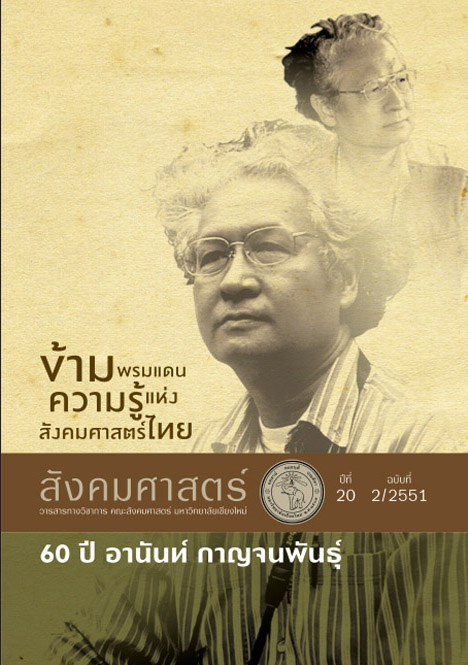
ในฐานะนักประวัติศาสตร์ ซึ่งสนใจประวัติศาสตร์ของความคิดและปัญญาชน ข้าพเจ้าได้เรียนรู้หลายอย่างจาก อานันท์ กาญจนพันธุ์ นักมานุษยวิทยาผู้ซึ่งคิดอย่างเป็นประวัติศาสตร์ งานวิทยานิพนธ์ระดับปริญญาโท ปี 2519 ของอานันท์นั้นเป็นเรื่องเกี่ยวกับประวัติศาสตร์นิพนธ์ของล้านนาในช่วงพุทธศตวรรษที่ 21 และ 22 และราวๆ ครึ่งหนึ่งของงาน วิทยานิพนธ์ระดับปริญญาเอก ปี 2527 เรื่องกระบวนการเปลี่ยนแปลงเข้าสู่ระบบตลาดบางส่วนของการผลิตข้าว ก็เป็นงานศึกษาเชิงประวัติศาสตร์ว่าด้วยการเกษตรกรรมในภาคเหนือของไทยนับจากกลางพุทธศตวรรษที่19 เป็นต้นมาจนกระทั่งถึงปี 2497 นับจากนั้นมางานวิจัยของอานันท์ได้มุ่งเน้นให้ความสนใจต่อการศึกษาประเด็นปัญหาเกี่ยวกับเรื่อง กระบวนการเปลี่ยนแปลงเข้าสู่ระบบตลาดของการผลิตข้าวในภาคเหนือของไทยพิธีกรรมไหว้ผี ระบบการสืบทอดเชื้อสายทางฝ่ายแม่ ชนชั้น พิธีกรรมของท้องถิ่นล้านนากับปฏิสัมพันธ์ด้านต่างๆ ที่มีต่อเจ้าหน้าที่รัฐและอำนาจของรัฐไทยส่วนกลาง การถือครองที่ดินและความเป็นชาวนา ชุมชนกับการจัดการทรัพยากรธรรมชาติ (ดิน ป่า น้ำ) สิทธิชุมชนในที่ดินและการเข้าถึงทรัพยากรธรรมชาติ และล่าสุด คือเรื่องเกี่ยวกับ ทฤษฎีและวิธีคิด ในเชิงมานุษยวิทยา นักประวัติศาสตร์เลือกที่จะให้อรรถาธิบายถึงเงื่อนไขต่างๆของปัจจุบันด้วยการมองย้อนกลับไปในอดีต และเพื่อให้ภารกิจทางวิชาการดังกล่าวบรรลุผล พวกเขามองหาแบบแผนความคล้ายคลึงต่างๆ ระหว่างอดีตกับปัจจุบัน ดังนั้นต่อคำถามที่ว่า ใครคือสายธารความคิดที่ดำรงอยู่ก่อนหน้า อานันท์ กาญจนพันธุ์ ในบริบทประวัติศาสตร์มานุษยวิทยาไทยเพื่อที่จะตอบคำถามดังกล่าว เกี่ยวกับ ต้นธารทางปัญญาของอานันท์ในบทความนี้ข้าพเจ้าอยากจะเสนอสังเขปประวัติศาสตร์ว่าด้วย อานันท์กาญจนพันธุ์ ประวัติศาสตร์ของความคิดซึ่งอานันท์อาจไม่ได้ตระหนักว่าท่านนั้นเป็นส่วนหนึ่งของบริบททางความคิดดังกล่าว
Article Details
ข้อเขียนทั้งหมดทีปรากฏในวารสารสังคมศาสตร์ เป็นความคิดเห็นของผู้เขียนโดยเฉพาะ มิใช่ทัศนคติของคณะสังคมศาสตร์ มหาวิทยาลัยเชียงใหม่ หรือกองบรรณาธิการวารสารสังคมศาสตร์
เอกสารอ้างอิง
--------. 2006. Watthanatham thang setthakit nai setthakit rai watthanatham [Economic Culture in an Un-cultured Economy]. Bangkok, Kobfai Publishing.
--------. 2005. Thrutsati lae withiwithaya khong kanwijai watthanatham kanthalu krop lae kap dak khong khwamkhit baep khu trongkankham [Theory and Methodology in Cultural Research: Transcending the Limitations and Pitfalls of Dichotomous Thought]. Bangkok, Amarin Publishing.
--------. 2001a. Miti chumchon withikhhit thongthin wa duay sitthi amnat aled kanchat kansaphayakorn [The Issue of Community: How to Think about Locality in Terms of Rights, Power and Resource Management]. Bangkok, Thailand Research Fund.
--------. 2001b. Withikhit cheongsorn nai kanwijai chumchon: phonlawat lae sakyaphap khnong chumchon nai kanphattahana [Multilayered Thinking in Community Research: The Dynamics and Potential of Community in Development]. Bangkok, Thailand Research Fund.
--------. 2000a. Local Control of Land and Forest: Cultural Dimensions of Resource Management in Northern Thailand. Chiang Mai, Chiang Mai University. Regional Center for Social Science and Sustainable Development, Faculty of Social Science.
--------. 2000b. Phonlawat khong chumchon nai kanjatkan saphayakorn sathanakan nai prathetthai [Community Dynamics in Resource Management: TheThai Case]. Bangkok, Thailand Research Fund.
--------. 1999. “Phithi wai phimuang lae amnat rattha nai lanna [“Rituals of Homage to the Muang Spirit and State Power in Lanna”] in Sangkhom lae watthanatham nai prathetthai [Society and Culture in Thailand], published on the inauguration of the Sirinthorn Anthropology Center, Bangkok.
--------. 1998. “Sathanaphap lae thitthang khong manut witthaya nai sangkhom thai [The Current State and Future Directions of Anthropology in Thai Society],” Warasan sangkhomsat [Chiang Mai], 11.1, pp. 26-52.
--------. 1984. “The Idiom of Phii Ka’: Peasant Conception of Class Differentiation in Northern Thailand,” Mankind, 14.4 (Aug.), pp. 325-329.
Ayal, Eliezer B., ed., The Study of Thailand: Analyses of Knowledge, Approaches, and Prospects in Anthropology, Art History, Economics, History, and Political Science. Athens, Ohio, Center for International Studies. Southeast Asia Series no. 54.
Boon Chuey Srisavasdi. 2002. Chaokhao nai thai [Hill Peoples in Thailand]. Bangkok, Sinlapawatthanatham.
--------. The Hill Tribes of Siam. 1963. Bangkok, Khun Aroon. Chaiyan Rajchagool. 1994. The Rise and Fall of the Thai Absolute Monarchy: Foundations of the Modern Thai State from Feudalism to Peripheral Capitalism. Bangkok, White Lotus.
Chayan Vaddhanaputi. 2003. “The Role of Social Sciences in Emerging Civil Society in Thailand,” Asian Journal of Social Science, 31.2 (June).
Geddes, William R. 1967. “The Tribal Research Centre, Thailand: An Account of Plans and Activities” in Kunstadter 1967:553-581.
Hanks, Lucien M. 1962. “Merit and Power in the Thai Social Order,” American Anthropologist, 64.6, pp. 1247-1261.
--------. 1978. “Comment,” in Ayal (1978), pp. 61-66. Jit Poumisak. 1976. Khwampenma khong kham sayam thai lao lae khom lae laksana thangsangkhom khong chu chonchat [Etymology of the Terms Siam, Thai, Lao, and Khom, and the Social Characteristics of Nationalities]. Bangkok, Social Science Association of Thailand.
Kanya Lilalai. 2007. Kankhonkhwa prawattisat chonchat thai [Research in the History of the Tai Peoples]. Bangkok, Withithat Project. 2nd printing.
Keyes, Charles F. 1978. “Ethnography and Anthropological Interpretation in the Study of Thailand,” in Ayal (1978), pp. 1-60.
Kunstadter, Peter, (ed.). 1967. Southeast Asian Tribes, Minorities, and Nations. Princeton, Princeton University Press. Two volumes.
Manndorff, Hans. 1967. “The Hill Tribe Program of the Public Welfare Department, Ministry of Interior, Thailand: Research and Socio-Economic Development” in Kunstadter 1967:525-552.
Nidhi Eeoseewong. 2005. Pen and Sail: Literature and History in Early Bangkok, ed. Chris Baker and Ben Anderson. Chiang Mai, Silkworm Books.
Paritta Chalermphow-Koanantakun. 2005. “Thopthuan phumpanya thathai khwamru [Reviewing Local Knowledge: A Challenge to our Thinking” in Paritta Chalermphow-Koanantakun et al., Phumpanya thai phumpanya thet [Local Knowledge of the Thai, Local Knowledge of the Land]. Bangkok, Sirinthorn Anthropology Centre.
Pattaya Saihu. 2001. Konlakai khong sangkhom [Social Mechanisms]. Bangkok, Chulalongkorn University Press. 10th printing.
Pels, Peter and Oscar Salemink (eds.). 1999. “Introduction: Locating the Colonial Subjects of Anthropology,” by Pels and Salemink in Colonial Subjects: Essays on the Practical History of Anthropology, pp. 1-52. Ann Arbor, University of Michigan Press.
Phothiwongsajan, Phra. 1963. Latthi thamniam tangtang, A Miscellany of Beliefs and Traditions]. Bangkok, Khlang Witthaya Press. Volume II, part 18.
Reynolds, Craig J. n. d. “The Origins of Community (chumchon) in the Thai Discourse of Global Governance” in Andrew Walker (ed.), Spirits, States and Scooters: Tai Communities on the Move. Asian Studies Association of Australia and National University of Singapore Press. Forthcoming.
--------. 2006. “Thai Manual Knowledge: Theory and Practice” in Seditious Histories: Contesting Thai and Southeast Asian Pasts, chapter 10. Seattle, University of Washington Press.
--------. 2003. “Tai-land and its Others,” South East Asia Research, 11.1, pp. 113-130.
Robinson, Kathryn. 2004. “Chandra Jayawardene and the Ethical ‘Turn’ in Australian Anthropology,” Critique of Anthropology, 24.4, 379-402.
Saichon Satyanurak. 2007. Kansupthot lae kanprapplian khwammai “chatthai” lae “khwampenthai” doi panyachon phailang kanpatiwat pho so 2475: phraya anuman rajadhon [Continuity and Change in the Meaning of “the Thai Race” and “Thainess” in the Work of Intellectuals after the 1932 Revolution: Phra Anuman Rajadhon]. Chiang Mai, unpublished manuscript.
Sharp, Lauriston. 1952. “Steel Axes for Stone-Age Australians,” Human Organization, 11.2 (1952), 446-460.
Streckfuss, David. 1993. “The Mixed Colonial Legacy in Siam: Origins of Thai Racialist Thought, 1890-1910,” in Laurie J. Sears, ed., Autonomous Histories, Particular Truths: Essays in Honor of John R. W. Smail, pp. 123-153. Madison, Center for Southeast Asian Studies, University of Wisconsin.
Sun manutsayawitthaya sirinthorn. 2006. Watthanatham rai akhati chiwit rai khwam runraeng [Culture without Prejudice, Life without Violence]. Bangkok, Sirinthorn Anthropology Centre.
Suthep Sunthornphesat. 2005. Muban isan yuk ‘songkhram yen’ sangkhom witthaya khong muban phak tawan ok chiang nua [The Isan Village during the Cold War: Social Studies of the Northeastern Village]. Bangkok, Matichon. First published in 1968 as Sangkhom witthaya khong muban phak tawan ok chiang nua [Social Studies of the Northeastern Village].
Tanabe, Shigeharu. 2000. “Autochthony and the Inthakhin Cult of Chiang Mai” in Turton 2000:294-318.
Thongchai Winichakul. 2000. “The Others Within: Travel and Ethno-Spatial Differentiation of Siamese Subjects, 1885-1910” in Turton 2000:38-62.
Turton, Andrew, (ed.). 2000. Civility and Savagery: Social Identity in Tai States. Richmond, Surrey: Curzon Press, 2000.
Vervoorn, Aat. 2004. Re-Orient: Change in Asian Societies. Melbourne, Oxford University Press.
Wachirayan Warorot. 1978. Manut witthaya lem 1 ton thi 1-2 [The Study of Humankind, vol. 1, parts 1-2]. Bangkok, Mahamakut Buddhist Academy. Fifth Printing.
Wachirayan Warorot. 1971. Phraniphon tang ruang [Miscellaneous Works]. Bangkok, Mahamakut ratchawitthayalai.
Wakin, Eric. 1992. Anthropology Goes to War: Professional Ethics and Counterinsurgency in Thailand. Madison, Center for Southeast Asian Studies, University of Wisconsin. Monograph number 7.
Yos Santasombat. 2000. Lak chang: kansang mai khong attalak tai nai tai khong [Lak Chang: A Reconstruction of Tai Identities among the Dehong]. Bangkok, Amarin.
--------. 2001. Lak Chang: A Reconstruction of Tai Identity in Daikong. Canberra: Pandanus Books, Research School of Pacific and Asian Studies, Australian National University.
