
การเมืองเรื่องการต่อสู้ (Contentious politics): พัฒนาการแนวคิดและกรอบการวิเคราะห์ในการศึกษาการต่อสู้ทางการเมืองและขบวนการเคลื่อนไหวทางสังคม
Article Sidebar
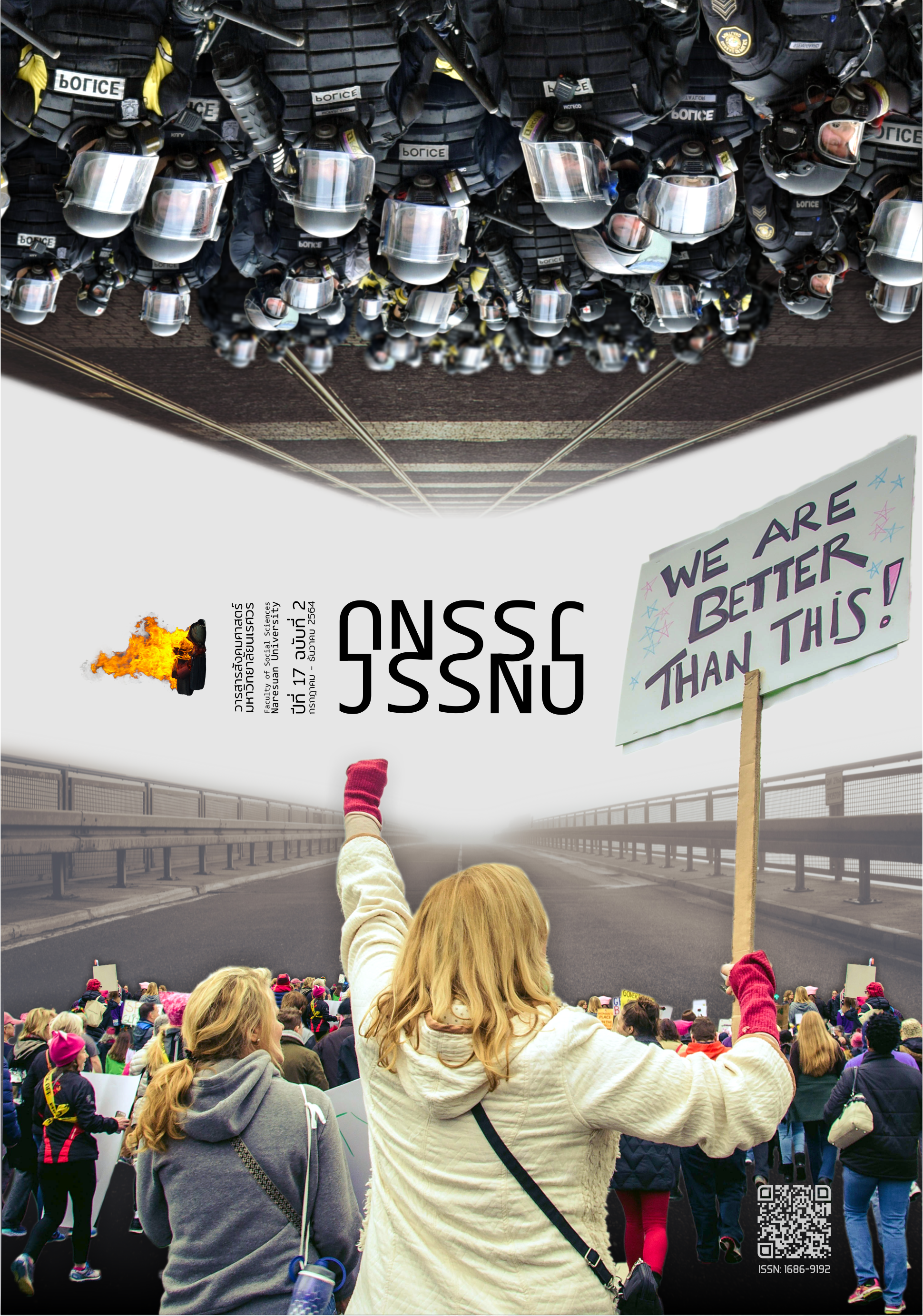
Main Article Content
บทคัดย่อ
แนวคิดการเมืองเรื่องการต่อสู้หรือการเมืองเรื่องการปะทะเป็นหนึ่งในแนวทางการศึกษาการต่อสู้ทางการเมืองและขบวนการเคลื่อนไหวทางสังคมที่ให้ความสำคัญต่อการพิจารณาความสัมพันธ์ระหว่างการเมืองและขบวนการเคลื่อนไหวทางสังคม และการพัฒนากรอบการวิเคราะห์กลไกและกระบวนการของความขัดแย้งเพื่อศึกษาการเปลี่ยนแปลงและความหลากหลายของรูปแบบการเคลื่อนไหวต่อสู้ทางการเมืองของประชาชน แม้ว่าแนวคิดการเมืองเรื่องการต่อสู้จะมีพัฒนาการที่ยาวนานจากการศึกษาขบวนการเคลื่อนไหวทางสังคมในสังคมยุโรปและสหรัฐอเมริกา แต่ในวงวิชาการรัฐศาสตร์ไทยยังมีงานศึกษาเกี่ยวกับการเมืองเรื่องการต่อสู้ไม่มากนัก บทความนี้ จึงมีเป้าหมายเพื่อแนะนำให้ผู้อ่านได้เข้าใจที่มาและพัฒนาการของแนวคิดการเมืองเรื่องการต่อสู้ การเปลี่ยนแปลงของแนวคิดและกรอบการวิเคราะห์ของการศึกษาการเมืองเรื่องการต่อสู้ รวมถึงนำเสนอให้ผู้อ่านเห็นขอบเขตแนวทางการศึกษาและทิศทางของแนวคิดการเมืองเรื่องการต่อสู้ในปัจจุบันเพื่อเป็นประโยชน์ต่อผู้ที่สนใจศึกษาการเคลื่อนไหวต่อสู้ทางการเมืองของประชาชนต่อไป
Downloads
Article Details
เอกสารอ้างอิง
Alimi, E. Y., Demetriou, C., & Bosi, L. (2015). The dynamics of radicalization: A relational comparative perspective. New York: Oxford University Press.
Aslanidis, P. (2015). Occupy populism: Social movements of the great recession in comparative perspective (Doctoral dissertation). Macedonia: University of Macedonia. Retrieved from https://dspace.lib.uom.gr/bitstream/2159/18750/2/AslanidisParis_Phd2015.pdf
Benford, R. D. (1997). An insider’s critique of the social movement framing perspective. Sociological Inquiry, 67(4), 409-430.
Bennett, W. L., & Segerberg, A. (2013). The logic of connective action: Digital media and the personalization of contentious politics. Cambridge: Cambridge University Press.
Bergstrand, K. (2014). The mobilizing power of grievances: Applying loss aversion and omission bias to social movements. Mobilization: An International Quarterly, 19(2), 123-142.
Boudrea, V. (2004). Resisting dictatorship: Repression and protest in Southeast Asia. Cambridge: Cambridge University Press.
Boykoff, J. (2007). Limiting dissent: The mechanisms of state repression in the USA. Social Movement Studies, 6(3), 281-310.
Castell, M. (2015). Networks of outrage and hope: Social movements in the Internet age (2nd ed.). Cambridge: Polity Press.
Davenport, C. (2007). State repression and political order. Annual Review of Political Science, 10, 1–23. https://doi.org/10.1146/annurev.polisci.10.101405.143216
Davenport, C. (2009). Regimes, repertoires and state repression. Swiss Political Science Review, 15(2), 377–385. https://doi.org/10.1002/j.1662-6370.2009.tb00138.x
Fu, D. (2017). Mobilizing without the masses: Control and contention in China. Cambridge: Cambridge University Press.
Fu, D., & Simmons, E. S. (2021). Ethnographic approaches to contentious politics: The what, how, and why. Comparative Political Studies, 54(10), 1695–1721. https://doi.org/10.1177/00104140211025544
Gamson, W., & Meyer, D. (1996). Framing political opportunity. In D. McAdam, J. McCarthy, & M. Zald (Eds.), Comparative perspective on social movements (pp.275-290). Cambridge: Cambridge University Press.
Goffman, E. (1974). Frame analysis: An essay on the organization of experience. New York: Harper & Row.
Goldstone, J. A. (Ed.). (2003). State, parties, and social movements. Cambridge: Cambridge University Press.
Goodwin, J., & Jasper, J. (1999). Caught in a winding, snarling vine: The structural bias of political process theory. Sociological Forum, 14(1), 27-54.
Gurr, T. R. (1970). Why men rebel. Princeton: Princeton University Press.
Heaney, M. T., & Rojas, F. (2015). Party in the street: The antiwar movement and the democratic party after 9/11. Cambridge: Cambridge University Press.
Howard, P., & Hussain, M. (2013). Democracy’s fourth wave?: Digital media and the Arab Spring. New York: Oxford University Press.
Jenkins, C. J. (1983). Resource mobilization theory and the study of social movements. Annual Review of Sociology, 9, 527-553.
Kalyvas, S. N. (2003). The ontology of political violence: Action and identity in civil wars. Perspective on Politics, 1(3), 475-494.
Kitschelt, H. (1993). Social movements, political parties, and democratic theory. The Annals of the American Academy of Political and Social Science, 85, 13-29.
Kriesi, H., Koopmans, R., Duyvendak, J. W., & Giugni, M. G. (1995). New social movements in Western Europe: A comparative analysis. London: University of Minnesota Press.
Kriesi, H. (2004). Political context and opportunity. In D. Snow, S. Soule, H. Kriesi, & H. McCammon (Eds.), The wiley blackwell companion to social movements (pp. 67-90). Malden/Oxford: Blackwell Publishing.
Kriesi, H. (2015). Party systems, electoral systems, and social movements. In D. Porta & M. Diani (Eds.), The oxford handbook of social movements (pp. 667-680). Oxford: Oxford University Press.
Lichbach, M. I. (1987). Deterrence or escalation?: The puzzle of aggregate studies of repression and dissent, Journal of Conflict Resolution, 31(2), 266-297.
Lichbach, M. I. (1998). Contending theories of contentious politics and the structure-action problem of social order. Annual Review of Political Science, 1, 401–424. https://doi.org/10.1146/annurev.polisci.1.1.401
Lim, T. (2016). Doing comparative politics: An introduction to approaches and issue (3rd ed.). London: Lynne Rienner Publishers.
McAdam, D. (1982). Political process and the development of black insurgency 1930-1970. Chicago: University of Chicago Press.
McAdam, D., McCarthy, J. & Zald, M. (1996). Comparative perspective on social movements. Cambridge: Cambridge University Press.
McAdam, D., Tarrow, S., & Tilly, C. (2001). Dynamics of contention. Cambridge: Cambridge University Press.
McAdam, D. & Tarrow, S. (2019). The Political context of social movements. In D. Snow, S. Soule, H. Kriesi, & H. McCammon (Eds.), The wiley blackwell companion to social movements (pp. 19-42). Malden/Oxford: Blackwell Publishing.
McCarthy, J. D., & Zald, M. N. (1977). Resource mobilization and social movements: A partial theory. American Journal of Sociology, 82(6), 1212–1241. https://doi.org/10.1086/226464
Melucci, A. (1988). Getting involved: Identity and mobilization in social movements. In B. Klandermans, H. Kriesi, & S. Tarrow (Eds.), From structure to action: Comparing social movement research across cultures (pp. 329-348). Greenwich: JAI Press.
Mosca, L. (2014). Bringing communication back in: Social movements and media. In C. Padovani & A. Calabrese (Eds.), Communication rights and social justice: Historical accounts of transnational mobilizations (pp. 219-233). The United Kingdom: Palgrave Macmillan.
Nuttapattanun, E. (2013a). Interactions between state, movement and countermovement: The case study of the red shirts’ political movement from 2006-2010 (Doctoral dissertation). Bangkok: Chulalongkorn University. [in Thai].
Nuttapattanun, E. (2013b). Interactions between state, movement and countermovement: The international literatures in the tradition of social and political movements studies (the primary survey). Journal of Social Science Chiang Mai University, 9(2), 7-60. [in Thai].
Oberschall, A. (1973). Social conflict and social movements. Englewood Cliffs: Prentice Hall.
Olson, M. (1971). The logic of collective action: Public goods and the theory of groups. Cambridge: Harvard University Press.
Ostrom, E. (1998). A behavioral approach to the rational choice theory of collective action presidential address, American Political Science Association, 1997. The American Political Science Review, 92(1), 1-22.
Oxford Learner’s Dictionary. (n.d.). ‘Contentious’. Retrieved May 28, 2021, from https://www.oxfordlearnersdictionaries.com/definition/english/contentious?q=contentious
Perry, E. J. (1993). Shanghai on strike: The politics of Chinese labor. Stanford: Stanford University Press.
Popkin, S. L. (1979). The rational peasant: The political economy of rural society in Vietnam. Berkeley: University of California Press.
Porta, D. (2014). Mobilizing for democracy: Comparing 1989 and 2011. Oxford: Oxford University Press.
Porta, D., & Diani, M. (2015). Introduction: The field of social movement studies. In Porta, D., & Diani, M. (Eds.), The oxford handbook of social movements (pp. 1-27). Oxford: Oxford University Press.
Porta, D., Fernandez, J., Kouki, H., & Mosca, L. (2017). Movement parties against austerity. Cambridge: John Wiley & Sons.
Rossi, F. & Porta, D. (2015). Mobilizing for democracy: Social movements in democratization processes. In B. Klandermans & C. V. Stralen (Eds.), Movements in times of democratic transition (pp. 9-33). Philadelphia: Temple University Press.
Sinpeng, A. (2011). From assembly to streets: Contentious politics in Thailand (1992-2010). Rian Thai: International Journal of Thai Studies, 4, 1-25
Sinpeng, A. (2014). Party-social movement coalition in Thailand’s political conflict (2005-2011). In P. Liamputtong (Ed.), Contemporary socio-cultural and political perspectives in Thailand (pp. 157-168). Dordrecht: Springer Netherlands.
Slater, D. (2010). Ordering power: Contentious politics and authoritarian leviathans in Southeast Asia. Cambridge: Cambridge University Press.
Smelser, N. (1962). Theory of collective behavior. New York: The Free Press.
Snow, D. A., & Benford, R. D. (1988). Ideology, frame resonance, and participant mobilization. International Social Movement Research, 1, 197-217.
Swidler, A. (1986). Culture in action: Symbols and strategies. American Sociological Review, 51(2), 273-286.
Tarrow, S. (1994). Power in movement, collective action and politics. Cambridge: Cambridge University Press.
Tarrow, S. (1996). Social movements in contentious politics: A review article. American Political Science Review, 90(4), 847-883.
Tarrow, S. (2001). Transnational politics: Contention and institutions in international politics. Annual Review of Political Science, 4, 1-20.
Tarrow, S. (2011). Power in movement: Social movements and contentious politics (3rd ed.). Cambridge: Cambridge University Press.
Tarrow, S. (2012). Strangers at the gates: Movements and states in contentious politics. Cambridge: Cambridge University Press.
Tarrow, S. (2013). The language of contention: Revolutions in words, 1688–2021. Cambridge: Cambridge University Press.
Tarrow, S. (2015). Contentious politics. In D. Porta & M. Diani (Eds.), The oxford handbook of social movements (pp. 86-107). Oxford: Oxford University Press.
Thabchumpon, N. (2016). Contending political networks: A study of the yellow shirts and red shirts in Thailand’s politics. Southeast Asian Studies, 5(1), 93-113.
Tilly, C. (1978). From mobilization to revolution. Reading, MA: Addison-Wesley.
Tilly, C. (1995). Popular contention in Great Britain, 1758-1834. Cambridge: Harvard University Press.
Tilly, C. (2001). Mechanisms in political processes. Annual Review of Political Science, 4, 21-41.
Tilly, C. (2003). The politics of collective violence. New York: Cambridge University Press.
Tilly, C. (2004). Social movements 1768-2004. Boulder–London: Paradigm publishers.
Tilly, C. (2006). Regimes and repertoires. Chicago and London: The University of Chicago Press.
Tilly, C. (2008). Contentious performances. Cambridge: Cambridge University Press.
Tilly, C. & Tarrow, S. (2015). Contentious politics (2nd ed.). New York: Oxford University Press.
Turner, R. H., & Killian, L. M. (1957). Collective behavior. Englewood Cliffs: Prentice-Hall.
Weidmann, N., & Rod, E. (2019). The Internet and political protest in autocracies. New York: Oxford University Press.
Zayani, M. (2015). Networked publics and digital contention: The politics of everyday life in Tunisia. New York: Oxford University Press.
