Effects of Marigold Crude Extract Supplementation in Diets on Body and Caudal Fin Coloration Intensity in Siamese Fighting Fish (Betta splendens)
Article Sidebar
Main Article Content
Abstract
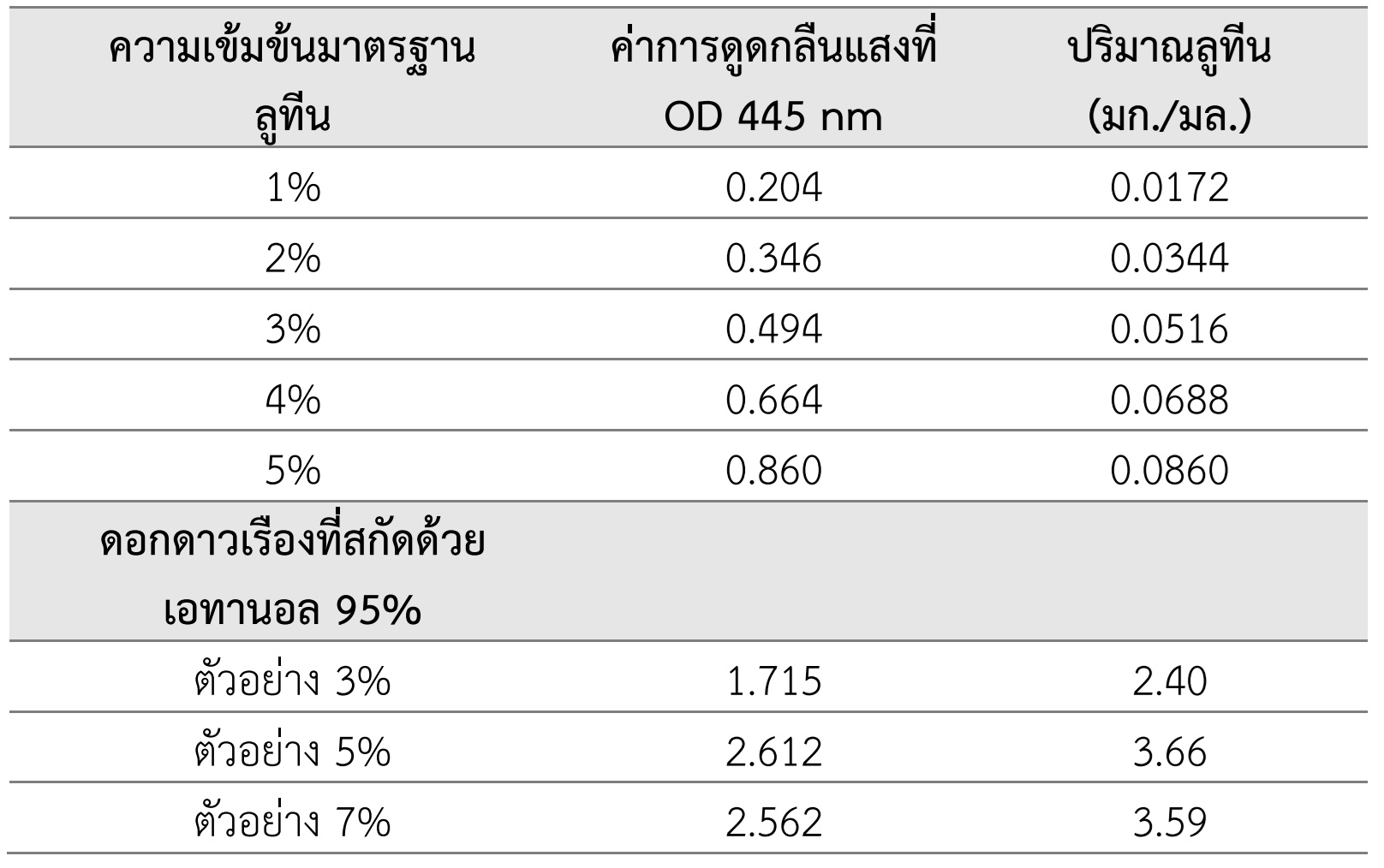
Siamese fighting fish is an economically important ornamental fish popular among aquarists for its variety of patterns and colors. The shade and intensity of its color are correlated with the pigment intake from the diet. A commonly used natural source in fish feed supplementation is marigold flower, which contains high levels of lutein in the carotenoid group. However, information on the optimal concentration of marigold extract for maximizing color enhancement in this species remains limited. This study, therefore, aimed to investigate the effect of supplementing marigold extract, prepared with 95% ethanol, in the diet at levels of 0%, 3%, 5%, and 7% on improving the color intensity of the body and caudal fin of the fish over a period of 5 weeks. Color assessment was performed using the RGB system from photographs. The results showed that marigold extract supplementation significantly enhanced the color intensity of the body and caudal fin, with the 5% level (3.66 mg/ml estimated lutein content) yielding the best results for all color values (R, G, B) on both the body (average R-value increase of 55.05) and caudal fin (average R-value increase of 48.29) when compared to the control group (p < 0.001). This study confirms the potential of marigold extract to enhance the coloration of this ornamental fish, with the 5% level being the appropriate inclusion rate.
Article Details
References
Afshari-Jouybari, H., & Farahnaky, A. 2011. Evaluation of Photoshop software potential for food
colorimetry. Journal of Food Engineering, 106(2), 170-175.
Besen, K. P., Hessa Melim, E. W., Favaretto, E. D., Moreira, M., & Hadi Perez Fabregat, T. E. 2019.
Lutein as a natural carotenoid source: Effect on growth, survival and skin pigmentation of goldfish juveniles (Carassius auratus). Aquaculture Research, 50(8), 2200-2206.
Bianca, R. A., Pinela, J., Barros, L., Oliveira, M. B. P. P., & Ferreira, I. C. F. R. 2020. Anthocyanin-rich
extract of jabuticaba epicarp as a natural colorant: Optimization of heat- and ultrasound-assisted extractions and application in a bakery product. Food Chemistry, 316, 126364.
Bjerkeng, B. 2008. Carotenoids in aquaculture: fish and crustaceans. In Birkhäuser Basel eBooks
(pp. 237–254). https://doi.org/10.1007/978-3-7643-7499-0_12
Capelli, B., Bagchi, D., & Cysewski, G. R. 2013. Synthetic astaxanthin is significantly inferior to algal-
based astaxanthin as an antioxidant and may not be suitable as a human nutraceutical supplement. Nutrafoods, 12(4), 145–152.
Casella, P., Molino, A., Mehariya, S., Iovine, A., Di Sanzo, G., Larocca, V., Martino, M., Leone, G. P., Marino, T., Musmarra, D., & Molino, A. 2021. Optimization of lutein extraction from Scenedesmus almeriensis using pressurized liquid extraction. Chemical Engineering Transactions, 87, 475–480.
Chatzifotis, S., Pavlidis, M., Jimeno, C. D., Vardanis, G., Sterioti, A., & Divanach, P. 2005. The effect
of different carotenoid sources on skin coloration of cultured red porgy (Pagrus pagrus). Aquaculture Research, 36(15), 1517–1525.
Dani, D., Thirugnanamurthy, S., Subramaniyan, Faizhullah, M., & Fernando, H. 2017. Application of
carotenoids on coloration of aquatic animals. International Journal of Fisheries and Aquatic Research, 2, 01-07.
De Carvalho, C. C. C. R., & Caramujo, M. J. 2017. Carotenoids in aquatic ecosystems and aquaculture:
a colorful business with implications for human health. Frontiers in Marine Science, 4.
Despy, J., Wymeersch, N., Bouchat, I., Destree, C., Burette, A., Richel, A., & Olive, G. 2014. P13 - Old
inks: Pigments extracted from plants. Proceedings of the 19th National Symposium on Applied Biological Sciences, Gembloux, Belgium, 83.
Fiedoruk-Pogrebniak, M. 2024. Mathematical processing of RGB data in microfluidic paper-based
analytical devices. Scientific Reports, 14. https://doi.org/10.1038/s41598-024-63546-2
Ho, A. L. F. C., O’Shea, S. K., & Pomeroy, H. F. 2013. Dietary esterified astaxanthin effects on color,
carotenoid concentrations, and compositions of clown anemonefish, Amphiprion ocellaris, skin. Aquaculture International, 21(2), 361-374. https://doi.org/10.1007/s10499-012-9558-9
Joint FAO/WHO Expert Committee on Food Additives. 2004. Lutein from Tagetes erecta.
https://www.fao.org/fileadmin/user_upload/jecfa_additives/docs/monograph3/additive-255.pdf
Li, J., & Engelberth, A. S. 2018. Quantification and purification of lutein and zeaxanthin recovered
from distillers dried grains with solubles (DDGS). Bioresources and Bioprocessing, 5(1), Article 32.
Li, W., Gao, Y., Zhao, J., & Wang, Q. 2007. Phenolic, flavonoid and lutein ester content and
antioxidant activity of eleven cultivars of Chinese marigold. Journal of Agricultural and Food Chemistry, 55(21), 8478–8484.
Lin, J. H., Lee, D. J., & Chang, J. S. 2015. Lutein production from biomass: Marigold flowers versus
microalgae. Bioresource Technology, 184, 421–428.
Manzoor, S., Ansari, M. J., Shah, A. A., Hussain, K., Khan, A., Al-Abbasi, F. A., & Alshammari, A. S. 2022. Green extraction of lutein from marigold flower petals, process optimization and its potential to improve the oxidative stability of sunflower oil. Ultrasonics Sonochemistry, 85, 105994.
Miao, Q., Si, X., Zhao, Q., Zhang, H., Qin, Y., Tang, C., & Zhang, J. 2024. Deposition and enrichment
of carotenoids in livestock products: an overview. Food Chemistry: X, 21, 101245.
Minz, P. S., & Saini, C. S. 2021. RGB camera-based image technique for color measurement of
flavored milk. Measurement: Food, 4, 100012
Monica, K. S., Saravanan, S., Bhuvaneswari, K. S., & Suresh, R. 2022. Role of Carotenoids in ornamental fish culture: a review. International Journal of Current Microbiology and Applied Sciences, 11(1), 1-10.
Pailan, G., Sardar, P., & Mahapatra, B. 2015. Marigold petal meal: a natural carotenoid source for pigmentation in swordtail (Xiphophorus helleri). Animal Nutrition and Feed Technology, 15, 417-425. https://doi.org/10.5958/0974-181X.2015.00042.6
Sandkam, B. A., Deere-Machemer, K. A., Johnson, A. M., Grether, G. F., Rodd, F. H., & Fuller, R. C. 2016. Exploring visual plasticity: dietary carotenoids can change color vision in guppies (Poecilia reticulata). Journal of Comparative Physiology A, 202(7), 527–534.
Sermwatanakul, A. 2019. Capacitating the local farmers to enhance global marketing of Thailand’s national aquatic animal, the Siamese fighting fish. Fish for the People, 17(2), 42–48. https://repository.seafdec.org/handle/20.500.12066/5516
Shah, T. R., Prasad, K., & Kumar, P. 2016. Maize—A potential source of human nutrition and health: a review. Cogent Food & Agriculture, 2(1), 1166995.
Wallat, G. K., Luzuriaga, D. A., Balaban, M. O., & Chapman, F. A. 2002. Analysis of skin color development in live goldfish using a color machine vision system. North American Journal of Aquaculture, 64(1), 79–84.
