
ผลของการเสริมสารสกัดหยาบดอกดาวเรืองในอาหารต่อความเข้มสีบริเวณลำตัวและหาง ของปลากัดไทย (Betta splendens)
Article Sidebar
Main Article Content
บทคัดย่อ
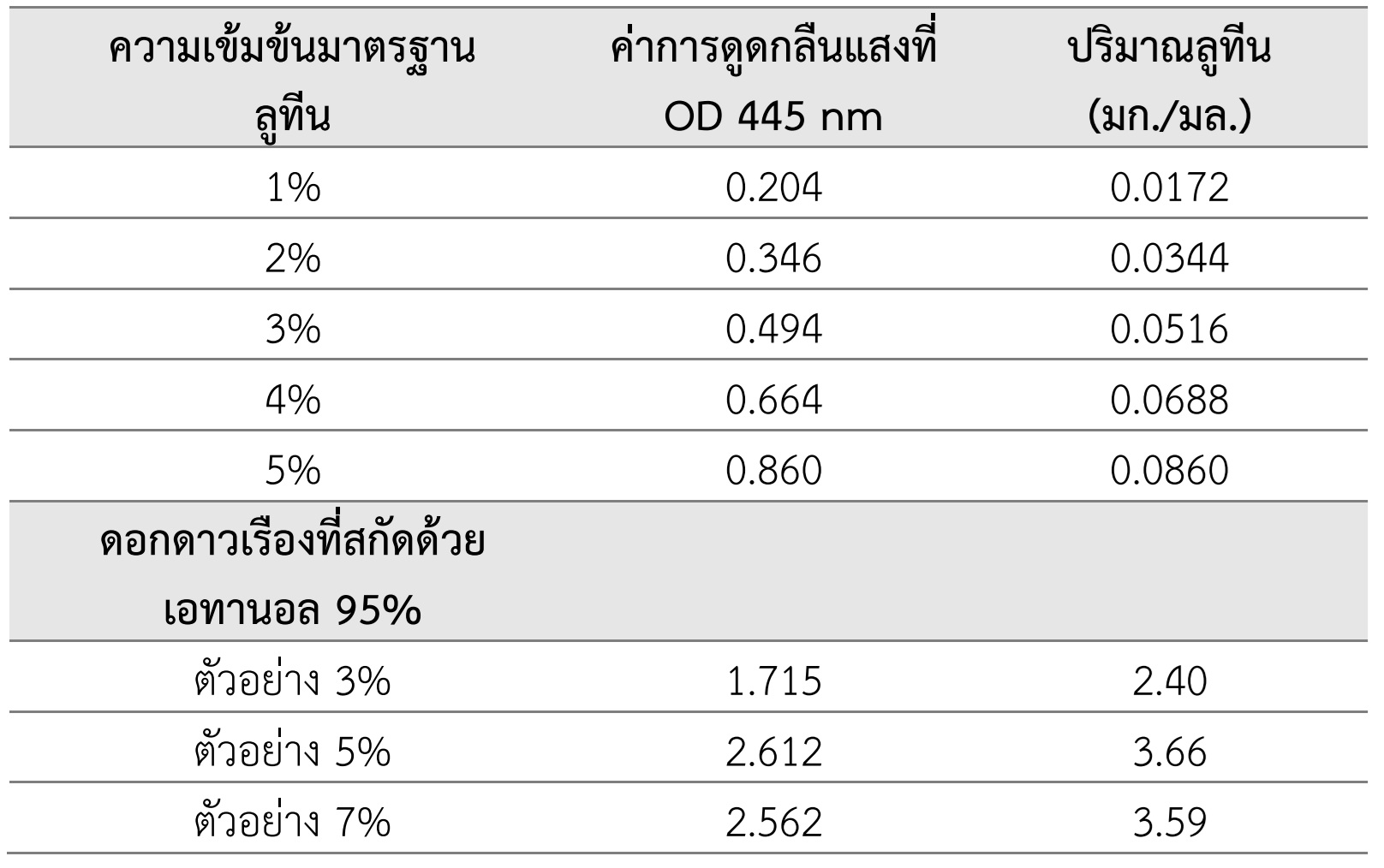
ปลากัดไทยเป็นปลาสวยงามเศรษฐกิจที่ได้รับความนิยมจากผู้เลี้ยงด้วยลวดลายและสีสันที่หลากหลาย โดยเฉดสีและความเข้มของสีสัมพันธ์กับการได้รับรงควัตถุจากอาหาร โดยแหล่งวัตถุดิบจากธรรมชาติที่นิยมใช้เสริมอาหารเร่งสี คือ ดอกดาวเรืองที่มีสารลูทีนในกลุ่มแคโรทีนอยด์ในระดับสูง อย่างไรก็ตาม ข้อมูลเกี่ยวกับระดับความเข้มข้นของสารสกัดจากดอกดาวเรืองที่ให้ประสิทธิภาพสูงสุดต่อการเพิ่มสีในปลากัดยังมีจำกัด งานวิจัยนี้จึงมีวัตถุประสงค์เพื่อศึกษาผลของการเสริมสารสกัดดอกดาวเรืองที่เตรียมด้วยเอทานอล 95% ในอาหารที่ระดับ 0%, 3%, 5% และ 7% ต่อการเพิ่มความเข้มสีของบริเวณลำตัวและหางของปลากัดไทยเป็นเวลา 5 สัปดาห์ โดยประเมินสีด้วยระบบ RGB จากภาพถ่าย ผลการทดลองพบว่าการเสริมสารสกัดดอกดาวเรืองช่วยเพิ่มความเข้มสีของลำตัวและครีบหางได้อย่างมีนัยสำคัญ โดยเฉพาะระดับ 5% (มีลูทีน 3.66 มก./มล.) ให้ผลดีที่สุดในทุกค่าสี (R, G, B) ทั้งบริเวณลำตัว (ค่า R เพิ่มเฉลี่ย 55.05) และครีบหาง (ค่า R เพิ่มเฉลี่ย 48.29) เมื่อเทียบกับกลุ่มควบคุม (p < 0.001) ผลการศึกษานี้ยืนยันศักยภาพของสารสกัดดอกดาวเรืองในการเสริมความเข้มสีของปลาสวยงาม โดยระดับ 5% เป็นอัตราที่เหมาะสมสำหรับปลากัดไทย
Article Details
เอกสารอ้างอิง
Afshari-Jouybari, H., & Farahnaky, A. 2011. Evaluation of Photoshop software potential for food
colorimetry. Journal of Food Engineering, 106(2), 170-175.
Besen, K. P., Hessa Melim, E. W., Favaretto, E. D., Moreira, M., & Hadi Perez Fabregat, T. E. 2019.
Lutein as a natural carotenoid source: Effect on growth, survival and skin pigmentation of goldfish juveniles (Carassius auratus). Aquaculture Research, 50(8), 2200-2206.
Bianca, R. A., Pinela, J., Barros, L., Oliveira, M. B. P. P., & Ferreira, I. C. F. R. 2020. Anthocyanin-rich
extract of jabuticaba epicarp as a natural colorant: Optimization of heat- and ultrasound-assisted extractions and application in a bakery product. Food Chemistry, 316, 126364.
Bjerkeng, B. 2008. Carotenoids in aquaculture: fish and crustaceans. In Birkhäuser Basel eBooks
(pp. 237–254). https://doi.org/10.1007/978-3-7643-7499-0_12
Capelli, B., Bagchi, D., & Cysewski, G. R. 2013. Synthetic astaxanthin is significantly inferior to algal-
based astaxanthin as an antioxidant and may not be suitable as a human nutraceutical supplement. Nutrafoods, 12(4), 145–152.
Casella, P., Molino, A., Mehariya, S., Iovine, A., Di Sanzo, G., Larocca, V., Martino, M., Leone, G. P., Marino, T., Musmarra, D., & Molino, A. 2021. Optimization of lutein extraction from Scenedesmus almeriensis using pressurized liquid extraction. Chemical Engineering Transactions, 87, 475–480.
Chatzifotis, S., Pavlidis, M., Jimeno, C. D., Vardanis, G., Sterioti, A., & Divanach, P. 2005. The effect
of different carotenoid sources on skin coloration of cultured red porgy (Pagrus pagrus). Aquaculture Research, 36(15), 1517–1525.
Dani, D., Thirugnanamurthy, S., Subramaniyan, Faizhullah, M., & Fernando, H. 2017. Application of
carotenoids on coloration of aquatic animals. International Journal of Fisheries and Aquatic Research, 2, 01-07.
De Carvalho, C. C. C. R., & Caramujo, M. J. 2017. Carotenoids in aquatic ecosystems and aquaculture:
a colorful business with implications for human health. Frontiers in Marine Science, 4.
Despy, J., Wymeersch, N., Bouchat, I., Destree, C., Burette, A., Richel, A., & Olive, G. 2014. P13 - Old
inks: Pigments extracted from plants. Proceedings of the 19th National Symposium on Applied Biological Sciences, Gembloux, Belgium, 83.
Fiedoruk-Pogrebniak, M. 2024. Mathematical processing of RGB data in microfluidic paper-based
analytical devices. Scientific Reports, 14. https://doi.org/10.1038/s41598-024-63546-2
Ho, A. L. F. C., O’Shea, S. K., & Pomeroy, H. F. 2013. Dietary esterified astaxanthin effects on color,
carotenoid concentrations, and compositions of clown anemonefish, Amphiprion ocellaris, skin. Aquaculture International, 21(2), 361-374. https://doi.org/10.1007/s10499-012-9558-9
Joint FAO/WHO Expert Committee on Food Additives. 2004. Lutein from Tagetes erecta.
https://www.fao.org/fileadmin/user_upload/jecfa_additives/docs/monograph3/additive-255.pdf
Li, J., & Engelberth, A. S. 2018. Quantification and purification of lutein and zeaxanthin recovered
from distillers dried grains with solubles (DDGS). Bioresources and Bioprocessing, 5(1), Article 32.
Li, W., Gao, Y., Zhao, J., & Wang, Q. 2007. Phenolic, flavonoid and lutein ester content and
antioxidant activity of eleven cultivars of Chinese marigold. Journal of Agricultural and Food Chemistry, 55(21), 8478–8484.
Lin, J. H., Lee, D. J., & Chang, J. S. 2015. Lutein production from biomass: Marigold flowers versus
microalgae. Bioresource Technology, 184, 421–428.
Manzoor, S., Ansari, M. J., Shah, A. A., Hussain, K., Khan, A., Al-Abbasi, F. A., & Alshammari, A. S. 2022. Green extraction of lutein from marigold flower petals, process optimization and its potential to improve the oxidative stability of sunflower oil. Ultrasonics Sonochemistry, 85, 105994.
Miao, Q., Si, X., Zhao, Q., Zhang, H., Qin, Y., Tang, C., & Zhang, J. 2024. Deposition and enrichment
of carotenoids in livestock products: an overview. Food Chemistry: X, 21, 101245.
Minz, P. S., & Saini, C. S. 2021. RGB camera-based image technique for color measurement of
flavored milk. Measurement: Food, 4, 100012
Monica, K. S., Saravanan, S., Bhuvaneswari, K. S., & Suresh, R. 2022. Role of Carotenoids in ornamental fish culture: a review. International Journal of Current Microbiology and Applied Sciences, 11(1), 1-10.
Pailan, G., Sardar, P., & Mahapatra, B. 2015. Marigold petal meal: a natural carotenoid source for pigmentation in swordtail (Xiphophorus helleri). Animal Nutrition and Feed Technology, 15, 417-425. https://doi.org/10.5958/0974-181X.2015.00042.6
Sandkam, B. A., Deere-Machemer, K. A., Johnson, A. M., Grether, G. F., Rodd, F. H., & Fuller, R. C. 2016. Exploring visual plasticity: dietary carotenoids can change color vision in guppies (Poecilia reticulata). Journal of Comparative Physiology A, 202(7), 527–534.
Sermwatanakul, A. 2019. Capacitating the local farmers to enhance global marketing of Thailand’s national aquatic animal, the Siamese fighting fish. Fish for the People, 17(2), 42–48. https://repository.seafdec.org/handle/20.500.12066/5516
Shah, T. R., Prasad, K., & Kumar, P. 2016. Maize—A potential source of human nutrition and health: a review. Cogent Food & Agriculture, 2(1), 1166995.
Wallat, G. K., Luzuriaga, D. A., Balaban, M. O., & Chapman, F. A. 2002. Analysis of skin color development in live goldfish using a color machine vision system. North American Journal of Aquaculture, 64(1), 79–84.
