
การดูดซับทองแดงในน้ำเสียสังเคราะห์โดยใช้รากและลำต้นผักตบชวา ที่ปรับปรุงด้วยไคโตซาน
Article Sidebar
Main Article Content
บทคัดย่อ
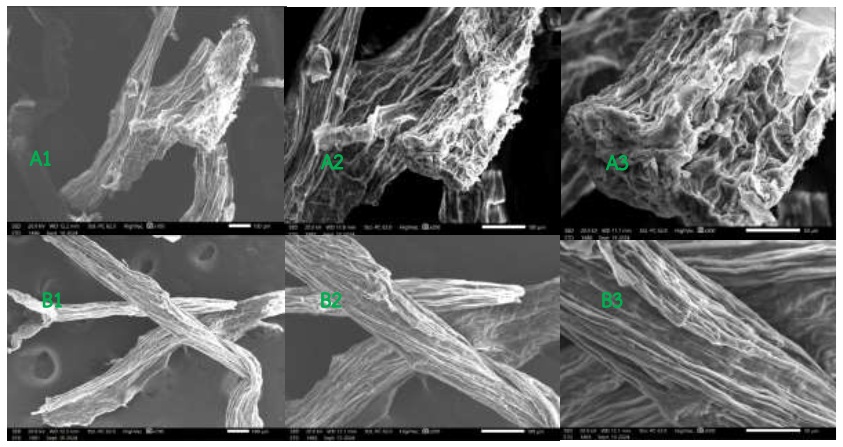
งานวิจัยนี้มีวัตถุประสงค์เพื่อศึกษาปริมาณการดูดซับทองแดงในน้ำเสียสังเคราะห์โดยใช้ตัวดูดซับจากรากและลำต้นของผักตบชวาที่ปรับปรุงด้วยไคโตซานซึ่งมีความสำคัญในการเพิ่มพื้นที่ผิวและมีหมู่ฟังก์ชันที่จับยึดไอออนโลหะหนักได้ ศึกษาพื้นที่ผิวตัวดูดซับโดยใช้ไอโซเทอร์มแบบแลงเมียร์ของการดูดซับเมทิลีนบลู ศึกษาลักษณะสัณฐานวิทยาและหมู่ฟังก์ชันของตัวดูดซับทั้ง 4 ชนิดโดยใช้กล้องจุลทรรศน์อิเล็กตรอนแบบส่องกราดและฟูเรียร์ทรานส์ฟอร์มอินฟราเรดสเปกโทรสโกปี พบว่า พื้นที่ผิวของลำต้นผักตบชวาที่ปรับปรุงด้วยไคโตซานมากที่สุด รองลงมาได้แก่ ลำต้นที่ไม่ปรับ รากที่ไม่ปรับ และรากที่ปรับ ตามลำดับ ซึ่งมีค่า 350.1, 283.3 , 281.2 และ 116.3 m2/g ตามลำดับ พบว่าสอดคล้องกับผลขนาดรูพรุนของวัสดุดูดซับที่ได้จากกล้องจุลทรรศน์อิเล็กตรอนแบบส่องกราด จากนั้นนำไปศึกษาการดูดซับทองแดงในน้ำเสียสังเคราะห์ โดยใช้การดูดซับแบบแบทช์ พบว่า ปริมาณการดูดซับทองแดงโดยใช้ลำต้นผักตบชวาที่ปรับปรุงจะมีปริมาณการดูดซับสูงสุด เท่ากับ 44.82 mg/g
รองลงไปได้แก่ ลำต้นที่ไม่ปรับ รากที่ไม่ปรับ และรากที่ปรับ ตามลำดับ ซึ่งมีปริมาณการดูดซับทองแดงเท่ากับ 20.99, 17.07 และ 14.25 mg/g ตามลำดับ พฤติกรรมการดูดซับทองแดงบนรากเป็นการดูดซับแบบชั้นเดียวตามไอโซเทอร์มแบบแลงเมียร์ ส่วนลำต้นเป็นไปตามไอโซเทอร์มแบบฟรุนดิช แสดงว่าเป็นการดูดซับแบบหลายชั้น สรุปได้ว่าการปรับปรุงวัสดุดูดซับจากลำต้นด้วยไคโตซานช่วยให้ปริมาณการดูดซับทองแดงดีขึ้น
Article Details
เอกสารอ้างอิง
ปรีชา ปัญญา. 2557. เคมีพื้นผิว. มหาวิทยาลัยราชภัฏกำแพงเพชร, กำแพงเพชร.
Chaiyaraksa, C., W. Boonyakiat, W. Bukkontod, and W. Ngakom. 2019. Adsorption of copper (II) and nickel (II) by chemical modified magnetic biochar derived from Eichhornia crassipes. EnvironmentAsia. 12 (2): 14–23.
González-Tavares, C., C.G. Salazar-Hernández, A. Talavera-López, J. M. Salgado-Román, R.Hernández- Soto, and J. A. Hernández. 2023. Removal of Ni(II) and Cu(II) in aqueous solutions using treated water hyacinth (Eichhornia crassipes) as bioadsorbent. Separations. 10 (5): 289.
Guibal, E. 2004. Interactions of metal ions with chitosan-based sorbents: A review. Separation
and Purification Technology. 38 (1): 43–74.
Hsu, C.-Y., Y. Ajaj, Z.H. Mahmoud, G. K. Ghadir, Z. K. Alani, M. M. Hussein, S.A. Hussein, M. M. Karim,
A. Al-khalidi, J. K. Abbas, A. H. Kareem, and E. Kianfar. 2024. Adsorption of heavy metal ions using chitosan/graphene nanocomposites: A review study. Results in Chemistry.
: 101332.
Huynh, A. T., Y. C. Chen, and B. N. Tran. 2021. A small-scale study on removal of heavy metals from contaminated water using water hyacinth. Processes. 9 (11): 1802.
Murmu, R., S. M. George, P. Yuvarani, P.Bhatnagar, K. Amudha, and M. S. Karuna. 2024. Sustainable solutions for heavy metal contamination: Characterization and regeneration of water hyacinth biosorbent in wastewater treatment. Global NEST Journal. 26 (6): 05910.
Oktaviyana, M., A. Wijayanti, R. A. Kusumadewi, and R. Hadisoebroto. 2020. The mixing speed effect and mass of adsorbent on copper (Cu) removal from wastewater by water hyacinth leaves. E3S Web of Conferences: ETMC and RC EnvE. 148: 05006.
Pisitsak, P., W. Phamonpon, P. Soontornchatchavet, and A. Sittinun. 2019. The use of water hyacinth fibers to develop chitosan-based biocomposites with improved Cu²+ removal efficiency. Composites Communications. 16: 1–4.
Rahman, A., M. A. Haque, S. Ghosh, P. Shinu, M. Attimarad, and G. Kobayashi. 2023. Modified shrimp-based chitosan as an emerging adsorbent removing heavy metals (chromium, nickel, arsenic, and cobalt) from polluted water. Sustainability. 15 (3): 2431.
Ullah, M. H., and M. J. Rahman. 2024. Adsorptive removal of toxic heavy metals from wastewater using water hyacinth and its biochar: A review. Heliyon. 10: e36869.
Zheng, J.-C., H.M. Feng, M. Lam, P. K. Lam, W. W. Ding, and H. Q. Yu. 2009. Removal of Cu (II) in
aqueous media by biosorption using water hyacinth roots as a biosorbent material. Journal of Hazardous Materials. 171 (1–3): 780–785.
