
ผลของระดับหนอนแมลงวันลายในสูตรอาหารต่อประสิทธิภาพการเจริญเติบโต ของลูกปลานิล
Article Sidebar
Main Article Content
บทคัดย่อ
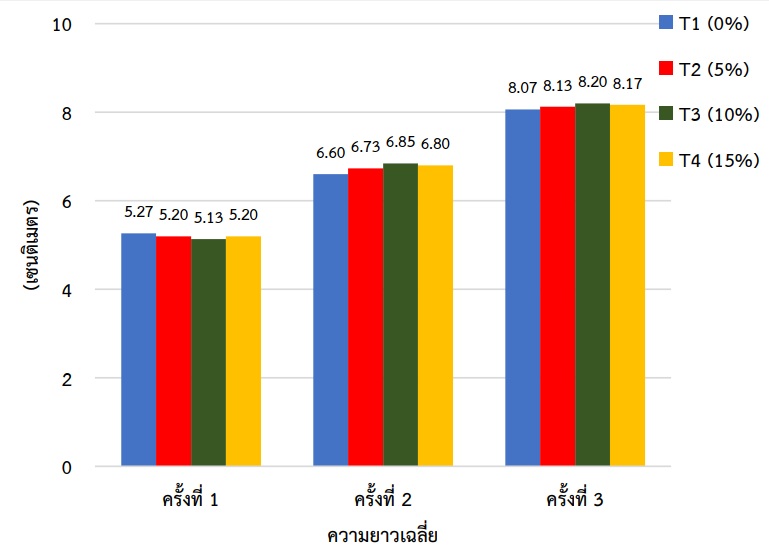
การวิจัยนี้มีวัตถุประสงค์เพื่อศึกษาประสิทธิภาพการเจริญเติบโตลูกปลานิลจากการเสริมหนอนแมลงวันลายในอาหารที่ระดับต่างกันและหาปริมาณที่เหมาะสมในการเลี้ยงลูกปลานิล โดยเสริมหนอนแมลงวันลายจำนวน 4 ระดับ คือ 0, 5, 10 และ 15 เปอร์เซ็นต์ตามลำดับ ให้อาหารที่มีโปรตีน 30 เปอร์เซ็นต์เท่ากันทุกกลุ่มทดลอง วางแผนการทดลองแบบสุ่มสมบูรณ์ (Completely Randomized Design; CRD) เลี้ยงในกระชัง อัตราความหนาแน่น 50 ตัวต่อกระชัง เป็นระยะเวลา 60 วัน ผลการทดลองพบว่ากลุ่มทดลองที่ 3 เสริมหนอนแมลงวันลาย 10 เปอร์เซ็นต์ มีน้ำหนักสุดท้ายเท่ากับ 13.00±1.56 กรัม ความยาวสุดท้ายเท่ากับ 8.20±11.60 เซนติเมตร น้ำหนักเพิ่มต่อวันเท่ากับ 0.17±0.01 กรัมต่อวัน ความยาวเพิ่มต่อวันเท่ากับ 0.13±0.02 เซนติเมตรต่อวัน อัตราการเติบโตจำเพาะเท่ากับ 12.96±0.03 เปอร์เซ็นต์ต่อวัน อัตราแลกเนื้อเท่ากับ 1.25±0.06 และประสิทธิภาพของอาหารเท่ากับ 0.63±0.02 แต่ไม่แตกต่างกันทางสถิติ (p>0.05) และอัตรารอดตายเท่ากับ 88.00±0.07 เปอร์เซ็นต์มีความแตกต่างกันทางสถิติ (p<0.05) มากกว่ากลุ่มการทดลองอื่น ดังนั้นหนอนแมลงวันลายสามารถใช้ในสูตรอาหารเลี้ยงลูกปลานิลได้ และสัดส่วนที่เหมาะสมในการใช้ในสูตรอาหารอยู่ที่ระดับ 10 เปอร์เซ็นต์
Article Details
เอกสารอ้างอิง
เกวลิน หนูฤทธิ์, และพัชนี บุญเอก. 2566. สถานการณ์สินค้าปลานิลและผลิตภัณฑ์ปี 2565 และแนวโน้มปี 2566. กรมประมง, กรุงเทพฯ.
จิตติมา หมั่นกิจ. 2561. ผลของสูตรอาหารผสมไข่น้ำและอัตราความหนาแน่นต่อการเจริญเติบโตของปลากระแหที่เลี้ยงในกระชัง. Veridian E-Journal, Science and Technology Silpakorn University, 5(1): 1–13.
จิตติมา หมั่นกิจ. 2563. การใช้หนอนแมลงวันลายเป็นสวนผสมในอาหารลูกปลาหมอไทยชุมพร 1. วารสารวิชาการ
สถาบันการอาชีวศึกษาเกษตร, 4(2): 15-25.
ชิงชัย โลหะวัฒนกุล. 2543. วารสารสัตว์น้ำ, 11(125): 185-188.
ณัฐวุฒิ ดวงแก้ว. 2561. ผลการใช้ตัวอ่อนแมลงวันลายทดแทนปลาป่นในอาหารต่อสมรรถภาพการผลิตไก่เนื้อ. วิทยานิพนธ์ปริญญาโท. มหาวิทยาลัยอุบลราชธานี, อุบลราชธานี.
ธนาภรณ์ จิตตปาลพงษ์. 2557. การสร้างสูตรอาหารสัตว์น้ำและสูตรอาหารสัตว์เศรษฐกิจ. กรมประมง, กรุงเทพฯ.
พิเชต พลายเพชร. 2559. การจัดการทางโภชนาการสำหรับเลี้ยงปลานิล. วารสารวิทยาศาสตร์และเทคโนโลยี, 24(1): 12–39.
มั่นสิน ตัณฑลเวศม์, และไพพรรณ พรประภา. 2544. การจัดการคุณภาพน้ำและการบำบัดน้ำเสียในบ่อเลี้ยงปลา และสัตว์น้ำอื่นๆ เล่ม 1. ภาควิชาวิศวกรรมสิ่งแวดล้อม คณะวิศวกรรมศาสตร์ จุฬาลงกรณ์มหาวิทยาลัย, กรุงเทพฯ.
ไมตรี ดวงสวัสดิ์, และจารุวรรณ สมศิริ. 2528. คุณสมบัติของน้ำและวิธีวิเคราะห์สำหรับงานวิจัยทางการประมง. กรมประมง. กรุงเทพฯ.
วรพรรณ เผ่าทองสุข, ยุคลธร สถาปนศิริ, วัสสิกา เสนออุดม, และวิภาพรรณ ชนะภักดิ์. 2562. การเปรียบเทียบ คุณภาพน้ำและการเจริญเติบโตของปลาสลิดในบ่อเลี้ยงปลาสลิดแบบดั้งเดิม แบบผสมผสาน และแบบภูมิ ปัญญา. รายงานการวิจัย. มหาวิทยาลัยหัวเฉียวเฉลิมพระเกียรติ, สมุทรปราการ.
เวียง เชื้อโพธิ์หัก. 2528. อาหารปลา. ภาควิชาเพาะเลี้ยงสัตว์น้ำ มหาวิทยาลัยเกษตรศาสตร์, กรุงเทพฯ.
สุดาพร ตงศิริ, จงกล พรมยะ, และนิสรา กิจเจริญ. 2568. การใช้หนอนแมลงวันลายอบแห้งเป็นอาหารปลาบึก อินทรีย์. วารสารวิจัยและส่งเสริมวิชาการเกษตร, 42(1): 132–142.
Alzawqari, M. H., Al-Baddany, A. A., Al-Baadani, H. H., Alhidary, I. A., Ullah Khan, R., Aqil, G. M., & Abdurab, A. 2016. Effect of feeding dried sweet orange (Citrus sinensis) peel and lemon grass (Cymbopogon citratus) leaves on growth performance, carcass traits, serum metabolites and antioxidant status in broiler during the finisher phase. Environmental Science and Pollution Research, 23: 17077–17082.
Belghit, I., Liland, N. S., Gjesdal, P., Biancarosa, I., Menchetti, E., Li, Y., & Lock, E. J. 2019. Black soldier fly larvae meal can replace fish meal in diets of sea–water phase Atlantic salmon (Salmo salar). Aquaculture, 503: 609–619.
Bruni, L., Pastorelli, R., Viti, C., Gasco, L., & Parisi, G. 2018. Characterisation of the intestinal microbial communities of rainbow trout (Oncorhynchus mykiss) fed with Hermetia illucens (black soldier fly) partially defatted larvae meal as partial dietary protein source. Aquaculture, 487: 56–63.
Devic, E., Leschen, W., Murray, F., & Little, D. C. 2018. Growth performance, feed utilization and body composition of advanced nursing Nile tilapia (Oreochromis niloticus) fed diets containing Black Soldier Fly (Hermetia illucens) larvae meal. Aquaculture Nutrition, 24(1): 416–423.
Dortmans, B., S. Diener, J. Egger, and C. Zurbrügg. 2021. Black Soldier Fly Biowaste Processing - A Step-by-Step Guide, 2nd Edition. Publisher: Eawag: Swiss Federal Institute of Aquatic Science and Technology, Dübendorf, Switzerland. ISBN: 978-3-906484-75-4.
Einstein, A.1993. Digestion & nutrient metabolism. In C. T. Robbins (Ed.), Wildlife Feeding and Nutrition (2nd ed.). Academic Press.
Emlen.1993. Food intake regulation. In C. T. Robbins (Ed.), Wildlife Feeding and Nutrition
(2nd ed.), Academic Press.
Hem, S., Toure, S., Sagbla, C., & Legendre, M. 2008. Bioconversion of palm kernel meal for aquaculture: Experiences from the forest region (Republic of Guinea). African Journal of Biotechnology, 7(8): 1192–1198.
Hepher, B., & Pruginin, Y. 1981. Commercial Fish Farming: With Special Reference to Fish Culture in Israel. John Wiley & Sons.
Kumar, S. V. R., Inamdar, N. M., Nayeemunnisa, & Viswanatha, G. L. 2011. Protective effect of lemongrass oil against dexamethasone induced hyperlipidemia in rats: Possible role of decreased lecithin cholesterol acetyltransferase activity. Asian Pacific Journal of Tropical Medicine, 4(8): 658–660.
Limbu, S. M., Shoko, A. P., Ulotu, E. E., Luvanga, S. A., Munyi, F. M., John, J. O., & Opiyo, M. A. 2022. Black soldier fly (Hermetia illucens, L.) larvae meal improves growth performance, feed efficiency and economic returns of Nile tilapia (Oreochromis niloticus, L.) fry. Aquaculture, Fish and Fisheries, 2(3): 167–178.
Li, M., Wang, G., Liu, C., Shang, R., & Chen, Y. 2021. Defatted black soldier fly (Hermetia illucens) larvae meal can partially replace fish meal in diets for adult Chinese soft-shelled turtles. Aquaculture, 541: 736758.
Makkar, H. P., Tran, G., Heuzé, V., & Ankers, P. 2014. State-of-the-art on use of insects as animal feed. Animal Feed Science and Technology, 197: 1–33.
Mohan, K., Rajan, D. K., Muralisankar, T., Ganesan, A. R., Sathishkumar, P., & Revathi, N. 2022. Use of black soldier fly (Hermetia illucens L.) larvae meal in aquafeeds for a sustainable aquaculture industry: A review of past and future needs. Aquaculture, 553: 738095.
Newton, L., Sheppard, C., Watson, D. W., Burtle, G., & Dove, R. 2005. Using the black soldier fly, Hermetia illucens, as a value-added tool for the management of swine manure (Report No.17). Animal and Poultry Waste Management Center, North Carolina State University. Nguyen, T., Tomberlin, J. K., & Vanlaerhoven, S. 2015. Ability of black soldier fly (Diptera: Stratiomyidae) larvae to recycle food waste. Environmental Entomology, 44(2): 406–410.
Wang, Y. S., & Shelomi, M. 2017. Review of black soldier fly (Hermetia illucens) as animal feed and human food. Foods, 6(10): 91. https://doi.org/10.3390/foods6100091
Weththasinghe, P., Hansen, J. Ø., Nøkland, D., Lagos, L., Rawski, M., & Øverland, M. 2021. Full-fat black soldier fly larvae (Hermetia illucens) meal and paste in extruded diets for Atlantic salmon (Salmo salar): Effect on physical pellet quality, nutrient digestibility, nutrient utilization and growth performances. Aquaculture, 530: 735785.
Yildirim-Aksoy, M., Eljack, R., Schrimsher, C., & Beck, B. H. 2020. Use of dietary frass from black soldier fly larvae, Hermetia illucens, in hybrid tilapia (Nile × Mozambique, Oreochromis niloticus × O. mozambique) diets improves growth and resistance to bacterial diseases. Aquaculture Reports, 17: 100373.
