
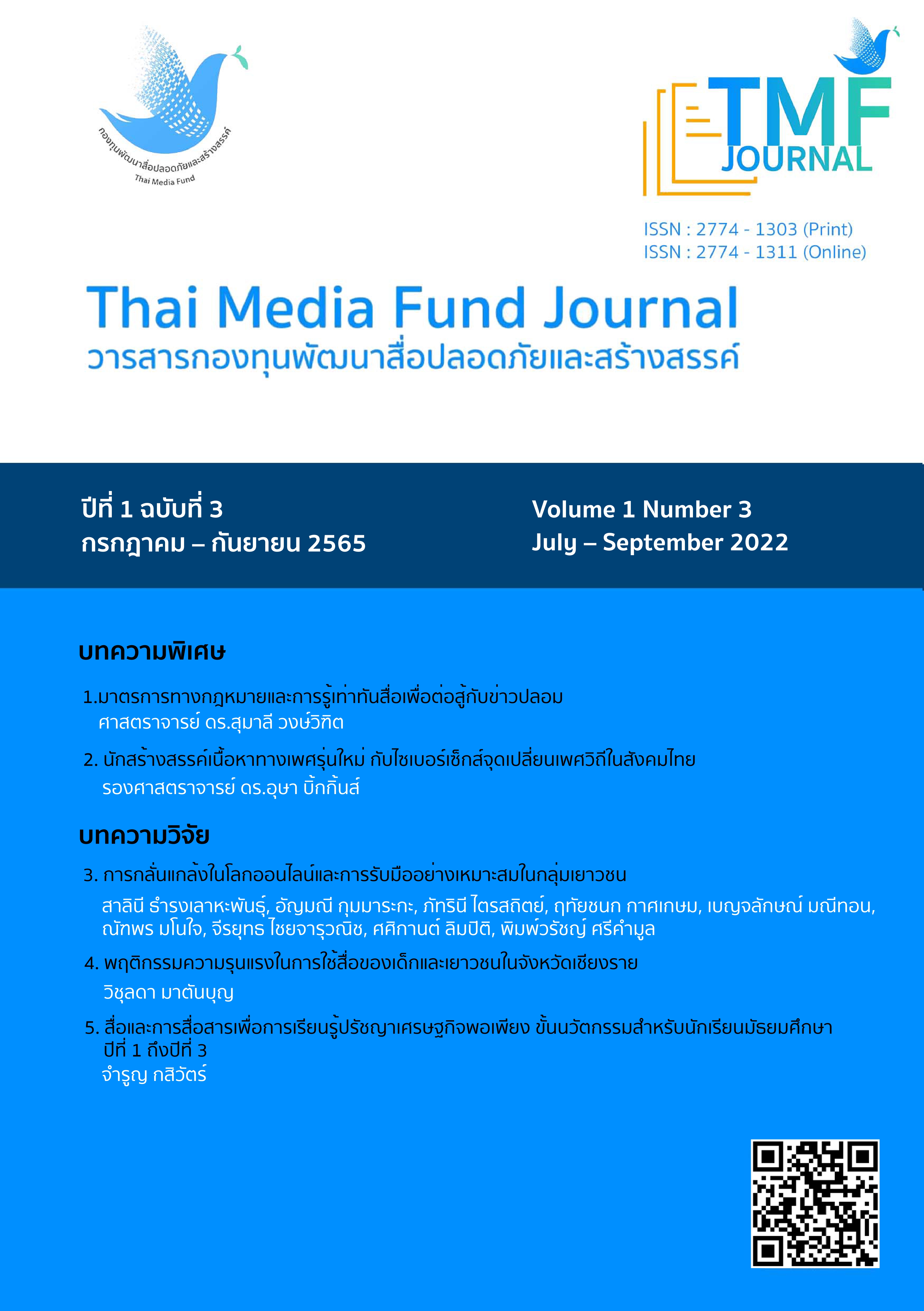
Impacts and Proper Responses of Cyberbullying in Youth
Article Sidebar
Main Article Content
Abstract
Online is an important channel to communicate in the present. Meanwhile, it may cause cyberbullying that damages and hurts others’ feelings. This study consists of two parts, the comparative study of cyberbullying from literature reviews and from workshops. The objectives are to provide knowledge and to study experiences of being cyberbullied from samples of high school and undergraduate students in 6 institutions in Chiang Mai including Fangchanupathum school, Sansai Wittayakom school, Montfort college, Chiang Mai University, Thailand National sports University and Chiang Mai Rajabhat University. The comparative results show that the frequencies of cyberbullying in Thailand and other countries are not different. The factors relating cyberbullying include gender, age, internet usage, psychological factors and parents. When being cyberbullied, it affects mental, feelings, social and study of the victims. Moreover, the results indicate that the pre-test scores of high school students are higher than those of undergraduate students. The knowledge and understanding about cyberbullying of participants are increased with statistically significant. The results of workshops reflect the achievement of providing knowledge and understanding in cyberbullying. Therefore, providing knowledge and proper responses of cyberbullying for youths is a vital channel to reduce cyberbullying problems.
Article Details

This work is licensed under a Creative Commons Attribution-NonCommercial-NoDerivatives 4.0 International License.
References
Archapetch, N. (2017). Cyberbullying: Aggressive misbehavior and innovation for solution. The journal of Social Communication Innovation), 5(1), 100-106.
Atthajãto, A., & Wattanapradith, K. (2020). 5 institutions for solving thai youth’s cyberbullying based on buddhist peaceful means. Journal of MCU Peace Studies, 8(extra), 357-370.
Bauman, S., Toomey, R. B., & Walker, J. L. (2013). Associations among bullying, cyberbullying, and suicide in high school students. Journal of adolescence, 36(2), 341-350.
Campbell, M., Spears, B., Slee, P., Butler, D., & Kift, S. (2012). Victims’ perceptions of traditional and cyberbullying, and the psychosocial correlates of their victimisation. Emotional and Behavioural Difficulties, 17(3-4), 389-401.
Dangchamroon, A. (2020). Teacher, Department of curriculum and instruction, Ramkhamhaeng, University. Interview. April, 13.
IBM Corp. Released. (2017). IBM SPSS statistics for windows, version 25.0. Armonk, NY: IBM Corp.
Kowalski, R. M., & Limber, S. P. (2013). Psychological, physical, and academic correlates of cyberbullying and traditional bullying. Journal of Adolescent Health, 53(1), S13-S20.
Kowalski, R. M., Giumetti, G. W., Schroeder, A. N., & Lattanner, M. R. (2014). Bullying in the digital age: a critical review and meta-analysis of cyberbullying research among youth. Psychological Bulletin, 140(4), 1073-1137.
Kwamkanung, J., & Kaewchinda, M. (2016). Counseling with stabililization techniques to enhance coping skills for cyberbullied youth. Journal of Graduate Studies of Valaya Alongkorn Rajabhat, 10(2), 40-52.
Office of the Broadcasting Commission Television Business and the National Telecommunications Commission. (2020). Report on the results of a survey of Internet data about Internet users in Thailand (2020). Retrieved from http://webstats.nbtc.go.th/
O'Keeffe, G. S., Clarke-Pearson, K., & Council on Communications and Media. (2011). The impact of social media on children, adolescents, and families. Pediatrics, 127(4), 800-804.
Patchin, J. W., & Hinduja, S. (2011). Traditional and nontraditional bullying among youth: A test of general strain theory. Youth & Society, 43(2), 727–751.
Pokaew, D. (2020). Graduate students, faculty of education: Mahachulalongkornrajavidyalaya, University. Interview. April, 8.
Pokpong, S., & Musiphan, W. (2010). Factors affecting attitudes and behaviors of physical violence and bullying through cyber world of thai adolescents. Nakornprathom: Mahidol University.
Saejew, P. (2020). Managing director of B.T. Striker Digital Co.,Ltd. Interview, January, 5.
Schenk, A. M., & Fremouw, W. J. (2012). Prevalence, psychological impact, and coping of cyberbully victims among college students. Journal of School Violence, 11(1), 21-37.
Sirirassamee, T., & Sirirassamee, B. (2015). Health risk behavior among thai youth: National survey 2013. Asia Pacific Journal of Public Health, 27(1), 76-84.
Sittimongkol, R. et al. (2018). An application of logistic regression to the study of cyberbullying behavior of students in department of mathematics and statistics, Thammasat University. Thai Journal of Science and Technology. 7(1).
-12.
Surat, P. (2018). Causes and effects related with cyber bullying: A case study of cybervictim thai youths. Journal of Suvarnabhumi Institute of Technology, 4(1), 260-273.
Tokunaga, R. S. (2010). Following you home from school: A critical review and synthesis of research on cyberbullying victimization. Computers in Human Behavior, 26(3),
-287.
UNICEF. (2016). Ending the torment: Tackling bullying from the schoolyard to cyberspace. Access 16 December 2019, Retrieved from https://violenceagainstchildren.un.org
Whittaker, E., & Kowalski, R. M. (2015). Cyberbullying via social media. Journal of School Violence, 14(1), 11-29.
Yathongkham, W. et al. (2020). Analysis of cyber-bullying messages on youtube websites by using text mining techniques. In The 16th National Conference on Computing and Information Technology, Bangkok. Thailand.
