GUIDELINES FOR APPLYING BUDDHIST PRINCIPLES TO THE PROMOTION OF THE JUSTICE SYSTEM WITHIN THE CONTEXT OF THE LAW IN THE THA RUEA SUBDISTRICT ADMINISTRATIVE ORGANIZATION, MUEANG NAKHON SI THAMMARAT DISTRICT, NAKHON SI THAMMARAT PROVINCE
Keywords:
Application, Buddhism Principles, Promotion of Justice SystemAbstract
Background and Objective: The community justice system is an important mechanism for maintaining peace and order and fairness in society. Buddhist principles have been used as a guideline for promoting the justice process since the time of the Buddha, it has also had a long-standing influence Thailand's legal system and justice processes. Examples of this influence include mediation and compromises to resolve disputes peacefully, using the principles of the Seven Atikornasamatha and the Four Brahmaviharas, these principles can be applied to effectively promote the community justice system. This research, aims to explore how the principles of the Seven Atikornasamatha can be applied to promote the community justice system in the area of Tha Ruea Sub-district Administrative Organization, Mueang District, Nakhon Si Thammarat Province, within the legal context.
Methodology: This research adopted a qualitative research design. Data were collected from relevant documents and in-depth interviews using a semi-structured interview format. The interviews targeted specific groups of key informants, including: 1) Five local residents; 2) Five local government officials; 3) Three educational personnel; 4) Three religious representatives; and 5) Five police officers, totaling 21 people. The data were analyzed using analytic induction.
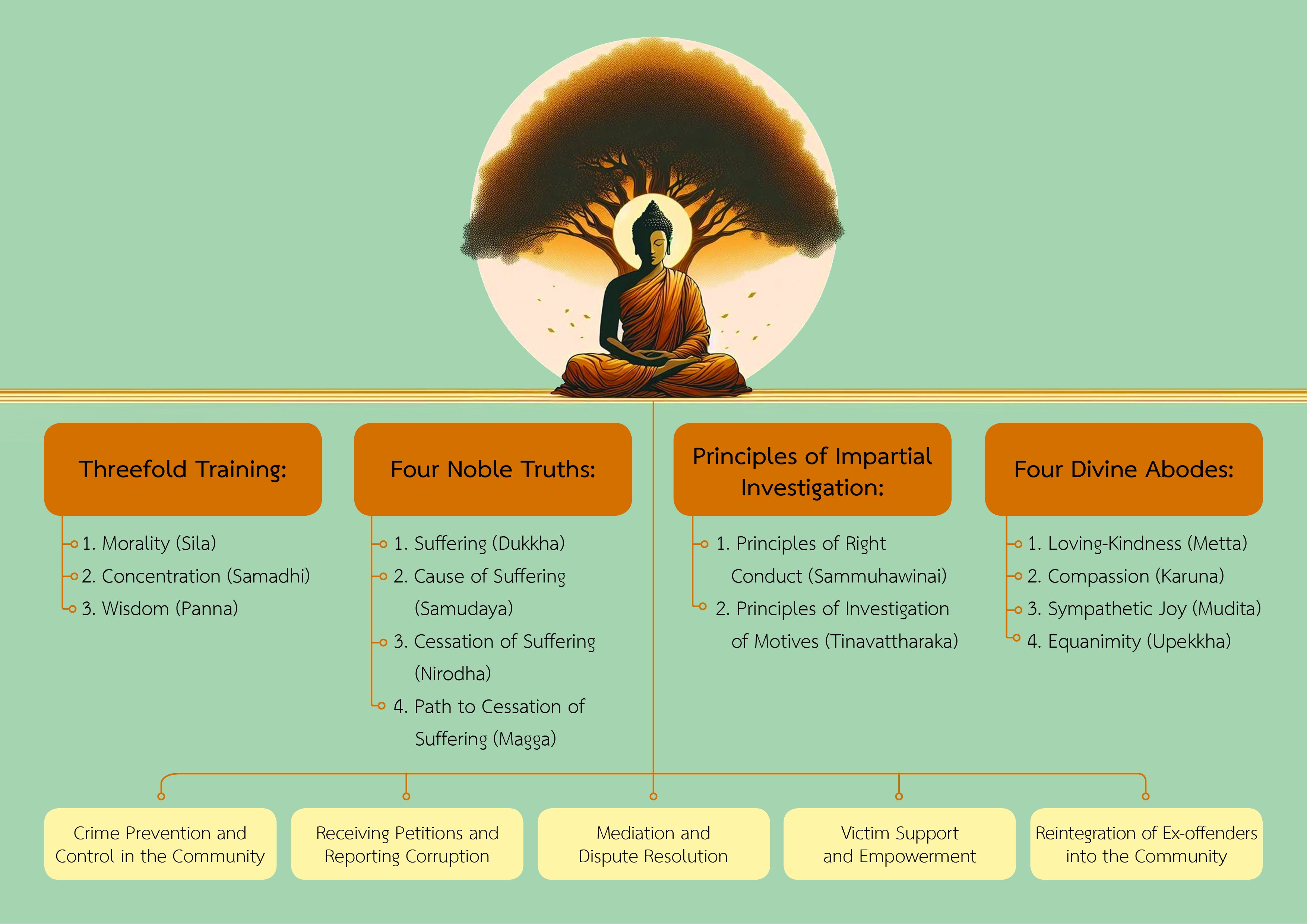
Main Results: The study showed that the application of Buddhist principles to promote the justice system in the Tha Ruea community, Mueang Nakhon Si Thammarat district, Nakhon Si Thammarat province, included: 1) Focusing on crime prevention through environmental improvements and cooperation between the police and local residents. The principles of Trisikkha and the Four Brahmaviharas helped to promote morality and peace; 2) Receiving complaints and reporting corruption by using Trisikkha and the Four Brahmaviharas to listen attentively and impartially; 3) Mediating disputes using the principles of Adhikarana Samatha and the Four Brahmaviharas to create a safe and neutral atmosphere for negotiation; 4) Providing restorative justice for victims of crime, emphasizing compassion and forgiveness for rehabilitation; and 5) Accepting ex-convicts back into the community using Trisikkha, the Four Noble Truths, and the Four Brahmaviharas to help offenders become good citizens again.
Involvement to Buddhadhamma: The community justice system acts as a mechanism to maintain peace and promoting harmonious living within the community. The application of Buddhist principles as Buddhist innovation, including the principles of Traisikkha (Precepts, Meditation, Wisdom), the Four Noble Truths (Suffering, Cause of Suffering, Cessation of Suffering, Path to Cessation of Suffering), the Four Brahmaviharas (Loving-kindness, Compassion, Sympathetic Joy, Equanimity) and the principles of Adhikarana-samatha (Sammukawinai, Tinnavattharaka principles), helps enhance the effectiveness of community justice system while upholding the law and ensuring fairness.
Conclusions: The application of Buddhist principles as a guideline for promoting a justice system in the Tha Ruea Subdistrict Administrative Organization, Mueang district, Nakhon Si Thammarat province, by studying its role in promoting justice under the legal context of the community, such as crime prevention, receiving complaints, reporting clues, mediating disputes, compensating crime victims, and accepting ex-convicts back into the community, can significantly improve efficiency and fairness, which will lead to the development of a peaceful and harmonious community.
References
Boodmala, K. & Phrakrupalad Adisak Wachirapañño. (2024). Guidelines for Solving Crime Problems through Buddhist Peaceful Means. Journal of MCU Peace Studies, 12(4), 1659-1669.
Community Justice Development Division, Office of the Permanent Secretary, Ministry of Justice, Ministry of Justice. (2014). (Draft) Manual for the Administration of Subdistrict Community Justice Centers. Bangkok, Thailand: Community Justice Development Division, Office of the Permanent Secretary, Ministry of Justice, Ministry of Justice.
Eu-amnuay, C. (2007). Community Justice: The Theory of Community Justice Process. In Community Justice: The Role of Justice Administration by the Community for the Community. Bangkok, Thailand: The Thailand Research Fund.
Jennanont, V. (2020). Using Buddhadhamma of Community Conflict by Mediation Process in the Headman Community and the Village Committee: Study on Kwao Krang Village Moo 2 Kwao Yai
Sub-Disttrict, Kantharawichai Disttrict, Mahasarakham Province. Journal of Politics and Governance, 10(2), 124-139.
Kulwattanaporn, C. (2021). The Application of Buddhist Principles to the Management of Conflicts in the Organization. The Journal of Research and Academics, 4(3), 283-296.
Mahachulalongkornrajavidyalaya University. (1996). Thai Tripitaka. Bangkok, Thailand: MCU Press.
Manilanka, N. (2024). Reducing Criminal Cases in the Justice Process and Council of Buddhist Organizations According to Buddhist Principles. Journal of Political Science Suan Sunandha Rajabhat University, 7(1), 172-186.
Manotham, P. & Surakarn, A. (2020). Forgiveness of Injured Persons: Case Study the Youthwas Seriously Injured from the Criminal Case ofthe Central Juvenile and Family Court. [Master’s thesis, Srinakharinwirot University]. DSpace at Srinakharinwirot University. http://ir-ithesis. swu.ac.th/dspace/handle/123456789/1404.
Navachainun, T., Phramaha Duangden Thitañano & Thontiravong, B. (2017). Phramaha Duangden Thitañano & Thontiravong, B. (2017). An Application of Buddhist Peaceful Means to Mediation: A Case Study of the Mediators of Mediation Center, Legal Execution Department. Journal of MCU Peace Studies, 5(Sp1), 87-98.
Ongkaloy, W. (2022). Developing Quality of Life Based on Buddhist Principles of Prisoners. Journal of MCU Ubon Review, 7(2), 279-292.
Phra Chayanan Kittipunyo, Phra Wutthichai Mahasatto, Talanuk, D. & Kongjam, S. (2019). Application of Buddhist Principles in Elderly Care; A Case Study of the Elderly in Baanrai Community, Tungtom Sub-district, Sanpatong District, Chiang Mai Province. Journal of Buddhist Studies, 10(2), 305-315.
Phramaha Amka Worapanyo Sukdaeng. (2022). Integrating Buddhism with the King Science in Solving Corruption in Thailand. Journal of MCU Buddhapanya Review, 7(3), 320-333.
Phraratpariyattiwimol, Phramahasakol Subharamedhi, Phrabidika Narin Silatecho, Laophontan, S. & Phramaha Jaising Siridhammo. (2021). The Concept of Desirable Justice According to Buddhist Doctrines. Journal of Buddhist Studies Vanam Dongrak, 8(1), 47-64.
Saleephan, T., Foithong, P. & Teekamket, W. (2017). Crime control approaches that differ from legal measures: A case study of using Buddhist principles as a guideline. Chalermkarnchana University Academic Journal, 4(2), 182-190.
Sitthiviriyachai, N. & Ninphet, T. (2023). Restorative Justice Process of Public Prosecutors. PCA Journal of Criminology and Social Sciences, 5(1), 47-61.
Sreeyaphai, S., Chachikul, P. & Uthaphun, P. (2022). An Analytical Study of applying Buddhist Principle for Reconciliation of Mediators in Khon Kaen Provincial Court. Dhammathas Academic Journal, 22(1), 139-151.
Watanasap, W. (2007). Mediation Negotiation Process. (3rd ed.). Khon Kaen, Thailand: Siriphan Offset.
Downloads
Published
How to Cite
Issue
Section
License
Copyright (c) 2025 Journal of Buddhist Anthropology

This work is licensed under a Creative Commons Attribution-NonCommercial-NoDerivatives 4.0 International License.