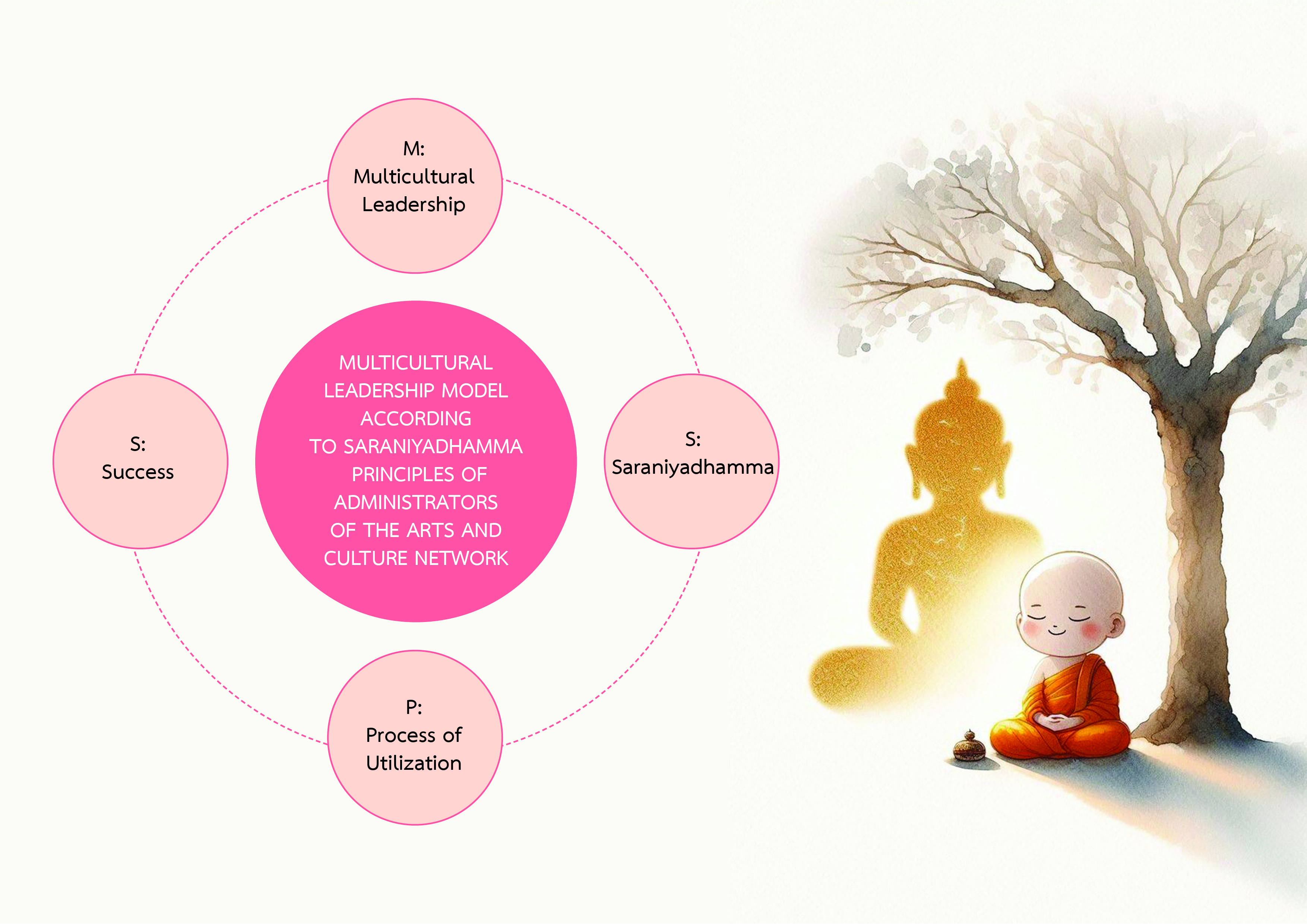
MULTICULTURAL LEADERSHIP MODEL ACCORDING TO SARANIYADHAMMA PRINCIPLES OF ADMINISTRATORS OF THE ARTS AND CULTURE NETWORK IN RAJABHAT UNIVERSITIES
Keywords:
Multicultural Leadership, Saraniyadhamma Principles, Administrators, Cultural Arts Network at Rajabhat UniversitiesAbstract
Background and Objectives: In managing diverse and complex organizations, as evident in the current situation, leaders integrated both science and art to adapt to evolving challenges. The application of Buddhist principles served as a key approach to leveraging social capital in management, aligning with the era of change. This research aimed to: 1) Study the past state of multicultural leadership of administrators in the cultural arts network at Rajabhat Universities; 2) Develop a model of multicultural leadership based on the Saraniyadhamma principles for administrators in the cultural arts network at Rajabhat Universities; 3) Test the model of multicultural leadership based on the Saraniyadhamma principles for administrators in the cultural arts network at Rajabhat Universities; and 4) Evaluate the model of multicultural leadership based on the Saraniyadhamma principles for administrators in the cultural arts network at Rajabhat Universities.
Methodology: This research was conducted as a research and development study incorporating quantitative and qualitative approaches. The quantitative study aimed to examine essential needs and was analyzed using basic statistical methods, including ranking the needs index. The qualitative study involved analyzing data from documents and fieldwork. The research tools included questionnaires, structured interviews, and focus group discussions. Data were collected through questionnaires and in-depth interviews. Statistical methods used for data analysis included percentages, mean, and standard deviation. Additionally, content analysis was performed, and the findings were presented in a descriptive format.
Main Results: The findings indicated that the overall level of multicultural leadership among administrators in the cultural arts network at Rajabhat University was moderate. The development of the model included key elements such as knowledge, understanding, awareness, organizational culture, and participation. The results from implementing the multicultural leadership model showed a content validity index for its components, the methods of applying the model in educational institutions, and the evaluation outcomes based on the Saraniyadhamma principles for administrators within the cultural arts network at Rajabhat University. The assessment of content validity, measured by the Content Validity Index (CVI), evaluated the model's components, implementation guidelines, and the effectiveness of the model's measurement and evaluation. Remarkably, the content validity index for the evaluation was 1.00, and the overall content validity index for the entire model was also 1.00.
Involvement to Buddhadhamma: This research was based on the concept of applied Buddhism. It used the principles of Saraniyadhamma as Buddhist innovation for modern organizational management, which was highly significant in fostering fair leadership and promoting coexistence in a diverse society. This was particularly relevant in the context of managing the cultural arts network at Rajabhat University. The Saraniyadhamma principles encouraged friendly actions in all aspects, including actions, speech, and thoughts, as well as sharing positive things and adhering to ethical practices.
Conclusions: This research aimed to develop a multicultural leadership model based on the principles of Saraniyadhamma for leaders in the cultural arts network at Rajabhat Universities, focusing on applying Buddhist teachings in managing diverse organizations. The findings revealed that leaders strongly desired to develop high-level multicultural leadership skills. The developed model was suitable and could be practically implemented. The principles of Saraniyadhamma promoted collaboration within organizations by emphasizing compassion, polite communication, and positive thinking, ultimately fostering good relationships.
References
Cronbach, L. J. (1990). Essentials of Psychological Testing. (5th ed.). New York, United States: Harper & Row.
Hanrintr, C. (2022). Current Conditions, Desirable Conditions, Needs for Developing Transformational Leadership. Journal of Graduate School Sakon Nakhon Rajabhat University, 19(85), 52-60.
Kanjanawasee, S. (2016). Empowerment Evaluation: Differential Perspectives. The Social Research Association of Thailand Journal, 3(1), 19-25.
Krejcie, R. V. & Morgan, D. W. (1970). Determining Sample Size for Research Activities. Educational and Psychological Measurement, 30(3), 607-610.
Likert, R. (1967). "The Method of Constructing and Attitude Scale," in Attitude Theory and Measurement. New York, United States: Wiley & Son.
National Education Act B.E. 2542. (1999).
Nieto, S. (2013). Affirming Diversity: The Sociopolitical Context of Multicultural Education. (6th ed.). Upper Saddle River, New Jersey, United States: Pearson.
Nilkote, R., Singsorn, N., Saisena, N., Sukpom, T. & Papan, N. (2024). Knowledge Management and Empowering Professional Learning Communities Based on Buddhist Principles: The Dimension of Suppurisa Dhamma. Journal of Innovation Research on Education and Technology (JIRET), 2(3), 1-11.
Northouse, P. G. (2016). Leadership: Theory and Practice. (7th ed.). Thousand Oaks, California, United States: Sage Publications.
Pakdee, C., PhraLrusamu Thanachot Ciradhammo (Khuenphet), Sanwangton, T., Somsri, M., Jiakulpa, P., Wanpee, N. & Sunamathaworn, B. (2020). Form for Applying the States of Conciliation in Partici-Padtory Management of Village, Monastry and School (Boworn) to Stirenghten Srisuphan Community, Muang District, Chiang Mai Province. Mahamakut Graduate School Journal, 18(1),42-53.
Panish, W. (2012). The Ways to Create Learning for Students in the 21st Century. Bangkok, Thailand: Sodsri-Saridwong Foundation.
Podhisita, C. (2016). The Art and Science of Qualitative Research. (7th ed.). Bangkok, Thailand: Amarin Printing and Publishing.
Rinthaisong, I. (2019). Factor Structure and Construct Validity of Measuring Multicultural Leadership in Thai Society Context. Journal of Education Thaksin University, 18(2), 83-102.
Singsorn, N., Sanguanwong, N., Saisena, N., Klomkul, L. & Nilkote, R. (2024). Buddhist Emotional Intelligence and Women's Leadership Empowerment. Journal of MCU Nakhondhat, 11(9), 44-55.
Sleeter, C. E. & Grant, C. A. (2011). Making Choices for Multicultural Education: Five Approaches to Race, Class, and Gender. (6th ed.). Hoboken, New Jersey, United States: Wiley.
Srisa-ard, B. (2011). Introduction to research. (9th ed.). Bangkok, Thailand: Suweeriya Sasan.
Sukpom, T., Papan, N., Saisena, N., Hajaturus, A., Hajaturus, S., Thianboocha, A., Nilkote, R. & Woraphatsorakul, W. (2023). Buddhist Principles and Strengthening the Learning Organization: Learning and Team Building Dimensions for Administrators. Graduate School Journal, Chandrakasem Rajabhat University, 18(2), 21-32.
Suwanno, P. S., Uttaro, P. U. & Wachiramethi, P. (2020). A Model for the Development of Core Competency of Teachers Based on Kalyanamitta Dhamma of Pariyattidhamma School, Pali Section, In the Sangha Administrative Region 4. Nakhon Lampang Buddhist College's Journal, 9(2), 14-25.
Thongsuksai, T., Sungtong, E., Haruthaithanasan, T. & Nitjarunkul, K. (2020). Multicultural Leadership of School Administrators in Multicultural Education Management for Early Childhood Education in Southern Thailand Border Provinces. Hatyai Academic Journal, 8(1), 117-139.
Tulmethakaan, M. (2021). A Study of Needs for Improvement of Teacher Leadership for The Bachelor of Educations Students at Srinakharinwirot University. Journal of Graduate Studies Valaya Alongkorn Rajabhat University, 15(1), 142-153.
Downloads
Published
How to Cite
Issue
Section
License
Copyright (c) 2025 Journal of Buddhist Anthropology

This work is licensed under a Creative Commons Attribution-NonCommercial-NoDerivatives 4.0 International License.