DEVELOPMENT OF YOUTH MEDIATOR BY BUDDHIST PEACE METHODS A CASE STUDY OF UNDERGRADUATE STUDENTS AT MAHACHULALONGKORNRAJAVIDYALAYA UNIVERSITY, NAKHON SI THAMMARAT CAMPUS
Keywords:
Development, Youth Mediator, Dispute, Buddhist Peace MethodAbstract
Background and Objective: Currently, Thai society faces many problems, such as economic problems, difficulties in community living, and issues related to violence among teenagers. Violence occurred in all dimensions of children and youth, whether they witnessed violence within the family, became victims of violence, or acted as the perpetrators of violence against people close to them. This extended from home to the community and even spreading to schools. In this regard, statistics from the Ministry of Social Development and Human Security on crimes committed by Thai children and teenagers who had been prosecuted nationwide revealed that the problem of violence among youth, especially among students, resulted in more than 10,000 cases per year. The aforementioned situation, demonstrated the rising levels of violence among youth. Therefore, the researcher became interested in and recognized the importance of studying the development of youth mediators using Buddhist peaceful methods. The case study focused on undergraduate students from Mahachulalongkornrajavidyalaya University, Nakhon Si Thammarat Campus. The goal was to establish a core group of youth mediators, trained in Buddhist peaceful methods, who would act as peace engineers, promoting peace among students. This research aimed to present the development of youth mediators using Buddhist peaceful methods by the undergraduate students of Mahachulalongkornrajavidyalaya University, Nakhon Si Thammarat Campus.
Methodology: This was qualitative research with the following three principles: 1) Respect for human dignity; 2) Respect for rights, freedoms, and the rules of a just society; and 3) Responsibility for oneself, others, and society. Data were analyzed from documents and field data. The research instrument was an unstructured interview, with in-depth interview data collected from key informants which divided into four groups: 1) Educational institution administrators (3 People); 2) Faculty members (6 People); 3) Academics/staff (4 People); and 4) Student representatives (12 People), totaling 25 participants.
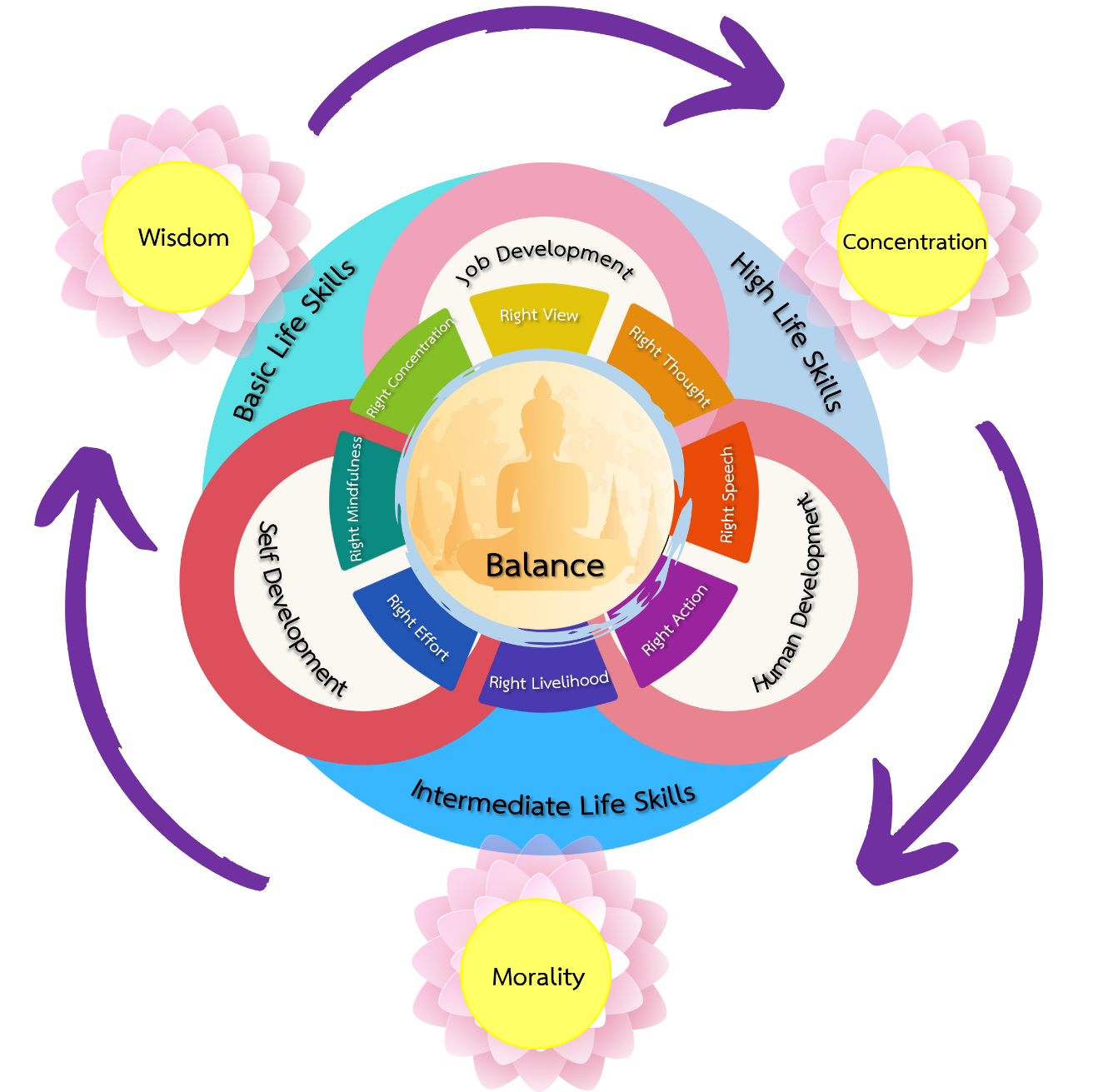
Main Results: The research revealed that the development of youth dispute mediation using Buddhist peaceful methods by undergraduate students of Mahachulalongkornrajavidyalaya University, Nakhon Si Thammarat Campus, integrated Buddhist peaceful methods with modern science through the principles of the Noble Eightfold Path, which can be analyzed in the form of a youth peaceful model that leads to the mediation process and the resolution of problems or potential conflicts in accordance with the process.
Involvement to Buddhadhamma: The development of youth mediation aligns with the principles of Buddhism, specifically the Noble Eightfold Path, which includes: Sammàdiññhi: Right View, Sammàsaïkappa: Right Thought, Sammàvàcà: Right Speech, Sammàkammanta: Right Action, Sammà-àjãva: Right Livelihood, Sammàvàyàma: Right Effort, Sammàsati: Right Mindfulness, and Sammàsamàdhi: Right Concentration.
Conclusions: The creation of youth mediators as models of youth mediation in society or "Peace Engineers" aimed to reduce problems and prevent conflicts in universities, communities and society based on the concept of "developing life at all 3 levels" to establish a balance of body, mind and thought with the goal of promoting a peaceful university life society.
References
Boonpunth, K. C. (2019). Public Participation in Building Sustainable Peace in Southern Thailand. King Prajadhipok's Institute Journal, 17(1), 100-117.
Mahachulalongkornrajavidyalaya University Nakhon Si Thammarat Campus. (2024). The 40th year of the founding of Mahachulalongkornrajavidyalaya University, Nakhon Si Thammarat Campus. Nakhon Si Thammarat, Thailand: Mahachulalongkornrajavidyalaya University Printing House.
Mokekhao, K., Wattanapradit, K. & Phra Pramote Vadakovido. (2024). Peace Innovation for Enhancing the Potential of Family Counselors in the Department of Wamen's Affairs and Family Development. Journal of MCU Peace Studies, 12(1), 284-296.
Office of Justice Affairs. (2022). Updating Thai Criminal Justice 2022. Bankkok, Thailand: Ministry of Justice.
Office of the Royal Society. (1982). Royal Institute Dictionary. Bankkok, Thailand: Office of the Royal Society.
Phramaha Hansa Dhammahaso. (2020). Buddhist Peaceful Means: Integrating Conflict Management Principles and Tools. Journal of MCU Peace Studies, 8(5), 2041-2054.
Phramaha Pipat Pavaddhano (Thadee). (2024). Social Development in Dimension Of The Noble Eightfold Path. Journal of Mahayana Voice, 10(3), 387-396.
Rajanakarin Child and Adolescent Mental Health Institute. (2013). Guidelines for the care and support of adolescents with violent behavior. Bangkok, Thailand: Department of Mental Health, Ministry of Public Health.
Saisorn, S. (2017). Lotus in the Sea of Fire: The Ways of Peace-makingin the View of Thich Nhat Hanh,a Vietnamese Zen Buddhist Monk. Humanities Journal, 24(1), 80-111.
Trainate, V. (2023). the noble eightfold path application for human capital competency enhancement in thailand industry 4.0. Journal of MCU Social Science Review, 12(1), 245-258.
Downloads
Published
How to Cite
Issue
Section
License
Copyright (c) 2025 Journal of Buddhist Anthropology

This work is licensed under a Creative Commons Attribution-NonCommercial-NoDerivatives 4.0 International License.