BUDDHIST WAY FOR PALLIATIVE CARE IN SURAT THANI PROVINCE
Keywords:
Buddhist Approach, End-of-Life Care, Palliative Care, Surat Thani ProvinceAbstract
Background and Objectives: The change in the structure of the Thai population that is moving towards the "aging population", which is a group with physical deterioration that comes with age, will cause more chronic illnesses to be found. End-of-life care is a care method that improves the quality of life of patients and families who face life-threatening illnesses by preventing and alleviating symptoms that cause suffering, including physical illnesses, mental, social, and spiritual problems. The objectives are to study patient care models, study Buddhist principles along with creating Buddhist activities for patient care, and propose a process and create a Buddhist network to promote patient care.
Methodology: This is a qualitative research using the action research process. The content is about the Buddhist way of caring for patients by applying the three characteristics of impermanence, suffering, and non-self. Buddhist activities in caring for patients include knowledge-providing activities and practical activities for patients by using the three characteristics of the three characteristics in creating activities and creating networks of the Buddhist way of caring for patients, including caregivers, neighbors, community leaders, temples, and public health agencies and networks related to public health. Key informants include professional nurses, nurse practitioners, and 30 caregivers. Participants are 30 patients who volunteered to join the project and their relatives who care for patients. Network creation includes 10 patients and their relatives who care for patients, totaling 70 people. Data were collected through in-depth interviews.
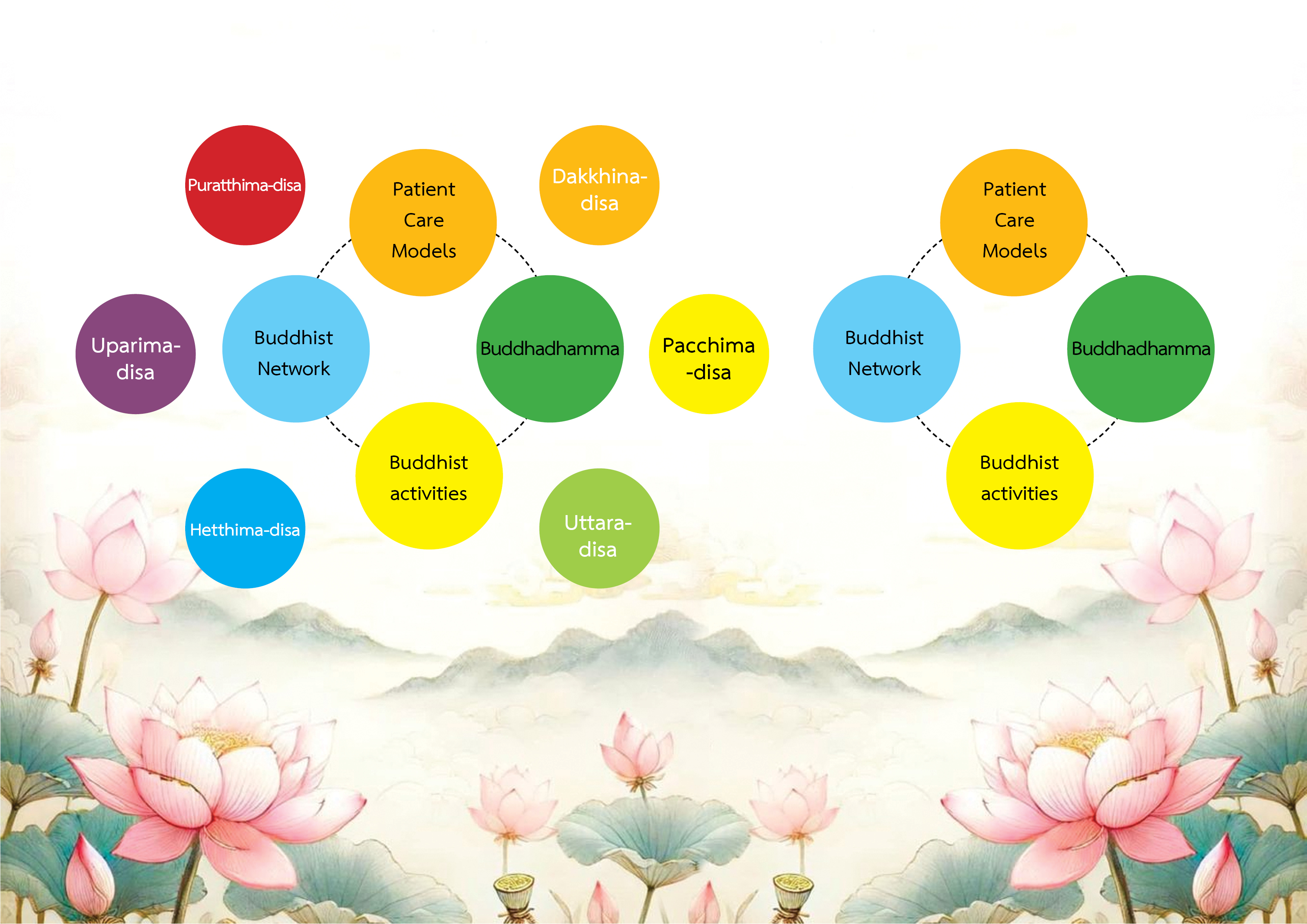
Main Results: It was found that 1) The patient care model includes care provided by religious organizations, home care/community care, hospital care, and semi-home care. 2) Buddhist principles include the Brahmaviharas, Sanghavatthu, Kalyanamitta, Abhinhapacchavekkha, Yonisomanasikara, Apamata Dhamma, and the development of Samatha and Vipassana for patient care, which are using morality to help with care, creating concentration, and creating wisdom through chanting loving-kindness, letting patients let go of various distresses, and discussing Dhamma with patients, and 3) The process and establishment of a Buddhist network to promote patient care includes referring/receiving patients in the network, organizing information systems for receiving-referring between the main network and the sub-network, supporting care and providing various services in the network, and supporting academic knowledge, exchanging knowledge in the network, and developing the quality or innovation of patient care in the network.
Involvement to Buddhadhamma: Buddhist way of caring for terminally ill patients in Surat Thani Province. Application of the principle of three characteristics: Impermanence, suffering and non-self in the physical and mental aspects of patients, and Buddhist activities, Brahmaviharas, Sanghavatthu, Kalyanamitta, Abhiññapaccavekhana, Yonisomanasikara, Apamatadhamma, developing Samatha and Vipassana, and the principle of Trisikkha.
Conclusions: The application of Buddhist principles in terminally ill patients aims to enable patients and their families to live together happily, have good relationships in the final moments, be physically and mentally comfortable, and have the best quality of life. It reduces suffering from life-sustaining, and enables patients to pass away peacefully, in accordance with religious beliefs, society, culture and the lifestyles of patients and their families.
References
Butimalai, P. (2018). Development of nursing practice guidelines to prevent complications for. Songklanagarind Journal of Nursing, 38(3), 79-91.
Charuchit, S., Ratree A. & Wansiri P. (2019). Home Visiting Model for Bedridden Patients According to Problems and Needs of Caregivers. Journal of Chanthaburi Rajabhat University College of Nursing, 30(1), 1-15.
Chunhabodee, A. (2013). Stress and needs of caregivers of stroke patients at home. Journal of Boromarajonani College of Nursing, 24(1), 1-9.
Ketkaew, B. (2017). Stress and needs of caregivers of bedridden disabled persons. Journal of the Southern Nursing College and Public Health Network, 4(1), 205-216.
Ketphet, T. (2024). Buddhist Way for Palliative Care in Surat thani Province. (Pharmaha Dilokrassme Thitajaro, Interviewer)
Kunthong, W. (2024). Buddhist Way for Palliative Care in Surat thani Province. (Pharmaha Dilokrassme Thitajaro, Interviewer)
Loi Mai, W. (2024). Buddhist Way for Palliative Care in Surat thani Province. (Pharmaha Dilokrassme Thitajaro, Interviewer)
Petchchu, C. (2024). Buddhist Way for Palliative Care in Surat thani Province. (Pharmaha Dilokrassme Thitajaro, Interviewer)
Phiwon, C. (2011). The Management of Holistic End of Life Care for The End Stage Cancer Patients: A Case Study Wat Kampramong, Sakonnakhon Province .[Unpublished master's Thesis dissertation]. Mahachula longkornrajavidyalaya University. Bangkok, Thailand.
Phra Sakdithat Saengthong. (2024). The Model and Process of Caring for Terminal Patients According to the Buddhist Principles of the People in Phrae Province. Dhammathat Academic Journal, 19(2), 176-188.
Phra Thep Suwannamethi. (2022). The form and process of healing the hearts of patients with Dhamma by the Volunteer Monks, Kilantham Group”. St. John's Journal, 19(2), 265-280.
Poolpeam, R. (2024). Buddhist Way for Palliative Care in Surat thani Province. (Pharmaha Dilokrassme Thitajaro, Interviewer)
Sikasai, N. (2024). Buddhist Way for Palliative Care in Surat thani Province. (Pharmaha Dilokrassme Thitajaro, Interviewer)
Tantitrakul, W. (2019). Factors related to spiritual well-being of terminal cancer patients. Nursing Journal of The Ministry of Public Health, 27(2), 198-213.
Wanarak, C. (2021). Development of a health care model for bedridden elderly people at home with the participation of the Ethics Club of Tung Maphrao Subdistrict Health Promotion Hospital, Thai Mueang District, Phang Nga Province. Public Health Academic Journal, 30(2), 285-294.
Wimon, K. (2024). Buddhist Way for Palliative Care in Surat thani Province. (Pharmaha Dilokrassme Thitajaro, Interviewer)
World Health Organization, (2020). Infection prevention and control of epidemic- and pandemic-prone acute respiratory diseases in health care. Social science Medical, 41(10):1403-9.
Downloads
Published
How to Cite
Issue
Section
License
Copyright (c) 2025 Journal of Buddhist Anthropology

This work is licensed under a Creative Commons Attribution-NonCommercial-NoDerivatives 4.0 International License.