STRENGTHENING THE BALANCED LIFESTYLE OF THE ELDERLY WITH THE PRINCIPLE OF ĀYUSASA DHAMMA
Keywords:
Strengthening, Lifestyle, Balance, Elderly, Āyusasa DhammaAbstract
Background and Objectives: Strengthening a balanced lifestyle for the elderly through the application of the Āyusasa Dhamma (Principles of Longevity) is essential to enhancing their quality of life and overall well-being. This research article aimed to study the concept of a balanced life for the elderly, examine the principles of Āyusasa Dhamma in promoting such balance, and explore how to enhance a balanced lifestyle among elderly individuals through these principles.
Methodology: This study employed a qualitative research approach, which consisted of document analysis and in-depth interviews with 16 participants, including Buddhist scholars, community leaders, public health officers, and elderly representatives from the Khlong Noi Subdistrict community. The participants were selected through purposive sampling. The research instrument was a structured in-depth interview guide, and the data were analyzed using qualitative methods by creating categories and themes.
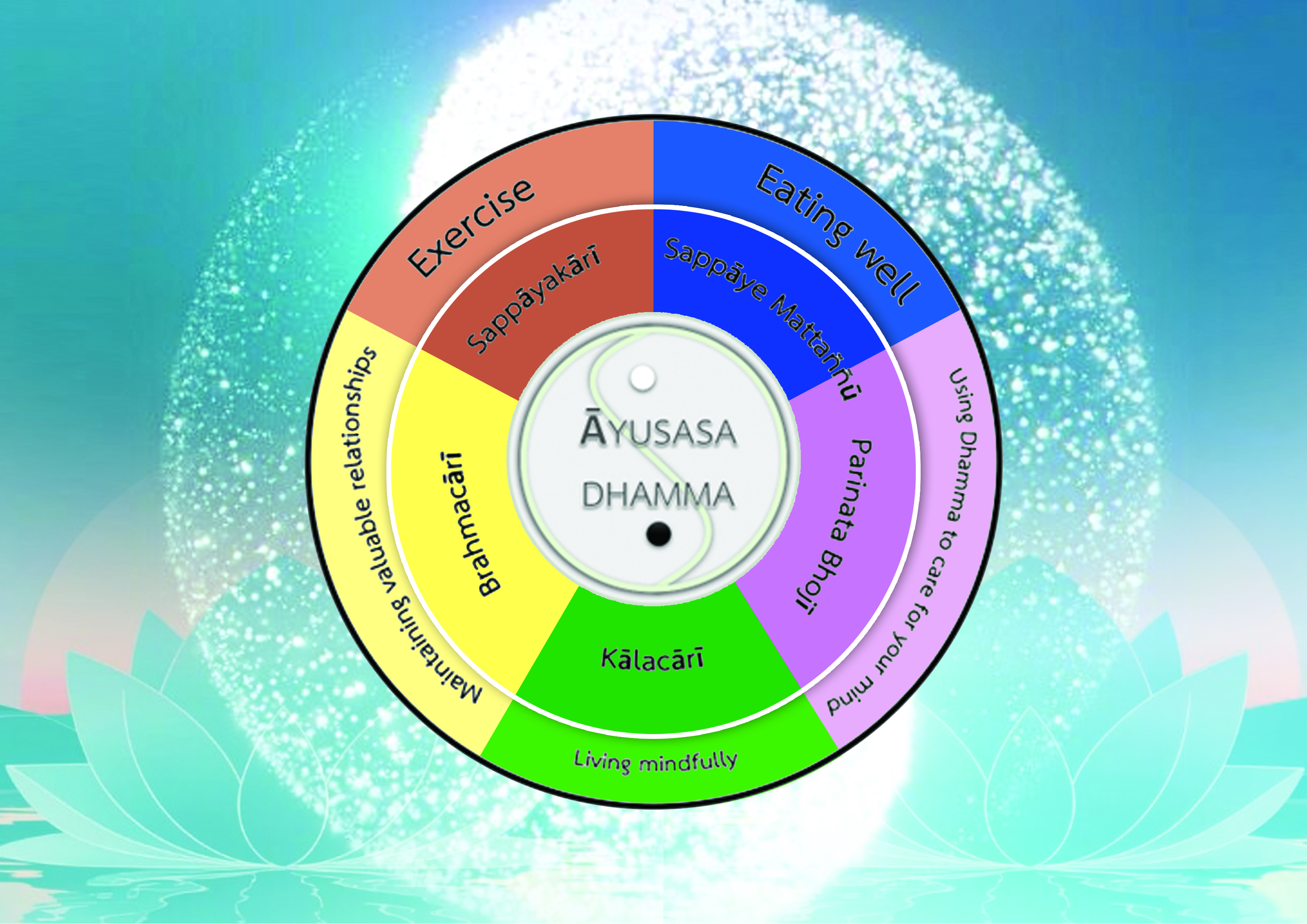
Main Results: The study revealed the following: 1) A balanced life is a crucial approach in enhancing quality of life, focusing on helping individuals live in harmony across physical, mental, social, and spiritual dimensions. This process involved adapting and developing living strategies in response to life's changes and challenges, especially during old age; 2) The Āyusasa Dhamma principles for enhancing a balanced lifestyle consists of five elements: Sappāyakārī (Engaging in Actions Conducive to Good Health), Sappāye Mattaññū (Knowing Moderation in What is Beneficial), Parinata Bhojī (Consuming Easily Digestible Food), Kālacārī (Acting Appropriately According to Time), and Brahmacārī (Observing Celibacy or Leading a Virtuous Life). These principles played an essential role in guiding the elderly toward balance in all aspects of life-physical, mental, and social, and 3) Strengthening a balanced lifestyle for the elderly through the Āyusasa Dhamma covered the following areas: Physical health: This included encouraging exercise, healthy eating, and behavior modification. Mental well-being: Buddhist teachings were used to foster peace of mind, letting go, and living mindfully. Social dimension: This emphasized maintaining positive interactions, engaging in suitable activities, and preserving meaningful relationships. These three areas complemented one another in contributing to a good quality of life in old age.
Involvement to Buddhadhamma: Strengthening a balanced lifestyle for the elderly through the principles of Āyusasa Dhamma was a process of developing wisdom and morality based on Buddhist teachings. It consisted of Sappāyakārī (Engaging in Actions Conducive to Health), Sappāye Mattaññū (Knowing Moderation in What is Beneficial), Parinata Bhojī (Consuming Easily Digestible Food), Kālacārī (Acting Appropriately According to Time), and Brahmacārī (Practicing Celibacy). These principles, derived from Tipiṭaka Volume 22, served as a key guideline for improving the quality of life of the elderly by using Buddhist teachings to integrate physical, mental, and social aspects. The Āyusasa Dhamma not only provided a sustainable way of living but also encouraged the elderly to live with dignity, happiness, and balance each day.
Conclusions: Promoting a balanced lifestyle for the elderly based on the five principles
of Āyusasa Dhamma is a key strategy in supporting physical, mental, and social well-being.
This focuses on proper nutrition, regular exercise, adequate rest, mindfulness and meditation for mental peace, and the ability to adapt to new social roles with understanding and happiness during retirement.
References
Gillsjö, C., Nyström, M., Palmér, L., Carlsson, G., Dalheim Englund, A. C. & Eriksson, I. (2021). Balance in life as a prerequisite for community dwelling older adults' sense of health and well being after retirement: An interview based study. International Journal of QualitativeStudies on Health and Well being, 16(1), 1984376. https://doi.org/10.1080/17482631.2021.1984376
Kantawong, T. (2020). Application of Ayussadhamma in Creating Health of The Elderly, Nong Hoi Sub-District, Muang District, Chiang Mai Province. Panya, 27(1), 1-12.
Kuptawatin, W., Wasanapong, M., Khun-dee, P. & Mitsamwang, R. (2018). Aging society and the modern world. Journal of Suvarnabhumi Institute of Technology, 4(Special), 444-450.
Lawshe, C. H. (1975). A Quantitative Approach to Content Validity. Personnel Psychology, 28(4), 563-575. https://doi.org/10.1111/j.1744-6570.1975.tb01393.x.
National Statistical Office. (2022). The 2021 Survey of The Older Persons in Thailand. Bangkok, Thailand: National Statistical Office.
Office of the National Economic and Social Development Council. (2020). The 20-Year National Strategy (2018-2037). (2nd ed.). Bangkok, Thailand: Secretariat of the National Strategy Committee, Office of the National Economic and Social Development Council.
Phra Soveuy Khunaratano (Noy), Phrakru Kosolattakit, Phrakru Khositwattnanukul, Panasree, S. & Anothai, S. (2022). An Application of Bhàvanà 4 for Developing Life Quality of Pakasai Sub-District Community, Nuea Khlong District, Krabi Province. Journal Of MCU Ubon Review, 7(1), 235-242.
Phrakhru Siriphurinithat (Phurinat Dissawan). (2019). Way of living of the elderly according to Buddhist principles. The Journal of Research and Academics, 2(2), 107-120.
Phrakru Chantopas (Chakro), Sinthunok, B. & Namket, S. (2021). An Appication of The Ayussa-Dhamma in The Life Style of Aged Persons in The Area of Kudjap District, Udorn Thani Province. Journal of MCU Nakhondhat, 8(4), 59-74.
Phramaha Niphon Mahadhammarakkhito, Saengsai, P., Phrakhru Siripannaphon & Wichuma, N. (2018). Integration of Ayussadhamma Doctrine and life style of the elderly. Journal of Graduate MCU KhonKaen Campus, 5(1), 57-70.
Phramaha Wichit Aggajito, Khammuangsaen, B. & Suvaco, P. P. (2022). The Ayussa-Dhamma for Promoting Healthy Life. SAU Journal of Social Sciences & Humanities, 5(2), 277-289.
Saramart, O., Pitchayapaiboon, P. & Boonyananta, S. (2019). Art-based Using to Develop Well-being of Older Adults: The Systematic Review. Journal of Graduate Studies in Northern Rajabhat Universities, 9(2), 17-32.
Sutthisanmethi, P., Wetprasit, S. & Thepa, P. C. A. (2022). The promotion of well-being for the elderly based on the 5 Ᾱyussadhamma in the Dusit District, Bangkok, Thailand: A case study of Wat Sawaswareesimaram Community. International Journal of Health Sciences, 6(3), 1391-1408. https://doi.org/10.53730/ijhs.v6n3.12766.
Downloads
Published
How to Cite
Issue
Section
License
Copyright (c) 2025 Journal of Buddhist Anthropology

This work is licensed under a Creative Commons Attribution-NonCommercial-NoDerivatives 4.0 International License.