INNOVATION IN THE DEVELOPMENT OF A DIGITAL ERA EDUCATION ASSESSMENT PLATFORM BASED ON BUDDHIST PRINCIPLES AT MAHACHULALONGKORNRAJAVIDYALAYA UNIVERSITY
Keywords:
Educational Innovation, Educational Assessment, Digital Platform, Buddhist Principles, Four Noble TruthsAbstract
Background and Objectives: In the digital era, Information and Communication Technology (ICT) plays a crucial role in all aspects of educational management, particularly in higher education. Universities must adapt to support modern and effective teaching, learning, and assessment systems. Mahachulalongkornrajavidyalaya University recognizes the importance of integrating Information and Communication Technology ICT with Buddhist principles to preserve the institution's identity and values while sustainably enhancing educational quality. This study aims to investigate the current state of the university's digital assessment platform, develop a Buddhist principles-based assessment platform, pilot the developed platform, and evaluate its effectiveness and user satisfaction. To make the evaluation of education inside the university flexible and modern, and to promote ethics simultaneously.
Methodology: This research employed a Research and Development (R&D) approach, comprising four main phases: 1) Investigating and analyzing the current digital assessment system through interviews and content analysis; 2) Designing and developing a prototype platform using the Four Noble Truths (Ariyasacca 4) of Buddhism as the conceptual framework; 3) Piloting the platform with 215 stakeholders including administrators, faculty members, experts, staff, and students;
and 4) Evaluating the platform's performance and user satisfaction using interviews, efficiency assessments, and both quantitative and qualitative surveys.
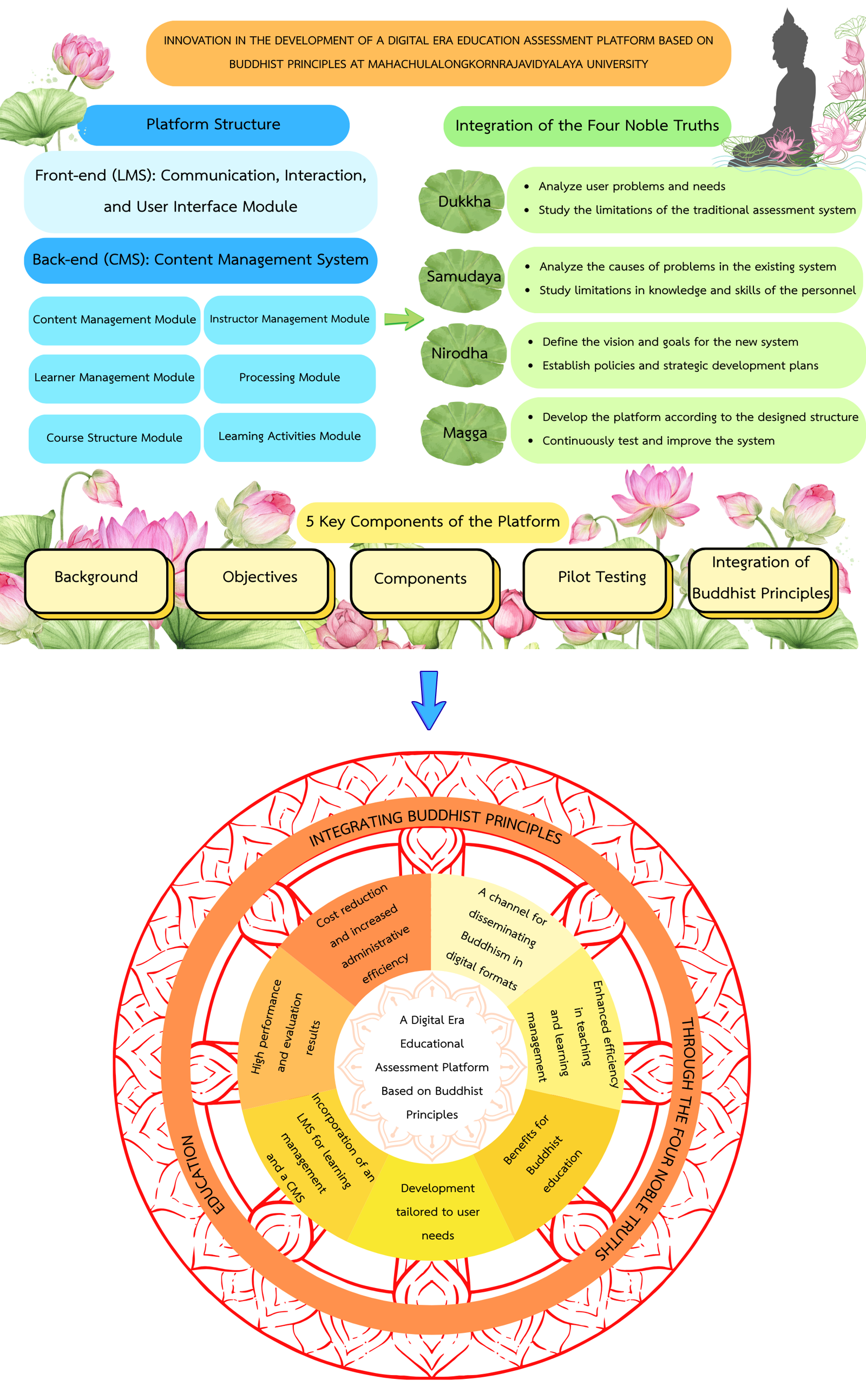
Main Results: The developed platform consists of six core modules: Content management, instructor management, learner management, course processing, course structure, and learning activities.
This platform effectively integrates a Learning Management System (LMS) for students and a Content Management System (CMS) for instructors. Evaluation results demonstrated a very high overall system efficiency ( = 4.55, S.D. = 0.50), particularly in functionality (
= 4.58, S.D. = 0.49)
and ease of use ( = 4.55, S.D. = 0.50). User satisfaction was also very high (
= 4.51, S.D. = 0.63), especially regarding the platform's flexibility in course structuring and its alignment with learning activities.
Involvement to Buddhadhamma: A key feature of this study is the application of the Four Noble Truths (Ariyasacca 4): Suffering (Dukkha), Origin of Suffering (Samudaya), Cessation of Suffering (Nirodha), and Path to the Cessation of Suffering (Magga) as the guiding framework throughout platform development. Starting from identifying problems in the existing assessment system (Dukkha), analyzing causes (Samudaya), setting goals for development addressing both technological and ethical aspects (Nirodha), and defining the development path to promote a balance between wisdom and morality (Magga), the platform successfully integrates digital technology with Buddhist ethical principles.
This synthesis not only meets technical requirements but also effectively fosters learner's moral and intellectual growth, aligning well with the context of a Buddhist university in the 21st century.
Conclusions: This research successfully developed a digital assessment platform that harmonizes advanced technology with Buddhist teachings. The platform demonstrates high effectiveness and user satisfaction. It is suitable for modern Buddhist universities, helping improve the quality of teaching and assessment that is flexible, modern, and ethical. Furthermore, this study provides a valuable reference for other educational institutions seeking to incorporate technology and spiritual values within their assessment systems.
References
Boeskens, L. (2025). International practices in digital education assessment. Paris, France: OECD Publishing.
Broadbent, J. & Poon, W. L. (2015). Self-regulated learning strategies and student engagement in online learning environments. Internet and Higher Education, 27, 1-13. http://dx.doi.org/10.1016/j.iheduc.2015.04.007.
Chaiyadet, M., Piriyasurawong, P. & Wannapiroon, P. (2024). Ubiquitous Buddhism learning ecosystem model. International Education Studies, 17(6), 105-120.
European Commission. (2020). Digital Education Action Plan (2021-2027): Resetting education and training for the digital age. COM (2020) 624 final. Brussels, Belgium: European Commission.
Gallego-Arrufat, M. J. (2024). Equity challenges in digital learning environments. International Review of Education, 70(1), 105-119.
Grosseck, G., Bran, R. A. & Țîru, L. G. (2024). Digital assessment: A survey of Romanian higher education teachers’ practices and needs. Education Sciences, 14(1), 32. https://doi.org/10.3390/educsci14010032.
Heil, J. & Ifenthaler, D. (2023). Online Assessment In Higher Education: A Systematic Review. Online Learning, 27(1), 187-218. https://doi.org/10.24059/olj.v27i1.3398.
Huang, R., Tlili, A., Chang, T.-W., Zhang, X., Nascimbeni, F. & Burgos, D. (2020). Disrupted classes, undisrupted learning during COVID-19 outbreak in China: application of open educational practices and resources. Smart Learning Environments, 7(1), 19. https://doi.org/10.1186/s40561-020-00125-8.
Hulus, A. (2024). E-Ethical-Learning: Principles and guidelines for ethical digital learning in higher education. ACM Journals, 2024(9). https://doi.org/10.1145/3698381.3686809.
Karunamuni, N. & Weerasekera, R. (2019). Theoretical Foundations to Guide Mindfulness Meditation:
A Path to Wisdom. Current Psychology, 38, 627-646. https://doi.org/10.1007/s12144-017-9631-7.
Khalil, M. & Ebner, M. (2016). De-identification in Learning Analytics. Journal of Learning Analytics, 3(1), 129-138. http://dx.doi.org/10.18608/jla.2016.31.8.
Kitaboo. (2023). Ensuring data privacy in digital assessment: Trends and tools. Karnataka, India: Kitaboo Whitepaper Series.
Meng, H. & Ma, Y. (2023). Machine Learning-Based Profiling in Test Cheating Detection. Educational Measurement: Issues and Practice, 42(1), 59-75.
Noguera, I., Guerrero-Roldán, A. E., Rodríguez, M. E. & Baneres, D. (2019). Students' and Instructors' Perspectives regarding E-Assessment: A Case Study in Introductory Digital Systems. International Journal of Engineering Education, 35(2), 473-490.
OECD. (2023). OECD Digital Education Outlook 2023: Towards an Effective Digital Education Ecosystem. Paris, France. OECD Publishing. https://doi.org/10.1787/c74f03de-en.
Paṇḍavaṃsa. (2022). Digital transformation in Buddhist monastic education: Case study of Sitagu Buddhist Academy. Myanmar Journal of Buddhist Education, 3(1), 45-60.
Rampelt, F. & Budde, J. (2022). Summary. In M. Bandtel et al. (Eds.), Digital Assessment in Higher Education: Perspectives of a European Community of Practice (pp. 7-9). Whitepaper No. 65. Berlin, Germany: Hochschulforum Digitalisierung.
Redecker, C. (2017). European framework for the digital competence of educators: Dig Comp Edu. Luxembourg: Publications Office of the European Union. https://doi.org/10.2760/159770.
Scully, D., Lehane, P. & Scully, C. (2011). “It is no longer scary”: digital learning before and during the Covid19 pandemic in Irish secondary schools. Technology, Pedagogy and Education, 30(1), 159-181. https://doi.org/10.1080/1475939X.2020.1854844.
Tsai, C.-C., Lee, M.-H. & Chai, C. S. (2022). Reimagining assessment in the post-pandemic era: A shift from summative to formative practices. Journal of Educational Technology & Society, 25(3), 51-63.
Downloads
Published
How to Cite
Issue
Section
License
Copyright (c) 2025 Journal of Buddhist Anthropology

This work is licensed under a Creative Commons Attribution-NonCommercial-NoDerivatives 4.0 International License.