THAI ADOLESCENTS' PERCEPTIONS OF THE IMPORTANCE OF BUDDHISM FOR A GOOD LIFE
Keywords:
Good Life, Buddhist Ethics, Individualism, Utilitarianism, SecularismAbstract
Background and Objectives: Historically, Buddhism has served as a major ethical framework in Thai society, providing moral orientation and a source of existential meaning through the observance of precepts and the cultivation of mindfulness. In the context of rapid digitalization and intensified economic competition over the past decade, however, the role of religion in the everyday lives of Thai adolescents appears to have diminished. Regular participation in religious activities and sustained engagement with Buddhist teachings have become less consistent, while material achievement and social recognition, particularly within social media environments, are increasingly used as benchmarks for self-worth. This shift may be linked to growing concerns regarding psychological distress, identity uncertainty, and the erosion of stable meaning structures among youth. It thus raises a critical question: To what extent does the contemporary conception of the "Good Life" among Thai adolescents remain grounded in religiously informed moral frameworks?
Methodology: This study employed a qualitative research methodology. The informants were undergraduate students at Chiang Mai University during the 2024 academic year. Participants were selected using purposive sampling and snowball sampling techniques and were divided into two groups: 1) Thai youths who identified as Buddhists and actively participated in activities of a Buddhist Arts Club (n = 10), and 2) Thai youths who identified as non-religious but had previously been Buddhists and had declared themselves non-religious for at least one year (n = 10). A total of 20 participants were included, or until data saturation was reached. The research instruments consisted of a demographic questionnaire, semi-structured in-depth interviews, and non-participant observation. Interview data were audio-recorded and transcribed verbatim. The researcher then repeatedly reviewed the transcripts to gain familiarity with the data and conducted initial coding to identify key issues emerging from the data. Related codes were subsequently grouped and synthesized into themes and sub-themes using thematic analysis. The findings were then presented through thematic analytical description, supported by direct quotations from participants to illustrate and substantiate the interpretations.
Main Results: The findings indicate that both Buddhist and non-religious Thai youths share the view that certain Buddhist teachings can be practically applied to promote a good life. In particular, these teachings are perceived as useful tools for understanding life problems, regulating emotions, and making rational decisions. Although non-religious youths do not consider a good life to be necessarily grounded in religion, they still selectively adopt certain Buddhist principles, such as the Four Noble Truths, the Three Characteristics of Existence, the law of karma, and mindfulness and meditation practices, as practical guidelines for managing their daily lives.
Involvement to Buddhadhamma: From a Buddhist ethical perspective, the findings reflect that Thai youths' conceptions of the good life are consistent with three progressive levels of Buddhist ethics: The Five Precepts (Pañca-sīla), the Ten Wholesome Courses of Action (Kusala-kammapatha), and the Noble Eightfold Path (Ariya-aṭṭhaṅgika-magga). However, a key difference between the two groups lies in their motivational foundations and sources of justification. Buddhist youths tend to be influenced by institutional factors such as family, religion, and education, whereas non-religious youths place greater emphasis on individual reasoning, utilitarian considerations, and direct personal experience.
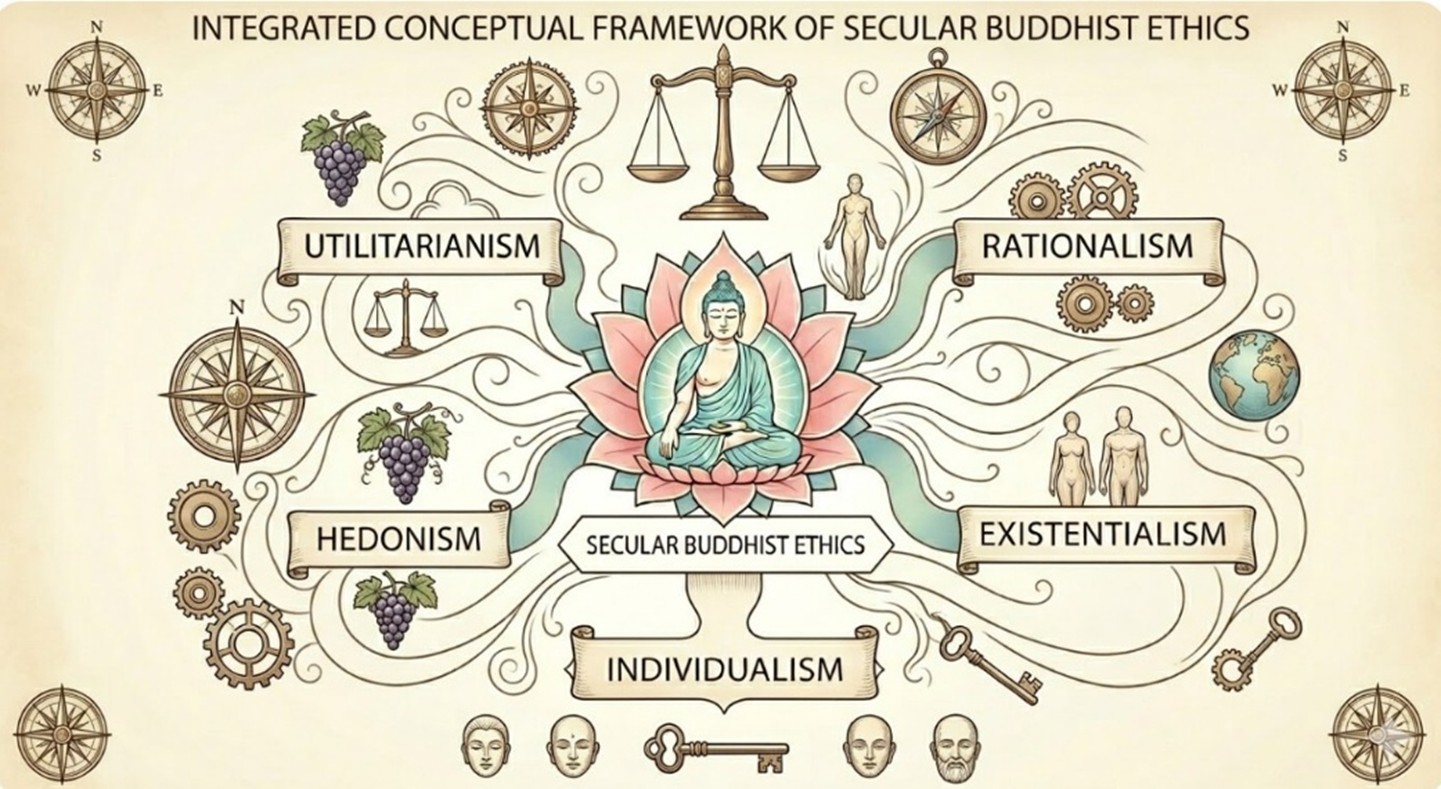
Conclusion: The findings of this study reveal an ongoing process of transforming Buddhism into what may be termed "Secular Buddhist Ethics." Rather than rejecting religion, this transformation reconfigures Buddhism into a rationally grounded ethical framework anchored in individual experience, critical reflection, and personal responsibility.
References
Anamwathana, P. (2025). Examining Religious Engagement Among Thai Buddhist Undergraduates. ISEAS Perspective, 42(1), 2335-6677.
Chotima, M. & Blauw, J. (2016). The Influence of Materialism on Well-Being among Thai Adolescents. Scholar: Human Sciences, 8(1), 141-158.
Chueatapra, S. (2020). The application of Buddhism in enhancing quality of life in Khampi Subdistrict, Nakae District, Nakhon Phanom Province. [Master's dissertation, Mahasarakham Rajabhat University]. Thesis Central Library Mahasarakham Rajabhat University. https://fulltext.rmu.ac.th/fulltext/2563/M128551/Chuatapra%20Sirichai.pdf.
Laksanawat, P. (2020). The application of Buddhist Teaching for Self-Development: A . Ramkhamhaeng Research Journal of Humanities and Social Sciences, 23(2), 33-44.
Mittsatsirikul, S. (2022). An application of Buddhist principles in encourage for well-being of the elderly in nan province in the situation of the Covid-19 epidemic.[Master's dissertation, Mahachulalongkornrajavidyalaya University]. Thesis Central Library Mahachulalongkornrajavidy. https://e-thesis.mcu.ac.th/items/4693.
Nithiuthai, S. (2011). The Development of the Youths according to the Buddhist way in Thai societies.[Master's dissertation, Mahachulalongkornrajavidyalaya University]. Thesis Central Library MahachulalongkornrajavidyalayaUniversity. http://kb.mcu.ac.th/userfiles/file/library1/Thesis/832554.pdf.
Phra Pittaya Sawekpan. (2005). Buddhist Beliefs and good life in Thai society: A case study of Buddhists in Bangkok. [Master's dissertation, Mahidol University].Thesis Central Library MahidolUniversity. https://digital.library.tu.ac.th/tu_dc/frontend/Info/item/dc:84994#.
Phra Suphakit Supanyo. (2021). The Application for Mindfulness Clear Comprehension In Living Daily Life. Journal of Political Science Suan Sunandha Rajabhat University, 4(2), 99-107.
Phra Thammapitaka (P.A. Payutto). (1999). Dhamma and Thai in the present situation (2nd ed.). Bangkok, Thailand: Kurusapa Printing House, Lat Phrao.
Phrakhru Palad Nabhichaya Ñāṇavīro (Lapimthong). (2021). An analytical study of irreligious people’s reasons. [Master's dissertation, Mahachulalongkornrajavidyalaya University]. Thesis Central Library Mahachulalongkornrajavidyalaya University. https://e-thesis.mcu.ac.th/items/2547.
R1. (2025). Thai Adolescent’s Perceptions of The Importance of Buddhism for A Good Life. (Sukham, S., Interviewer)
R10. (2025). Thai Adolescent’s Perceptions of The Importance of Buddhism for A Good Life. (Sukham, S., Interviewer)
R11. (2025). Thai Adolescent’s Perceptions of The Importance of Buddhism for A Good Life. (Sukham, S., Interviewer)
R12. (2025). Thai Adolescent’s Perceptions of The Importance of Buddhism for A Good Life. (Sukham, S., Interviewer)
R15. (2025). Thai Adolescent’s Perceptions of The Importance of Buddhism for A Good Life. (Sukham, S., Interviewer)
R17. (2025). Thai Adolescent’s Perceptions of The Importance of Buddhism for A Good Life. (Sukham S., Interviewer)
R2. (2025). Thai Adolescent’s Perceptions of The Importance of Buddhism for A Good Life. (Sukham, S., Interviewer)
R3. (2025). Thai Adolescent’s Perceptions of The Importance of Buddhism for A Good Life. (Sukham, S., Interviewer)
R9. (2025). Thai Adolescent’s Perceptions of The Importance of Buddhism for A Good Life. (Sukham, S., Interviewer)
Satchayanon, K. (2024). The role of non-religious individuals in modern society in shaping their professional aspirations. [Master's dissertation, Mahidol University]. Thesis Central Library Mahidol University. https://archive.cm.mahidol.ac.th/handle/123456789/5774.
Satyawongthip, P. (2015). Buddhadasa Bhikku's Viewpoints on Dealing with Teenagers. Journal of Humanities and Social Sciences, 23(43), 85-104.
Supanusont, S. (2003). The good life from the perspective of Buddhist ethics. [Master's dissertation, Mahidol University]. Thesis Central Library Mahidol University. https://mulinet11.li.mahidol.ac.th/e-thesis/4137753.pdf.
Verhaeghen, P. (2015). Good and Well: The Case for Secular Buddhist Ethics. Contemporary Buddhism, 16(1), 43-54. https://doi.org/10.1080/14639947.2015.1006802.
Downloads
Published
How to Cite
Issue
Section
License
Copyright (c) 2026 Journal of Buddhist Anthropology

This work is licensed under a Creative Commons Attribution-NonCommercial-NoDerivatives 4.0 International License.