A STUDY OF THE BUDDHIST PROPAGATION MODEL THROUGH SOCIAL MEDIA AT MAHACHULALONGKORNRAJAVIDYALAYA UNIVERSITY
Keywords:
Format, Propagation of Buddhism, Social MediaAbstract
Background and Objectives: In the past, the dissemination of Buddhism focused on sermons and traditional teachings. However, in the present, social media has become an important tool that enables Buddhist principles to be communicated to the younger generation easily and quickly. Therefore, Mahachulalongkornrajavidyalaya University has applied these media to effectively expand opportunities for the younger generation to access the Dharma. This research article aims to: Examine the model of Buddhist propagation through social media implemented by Mahachulalongkornrajavidyalaya University, analyze the factors influencing the Mahachulalongkornrajavidyalaya University's use of social media in Buddhist propagation, and propose guidelines for enhancing Buddhist propagation through social media at Mahachulalongkornrajavidyalaya University.
Methodology: This research employed a qualitative field research methodology utilizing in-depth interviews with twenty key informants selected via purposive sampling. The participants consisted of two senior administrators, five experts in Buddhist propagation, five experts in digital media usage, and eight faculty members, staff, and students.
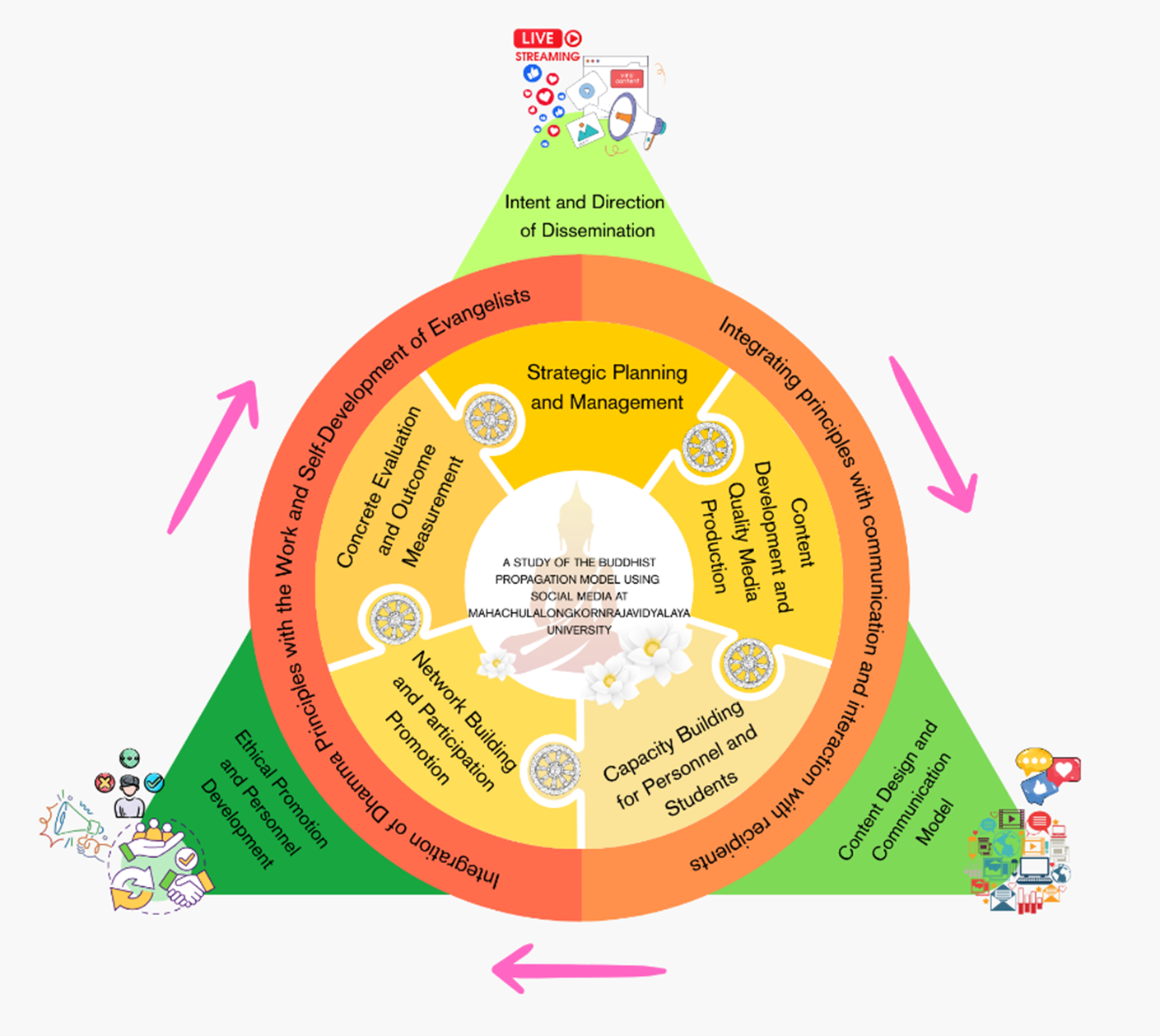
Main Results: The study found that Mahachulalongkornrajavidyalaya University has consistently promoted Buddhism through social media by adapting content formats to be diverse, easily accessible, and relevant to the contemporary era, while effectively integrating Dhamma principles into real-life contexts. Furthermore, the University encourages participation among its personnel, students, and the general public in the creation and dissemination of content. Consequently, this approach can serve as an applicable model for other Buddhist organizations. This success was attributed to five key factors: 1) Policy support and management; 2) Personnel readiness; 3) Technological infrastructure; 4) Understanding the audience and content adaptation; and 5) Building strong networks. Furthermore, the research proposes guidelines for the systematic integration of Buddhist principles at every stage of work, starting with the application of the principles of Iddhipāda 4, Brahmavihāra 4, and Sappurisadhamma 7 for planning, management, and evaluation. This extends to utilizing Saṅgahavatthu 4 for developing quality content and media production, and finally, employing Tisikkhā and Satipaṭṭhāna 4 to develop the potential of personnel and students, as well as to build participatory networks for practical propagation.
Involvement to Buddhadhamma: This research applies the following doctrinal principles: The Four Paths of Accomplishment (Iddhipāda 4), the Four Divine Abodes (Brahmavihāra 4),
the Seven Qualities of a Good Person (Sappurisadhamma 7), the Four Bases of Social Harmony (Saṅgahavatthu 4), the Threefold Training (Tisikkhā), and the Four Foundations of Mindfulness (Satipaṭṭhāna 4). This study aligns with the objectives of the journal, specifically Group 2: Applied Buddhism, by demonstrating the integration of Buddhist principles with modern information technology.
Conclusions: This research demonstrates that the Mahachulalongkornrajavidyalaya University has implemented a systematic and practical approach to propagating Buddhism via social media. This involves a transition from traditional formats to accessible communication styles that align with the behaviors of the audience in the digital age. These operations are driven by five key factors: 1) Policy support and management; 2) Personnel readiness; 3) Technological infrastructure; 4) Audience understanding and content adaptation; and 5) Strong network building. Furthermore, the integration of Dhamma principles into the propagation process serves as a crucial mechanism that ensures the effectiveness and sustainability of these efforts, ultimately serving as a model for other Buddhist organizations.
References
Chatvisut, M. (2019). Online Social Media and Propagation of Buddhism. Journal of Buddhist Studies, 10(2), 521-531.
Damjub, W. (2019). Social Media for Teaching and Learning in the 21st Century. Journal of Liberal Arts, Maejo University, 7(2), 143-159.
Marija, D. C. & Dragovic, A. (2020). The Social Media and Religion - New Challenges. New York, United States of America: Routledge. https://doi.org/10.47054/RDC201043dch
Mahachulalongkornrajavidyalaya University. (2017). History of Buddhism. Bangkok, Thailand: Mahachulalongkornrajavidyalaya University.
Phra Phromkunaphon (P.A. Payutto). (2010). Buddhism. Bangkok, Thailand: Mahachulalong kornrajavidyalaya University.
Phra Thammapitok (P.A. Payutto). (2000). Dictionary of Buddhism, Compiled Edition. Bangkok, Thailand: Mahachulalongkornrajavidyalaya University Press.
Phrakhrutheerasatpaisal & Phrabaidika Saengtham Supano. (2025). GUIDELINES FOR THE PROPAGATION OF BUDDHISM IN THE DIGITAL AGE. MCU Ubonratchathani Journal of Buddhist Studies, 7(1), 2223-2236.
Phrakhruwinaithon Panya Payawro (Srisamut) & Sapphet, B. (2021). THE MANAGEMENT ON BUDDHISM DISSEMINATION IN DIGITAL ERA. Journal of Social Science and Buddhistic Anthropology, 6(4), 423-433.
Boonti, M. (2012). Marketing Strategy Analysis for Vintage Fashion Business Through On-line Social Media. [Unpublished Master's thesis]. Chiang Mai University. Chiang Mai, Thailand.
Watana, S. & Liu, Y. (2021). Thai Buddhism and Online Social Media. Journal of MCU Social Development, 6(2), 10-22.
Downloads
Published
How to Cite
Issue
Section
License
Copyright (c) 2025 Journal of Buddhist Anthropology

This work is licensed under a Creative Commons Attribution-NonCommercial-NoDerivatives 4.0 International License.