APPLYING BUDDHIST PRINCIPLES TO CROSS-CULTURAL MANAGEMENT: A CASE STUDY OF RESTAURANT ENTREPRENEURS IN SONGKHLA PROVINCE
Keywords:
Buddhist Principles, Cross-cultural Management, Restaurant Entrepreneurs, SongkhlaAbstract
Background and Objectives: Cross-cultural management is a crucial issue in the service industry, which interacts with customers and employees from diverse cultures. However, most studies focus on Western management frameworks, while the application of Buddhist ethics, a vital body of knowledge within the Thai social context, has been studied relatively limited. This is despite the fact that Buddhist principles have the potential to promote understanding, compassion, and peaceful coexistence amidst cultural differences. This research therefore aims to study the application of Buddhist principles in cross-cultural management by restaurant operators in Songkhla province and to synthesize management models that integrate Buddhist principles into service business administration.
Methodology: This qualitative research studies the experiences and perspectives of entrepreneurs managing in a multicultural context. The primary informants were 15 restaurant owners in Songkhla province who serve foreign customers or employ foreign staff. A purposive sampling method was used, and the number of informants was determined based on data saturation. The research instrument was a semi-structured interview questionnaire. Data analysis employed content analysis, involving transcription of interviews, data review, semantic coding, categorization of codes, and synthesis into key themes reflecting the application of ethical principles in cross-cultural management. Data reliability was verified using triangulation.
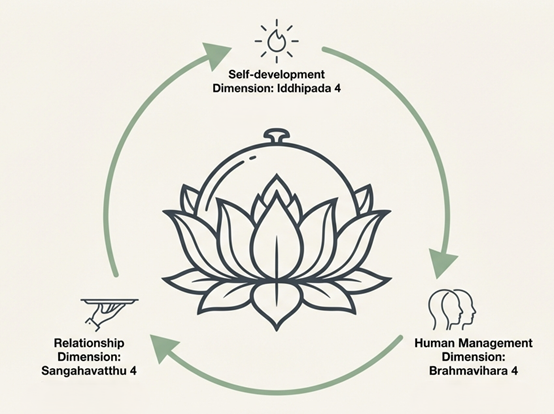
Main Results: The research findings indicate that entrepreneurs can concretely apply Buddhist principles to cross-cultural management, particularly Sangahavatthu 4 (Generosity, Kind Speech, Helpful Conduct, and Equality), which foster positive relationships with customers and employees from different cultures. Brahmavihara 4 (Loving-kindness, Compassion, Sympathetic Joy, and Equanimity) are used as guidelines for managing personnel with understanding and empathy. Meanwhile, Iddhipada 4 (Aspiration, Effort, Thoughtfulness, and Investigation) - Enhance entrepreneurial motivation and self-development. This data synthesis led to the development of a "Buddhist Cross-cultural Management Model for Restaurant Business," comprising three main dimensions: relationship, human management, and self-development. This model reflects the integration of Buddhist principles with modern cross-cultural management concepts, reducing conflict arising from cultural differences, increasing customer satisfaction, and promoting a supportive work environment.
Involvement to Buddhadhamma: The main highlight of this research is the application of Sangahavatthu 4 (Generosity, Kind Speech, Helpful Conduct, and Equality); Brahmavihara 4 (Loving-kindness, Compassion, Sympathetic Joy, and Equanimity); and Iddhipada 4 (Aspiration, Effort, Thoughtfulness, and Investigation) in cross-cultural management.
Conclusions: Research findings demonstrate that Buddhist principles can be effectively applied as a conceptual framework for cross-cultural management in the service industry, encompassing aspects such as relationship building, human resource management, and entrepreneurial potential development. This research therefore proposes a conceptual framework that integrates Buddhist principles with cross-cultural management within the service business context, providing a guideline for entrepreneurs to develop their organizations in a balanced and sustainable manner.
References
Bunsiri, P. & Kheowvongsri, S. (2024). Emotional intelligence of Institution Administrators Sadao District Songkhla Primary Educational Service Area Office 3. Journal of Buddhist Education and Research (JBER), 10(4), 494-509.
Burinkote, S. & Piyanusorn, P. (2022). Causal Relationship Effecting Cross-Cultural Management of Indian Tourist in Thailand. Santapol College Academic Journal, 8(1), 28–39.
Changpongpan, O., Boonkho, N. & Promwan, C. (2025). Ethics of Executive Leadership in the Digital Era. Journal of Buddhist Innovation and Management, 8(3), 250–263.
Chiarakul, T. (2022). Perspectives of Both Muslims and Non-Muslims Foreign Tourists and Thai Halal Restaurant Entrepreneur towards Integrated Marketing Communication and Service Quality Leading to Selection Intention of Thai Halal Restaurants. Journal of Business Administration and Languages (JBAL), 10(2), 123-138.
Creswell, J. W.,Poth, C. N. Lee, N. R.,Kotler, P. & Colehour, J. (2024). Qualitative Inquiry and Research Design: Choosing among Five Approaches (5th ed.). California, United States of America: Sage.
Denzin, N. K. & Lincoln, Y. S. (2018). The SAGE Handbook of Qualitative Research (5th ed.). California, United States of America: Sage.
Denzin, N. K. (2017). The Research Act: A Theoretical Introduction to Sociological Methods. New York, United States of America: McGraw-Hill. https://doi.org/10.4324/9781315134543.
Earley, P. C. & Ang, S. (2003). Cultural Intelligence: Individual Interactions Across Cultures. California, United States of America: Standford University Press.
Elo, S. & Kyngäs, H. (2008). The qualitative content analysis process. Journal of Advanced Nursing, 62(1), 107–115. https://doi.org/10.1111/j.1365-2648.2007.04569.x.
Goleman, D. (2006). Emotional Intelligence. London, United Kingdom: Bantam Books.
Graneheim, U. H. & Lundman, B. (2004). Qualitative content analysis in nursing research: concepts, procedures and measures to achieve trustworthiness. Nurse Education Today, 24(2), 105-112. https://doi.org/10.1016/j.nedt.2003.10.001.
Guest, G., Bunce, A. & Johnson, L. (2006). How Many Interviews Are Enough?: An Experiment with Data Saturation and Variability. Field Methods, 18(1), 59-82. http://dx.doi.org/10.1177/1525822X05279903.
Hall, E. T. (1976). Beyond Culture. New York, United States of America: Anchor Press.
Harvey, P. (2013). An Introduction to Buddhism: Teachings, History and Practices (2nd ed.). Cambridge, United Kingdom: Cambridge University Press.
Hofstede, G. (1980). Culture’s consequences: International differences in work-related values. California, United States of America: Sage.
Hofstede, G. (2011). Dimensionalizing Cultures: The Hofstede Model in Context. Online Readings in Psychology and Culture, 2(1). https://doi.org/10.9707/2307-0919.1014.
Leesmidt, K. (2020). A Causal Relationship Model of the Influences of Compassionate Leadership Integrated from Buddhist and Western Principles on Trust, Commitments, and Creativity among ThaiEmployees. [Doctoral dissertation, Chulalongkorn University]. Chulalongkorn Universi. https://digital.car.chula.ac.th/cgi/viewcontent.cgi?article=5200&context=chulaetd.
Lincoln, Y. S. & Guba, E. G. (1985). Naturalistic Inquiry. California, United States of America: Sage Publications.
Mahamud, T. & Punto, S. (2020). Applying Emotional Quotient in the Work of Human Resource in an Organization. Journal of Legal Entity Management and Local Innovation, 6(2), 267-280.
Mak, A. H., Lumbers, M., Eves, A. & Chang, R. C. (2012). Factors influencing tourist food consumption.International Journal of Hospitality Management, 31(3), 928-936. https://doi.org/10.1016/j.ijhm.2011.10.012.
Maneethon, P., Chuasuwan, S., Udomjaratdet, P., Namwong W., Soukaew, R., Cheekham, P. & Wannawong, K. (2025). Developing Sustainable Strength of Community Enterprises through an Entrepreneurial Mindset. Journal of Management Science and Communication, 4(1), 95-122.
R1. (2025). Applying Buddhist Principles to Cross-cultural Management for Restaurant Entrepreneurs. (Noknoi, C., Interviewer)
R10. (2025). Applying Buddhist Principles to Cross-cultural Management for Restaurant Entrepreneurs. (Noknoi, C., Interviewer)
R11. (2025). Applying Buddhist Principles to Cross-cultural Management for Restaurant Entrepreneurs. (Noknoi, C., Interviewer)
R12. (2025). Applying Buddhist Principles to Cross-cultural Management for Restaurant Entrepreneurs. (Noknoi, C., Interviewer)
R13. (2025). Applying Buddhist Principles to Cross-cultural Management for Restaurant Entrepreneurs. (Noknoi, C., Interviewer)
R14. (2025). Applying Buddhist Principles to Cross-cultural Management for Restaurant Entrepreneurs. (Noknoi, C., Interviewer)
R3. (2025). Applying Buddhist Principles to Cross-cultural Management for Restaurant Entrepreneurs. (Noknoi, C., Interviewer)
R5. (2025). Applying Buddhist Principles to Cross-cultural Management for Restaurant Entrepreneurs. (Noknoi, C., Interviewer)
R6. (2025). Applying Buddhist Principles to Cross-cultural Management for Restaurant Entrepreneurs. (Noknoi, C., Interviewer)
R7. (2025). Applying Buddhist Principles to Cross-cultural Management for Restaurant Entrepreneurs. (Noknoi, C., Interviewer)
R8. (2025). Applying Buddhist Principles to Cross-cultural Management for Restaurant Entrepreneurs. (Noknoi, C., Interviewer)
R9. (2025). Applying Buddhist Principles to Cross-cultural Management for Restaurant Entrepreneurs. (Noknoi, C., Interviewer)
Songkhla Provincial Statistical Office. (2023). Songkhla Provincial Statistical Report 2023. Songkhla, Thailand: Ministry of Interior.
Srisuk, W. (2022). A Synthesis of Body of Knowledge on Administration of Multicultural Society in the Southern Border Provinces: The Social Security Issues. Panyapiwat Journal, 14(1), 203-218.
Sritho, K., (Kimkai Sutthayano), P. S. & Prasertsri, P. C. (2025). Servant Leadership of Organization Executives. Academic Journal of Political Science and Public Administration, 7(4), 143-156.
Thomas, D. C. & Peterson, M. F. (2017). Cross-Cultural Management: Essential Concepts. California, United States of America: Sage Publications.
Thongpragob, C. (2025). Strategic Cross-cultural Communication Competence among Generation Y Leaders: An Integrated Framework in International Business under Economic Uncertainty. Journal of Social Science Development, 8(7), 262–275.
Trompenaars, F. & Hampden-Turner, C. (1998). Riding the Waves of Culture: Understanding Diversity in Global Business (2nd ed.). London, United Kingdom: McGraw-Hill.
Tsang, N. K. F. & Hsu, C. H. C. (2011). Thirty years of research on tourism and hospitality management in China: A review and analysis of journal publications. International Journal of Hospitality Management, 30(4), 886-896. https://doi.org/10.1016/j.ijhm.2011.01.009.
Downloads
Published
How to Cite
Issue
Section
License
Copyright (c) 2026 Journal of Buddhist Anthropology

This work is licensed under a Creative Commons Attribution-NonCommercial-NoDerivatives 4.0 International License.