การประยุกต์หลักธรรมทางพระพุทธศาสนาในการจัดการข้ามวัฒนธรรม: กรณีศึกษาผู้ประกอบการร้านอาหารในจังหวัดสงขลา
คำสำคัญ:
หลักธรรมทางพระพุทธศาสนา, การจัดการข้ามวัฒนธรรม, ผู้ประกอบการร้านอาหาร, สงขลาบทคัดย่อ
ความเป็นมาและวัตถุประสงค์: การจัดการข้ามวัฒนธรรมเป็นประเด็นสำคัญในธุรกิจบริการที่ต้องปฏิสัมพันธ์กับลูกค้าและพนักงานจากหลากหลายวัฒนธรรม อย่างไรก็ตาม งานศึกษาส่วนใหญ่มักอธิบายผ่านกรอบแนวคิดการจัดการตะวันตก ขณะที่การประยุกต์ใช้หลักจริยธรรมทางพระพุทธศาสนา ซึ่งเป็นองค์ความรู้สำคัญในบริบทสังคมไทย ยังได้รับการศึกษาค่อนข้างจำกัด ทั้งที่หลักธรรมทางพระพุทธศาสนามีศักยภาพในการส่งเสริมความเข้าใจ ความเมตตา และการอยู่ร่วมกันอย่างสันติท่ามกลางความแตกต่างทางวัฒนธรรม การวิจัยครั้งนี้ จึงมีวัตถุประสงค์เพื่อศึกษาการประยุกต์ใช้หลักธรรมทางพระพุทธศาสนาในการจัดการข้ามวัฒนธรรม ของผู้ประกอบการร้านอาหารในจังหวัดสงขลา และเพื่อสังเคราะห์แนวทางหรือโมเดลการจัดการที่ผสมผสานหลักธรรมเข้ากับการบริหารธุรกิจบริการ
วิธีดำเนินการวิจัย: การวิจัยนี้เป็นการวิจัยเชิงคุณภาพ โดยศึกษาประสบการณ์และมุมมองของผู้ประกอบการที่ต้องบริหารจัดการในบริบทพหุวัฒนธรรม ผู้ให้ข้อมูลหลักคือผู้ประกอบการร้านอาหารจำนวน 15 รายใน จังหวัดสงขลาที่มีลูกค้าหรือพนักงานต่างชาติ โดยใช้การเลือกแบบเจาะจง และกำหนดจำนวนผู้ให้ข้อมูล ตามหลักความอิ่มตัวของข้อมูล เครื่องมือที่ใช้คือแบบสัมภาษณ์กึ่งโครงสร้าง การวิเคราะห์ข้อมูลใช้การวิเคราะห์เชิงเนื้อหา โดยถอดเทปการสัมภาษณ์ อ่านทบทวนข้อมูล สร้างรหัสจากหน่วยความหมาย จัดกลุ่มรหัสเป็นหมวดหมู่ และสังเคราะห์เป็นธีมหลักที่สะท้อนรูปแบบการประยุกต์ใช้หลักธรรมในการจัดการข้ามวัฒนธรรม พร้อมตรวจสอบความน่าเชื่อถือของข้อมูลด้วยการตรวจสอบสามเส้า
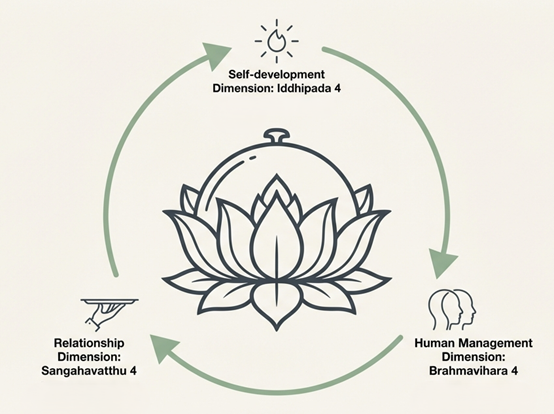
ผลการวิจัย: ผลการวิจัยพบว่าผู้ประกอบการสามารถประยุกต์ใช้หลักธรรมทางพระพุทธศาสนาในการจัดการข้ามวัฒนธรรมได้อย่างเป็นรูปธรรม โดยเฉพาะหลักสังคหวัตถุ 4 ได้แก่ ทาน ปิยวาจา อัตถจริยา และสมานัตตตา ซึ่งช่วยสร้างความสัมพันธ์ที่ดีกับลูกค้าและพนักงานต่างวัฒนธรรม หลักพรหมวิหาร 4 ได้แก่ เมตตา กรุณา มุทิตา และอุเบกขา ถูกนำมาใช้เป็นแนวทางในการบริหารบุคลากรด้วยความเข้าใจและเห็นอกเห็นใจ ขณะที่หลักอิทธิบาท 4 ได้แก่ ฉันทะ วิริยะ จิตตะ และวิมังสา ช่วยเสริมสร้างแรงบันดาลใจและการพัฒนาตนเองของผู้ประกอบการ จากการสังเคราะห์ข้อมูลนำไปสู่การพัฒนา“โมเดลการจัดการข้ามวัฒนธรรมเชิงพุทธสำหรับธุรกิจร้านอาหาร” ซึ่งประกอบด้วย 3 มิติหลัก ได้แก่ มิติแห่งความสัมพันธ์ มิติแห่งการบริหารคน และมิติแห่งการพัฒนาและความยั่งยืน โมเดลดังกล่าวสะท้อนการบูรณาการระหว่างหลักธรรมทางพระพุทธศาสนากับแนวคิดการจัดการข้ามวัฒนธรรมสมัยใหม่ ช่วยลดความขัดแย้งจากความแตกต่างทางวัฒนธรรม เพิ่มความพึงพอใจของลูกค้า และส่งเสริมบรรยากาศการทำงานที่เกื้อกูลกัน
ความเกี่ยวข้องกับหลักธรรมคําสอนทางพระพุทธศาสนา: จุดเด่นสำคัญของงานวิจัยนี้ คือ การนำหลักสังคหวัตถุ 4 (ทาน ปิยวาจา อัตถจริยา สมานัตตตา) พรหมวิหาร 4 (เมตตา กรุณา มุทิตา อุเบกขา) และ อิทธิบาท 4 (ฉันทะ วิริยะ จิตตะ วิมังสา) มาใช้ในการจัดการข้ามวัฒนธรรม
สรุป: ผลการวิจัยแสดงให้เห็นว่าหลักธรรมทางพระพุทธศาสนาสามารถนำมาประยุกต์ใช้เป็นกรอบแนวคิดในการจัดการข้ามวัฒนธรรมในธุรกิจบริการได้อย่างมีประสิทธิภาพ ทั้งในด้านการสร้างความสัมพันธ์ การบริหารบุคลากร และการพัฒนาศักยภาพของผู้ประกอบการ งานวิจัยนี้จึงเสนอกรอบแนวคิดที่บูรณาการหลักธรรมกับการจัดการข้ามวัฒนธรรมในบริบทธุรกิจบริการ และเป็นแนวทางสำหรับผู้ประกอบการในการพัฒนาองค์กรอย่างสมดุลและยั่งยืน
เอกสารอ้างอิง
Bunsiri, P. & Kheowvongsri, S. (2024). Emotional intelligence of Institution Administrators Sadao District Songkhla Primary Educational Service Area Office 3. Journal of Buddhist Education and Research (JBER), 10(4), 494-509.
Burinkote, S. & Piyanusorn, P. (2022). Causal Relationship Effecting Cross-Cultural Management of Indian Tourist in Thailand. Santapol College Academic Journal, 8(1), 28–39.
Changpongpan, O., Boonkho, N. & Promwan, C. (2025). Ethics of Executive Leadership in the Digital Era. Journal of Buddhist Innovation and Management, 8(3), 250–263.
Chiarakul, T. (2022). Perspectives of Both Muslims and Non-Muslims Foreign Tourists and Thai Halal Restaurant Entrepreneur towards Integrated Marketing Communication and Service Quality Leading to Selection Intention of Thai Halal Restaurants. Journal of Business Administration and Languages (JBAL), 10(2), 123-138.
Creswell, J. W.,Poth, C. N. Lee, N. R.,Kotler, P. & Colehour, J. (2024). Qualitative Inquiry and Research Design: Choosing among Five Approaches (5th ed.). California, United States of America: Sage.
Denzin, N. K. & Lincoln, Y. S. (2018). The SAGE Handbook of Qualitative Research (5th ed.). California, United States of America: Sage.
Denzin, N. K. (2017). The Research Act: A Theoretical Introduction to Sociological Methods. New York, United States of America: McGraw-Hill. https://doi.org/10.4324/9781315134543.
Earley, P. C. & Ang, S. (2003). Cultural Intelligence: Individual Interactions Across Cultures. California, United States of America: Standford University Press.
Elo, S. & Kyngäs, H. (2008). The qualitative content analysis process. Journal of Advanced Nursing, 62(1), 107–115. https://doi.org/10.1111/j.1365-2648.2007.04569.x.
Goleman, D. (2006). Emotional Intelligence. London, United Kingdom: Bantam Books.
Graneheim, U. H. & Lundman, B. (2004). Qualitative content analysis in nursing research: concepts, procedures and measures to achieve trustworthiness. Nurse Education Today, 24(2), 105-112. https://doi.org/10.1016/j.nedt.2003.10.001.
Guest, G., Bunce, A. & Johnson, L. (2006). How Many Interviews Are Enough?: An Experiment with Data Saturation and Variability. Field Methods, 18(1), 59-82. http://dx.doi.org/10.1177/1525822X05279903.
Hall, E. T. (1976). Beyond Culture. New York, United States of America: Anchor Press.
Harvey, P. (2013). An Introduction to Buddhism: Teachings, History and Practices (2nd ed.). Cambridge, United Kingdom: Cambridge University Press.
Hofstede, G. (1980). Culture’s consequences: International differences in work-related values. California, United States of America: Sage.
Hofstede, G. (2011). Dimensionalizing Cultures: The Hofstede Model in Context. Online Readings in Psychology and Culture, 2(1). https://doi.org/10.9707/2307-0919.1014.
Leesmidt, K. (2020). A Causal Relationship Model of the Influences of Compassionate Leadership Integrated from Buddhist and Western Principles on Trust, Commitments, and Creativity among ThaiEmployees. [Doctoral dissertation, Chulalongkorn University]. Chulalongkorn Universi. https://digital.car.chula.ac.th/cgi/viewcontent.cgi?article=5200&context=chulaetd.
Lincoln, Y. S. & Guba, E. G. (1985). Naturalistic Inquiry. California, United States of America: Sage Publications.
Mahamud, T. & Punto, S. (2020). Applying Emotional Quotient in the Work of Human Resource in an Organization. Journal of Legal Entity Management and Local Innovation, 6(2), 267-280.
Mak, A. H., Lumbers, M., Eves, A. & Chang, R. C. (2012). Factors influencing tourist food consumption.International Journal of Hospitality Management, 31(3), 928-936. https://doi.org/10.1016/j.ijhm.2011.10.012.
Maneethon, P., Chuasuwan, S., Udomjaratdet, P., Namwong W., Soukaew, R., Cheekham, P. & Wannawong, K. (2025). Developing Sustainable Strength of Community Enterprises through an Entrepreneurial Mindset. Journal of Management Science and Communication, 4(1), 95-122.
R1. (2025). Applying Buddhist Principles to Cross-cultural Management for Restaurant Entrepreneurs. (Noknoi, C., Interviewer)
R10. (2025). Applying Buddhist Principles to Cross-cultural Management for Restaurant Entrepreneurs. (Noknoi, C., Interviewer)
R11. (2025). Applying Buddhist Principles to Cross-cultural Management for Restaurant Entrepreneurs. (Noknoi, C., Interviewer)
R12. (2025). Applying Buddhist Principles to Cross-cultural Management for Restaurant Entrepreneurs. (Noknoi, C., Interviewer)
R13. (2025). Applying Buddhist Principles to Cross-cultural Management for Restaurant Entrepreneurs. (Noknoi, C., Interviewer)
R14. (2025). Applying Buddhist Principles to Cross-cultural Management for Restaurant Entrepreneurs. (Noknoi, C., Interviewer)
R3. (2025). Applying Buddhist Principles to Cross-cultural Management for Restaurant Entrepreneurs. (Noknoi, C., Interviewer)
R5. (2025). Applying Buddhist Principles to Cross-cultural Management for Restaurant Entrepreneurs. (Noknoi, C., Interviewer)
R6. (2025). Applying Buddhist Principles to Cross-cultural Management for Restaurant Entrepreneurs. (Noknoi, C., Interviewer)
R7. (2025). Applying Buddhist Principles to Cross-cultural Management for Restaurant Entrepreneurs. (Noknoi, C., Interviewer)
R8. (2025). Applying Buddhist Principles to Cross-cultural Management for Restaurant Entrepreneurs. (Noknoi, C., Interviewer)
R9. (2025). Applying Buddhist Principles to Cross-cultural Management for Restaurant Entrepreneurs. (Noknoi, C., Interviewer)
Songkhla Provincial Statistical Office. (2023). Songkhla Provincial Statistical Report 2023. Songkhla, Thailand: Ministry of Interior.
Srisuk, W. (2022). A Synthesis of Body of Knowledge on Administration of Multicultural Society in the Southern Border Provinces: The Social Security Issues. Panyapiwat Journal, 14(1), 203-218.
Sritho, K., (Kimkai Sutthayano), P. S. & Prasertsri, P. C. (2025). Servant Leadership of Organization Executives. Academic Journal of Political Science and Public Administration, 7(4), 143-156.
Thomas, D. C. & Peterson, M. F. (2017). Cross-Cultural Management: Essential Concepts. California, United States of America: Sage Publications.
Thongpragob, C. (2025). Strategic Cross-cultural Communication Competence among Generation Y Leaders: An Integrated Framework in International Business under Economic Uncertainty. Journal of Social Science Development, 8(7), 262–275.
Trompenaars, F. & Hampden-Turner, C. (1998). Riding the Waves of Culture: Understanding Diversity in Global Business (2nd ed.). London, United Kingdom: McGraw-Hill.
Tsang, N. K. F. & Hsu, C. H. C. (2011). Thirty years of research on tourism and hospitality management in China: A review and analysis of journal publications. International Journal of Hospitality Management, 30(4), 886-896. https://doi.org/10.1016/j.ijhm.2011.01.009.
ดาวน์โหลด
เผยแพร่แล้ว
รูปแบบการอ้างอิง
ฉบับ
ประเภทบทความ
สัญญาอนุญาต
ลิขสิทธิ์ (c) 2026 วารสารมานุษยวิทยาเชิงพุทธ

อนุญาตภายใต้เงื่อนไข Creative Commons Attribution-NonCommercial-NoDerivatives 4.0 International License.