LOGIC WITHOUT LOSERS: BUDDHIST DIALECTICAL REASONING AND THE TRANSFORMATION OF UNDERSTANDING IN THE MILINDAPAÑHA
Keywords:
Logic Without Losers, Buddhist Dialectical Reasoning, Milindapañha, Relational Rationality and Dialogical Ethics, Sociology of ReligionAbstract
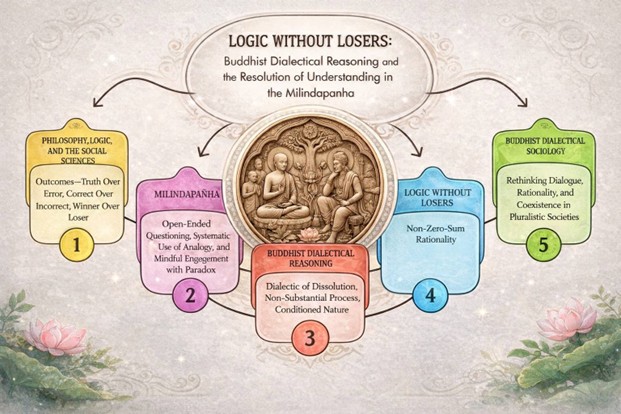
Background and Objectives: Contemporary academic reasoning, particularly within philosophy, logic, and the social sciences, has been predominantly shaped by adversarial models of rationality. These models assume that rational inquiry culminates in decisive outcomes: Truth over error, correctness over incorrectness, winner over loser. While such frameworks have yielded powerful analytical tools, they also risk reducing "Understanding" to a by-product of intellectual victory. Against this backdrop, this article re-examines the classical Buddhist dialogical text, the Milindapañha, as a distinctive form of dialectical reasoning that is not competitive but oriented toward the ethical unfolding of understanding. Rather than reading the text merely as doctrinal exposition or apologetic literature, this study aims to analyze the Milindapañha as a form of dialectical logic that does not seek to produce a loser, but instead emphasizes the structure of reasoning over doctrinal content. It further proposes a theoretical framework for Buddhist dialectical reasoning that foregrounds the process of wisdom's emergence. In doing so, the study seeks to connect the interpretation of Buddhist texts with contemporary debates in the sociology of religion, positioning them as alternative sources of rationality.
Methodology: This study employed qualitative theoretical documentary research grounded in a hermeneutic-interpretive methodology. The primary sources consisted of the Pāli Milindapañha and its authoritative translations, while the secondary sources were drawn from Buddhist Studies, the philosophy of logic, and the sociology of religion. Analytical strategies included close textual reading of the dialogical exchanges between Phra Nāgasena and King Milinda, dialectical analysis, comparative logic, and the sociology of knowledge. Rather than seeking definitive doctrinal conclusions, the analysis focused on how questions, analogies, and paradoxes function as logical and ethical mechanisms. Reflexivity and theoretical triangulation were employed to ensure interpretive rigor.
Main Results: The findings revealed that the Milindapañha operated through a non-adversarial dialectical structure characterized by; 1) Open-ended questioning that did not aim at final conclusions; 2) The use of analogy as a logical mechanism for elevating understanding, and 3) Mindful engagement with paradox. Phra Nāgasena did not seek to refute or defeat King Milinda's questions; Instead, he gradually unfolded the assumptions underlying them. Through this process, dialogue shifted from confrontation to shared inquiry. Understanding emerged not as the triumph of one position over another but as a relational event occurring within the dialogical space itself.
Involvement to Buddhadhamma: The dialogical logic articulated in the Milindapañha is deeply consonant with core principles of Buddhadhamma, particularly non-self (Anattā), dependent origination (Paṭiccasamuppāda), and right speech (Sammā-vācā). Reasoning is not detached from ethical cultivation but constitutes a form of practice aimed at reducing attachment to one's own views. The absence of winners and losers is not a rhetorical strategy but an ethical consequence of a worldview that denies a fixed self and absolute truth.
Conclusions: This article advances the conceptual framework of "Logic Without Losers" and proposes Buddhist dialectical reasoning as a theoretical contribution to the sociology of religion. By demonstrating that Buddhism is not merely a belief system but also a source of alternative logic, the study highlights its potential to engage constructively with the modern world. The Milindapañha thus emerges as a globally relevant resource for rethinking dialogue, rationality, and coexistence in pluralistic societies.
References
Aristotle. (1984). The complete works of Aristotle : the revised Oxford translation (J. Barnes, Ed.). New Jersey, United States of America: Princeton University Press.
Asad, T. (1993). Genealogies of Religion: Discipline and Reasons of Power in Christianity and Islam. Baltimore, United States of America: Johns Hopkins University Press.
Berger, P. L. & Luckmann, T. (1966). The Social Construction of Reality A Treatise in the Sociology of Knowledge. New York, United States of America: Penguin Books.
Bourdieu, P. (1991). Language and Symbolic Power (J. B. Thompson, Ed., G. Raymond & M. Adamson, Trans.). Cambridge, United Kingdom: Polity Press.
Denzin, N. K. (2012). Triangulation 2.0. Journal of Mixed Methods Research, 6(2), 80-88.
Finot, L. (1923). Les questions de Milinda-Milinda-Panha. Paris, France: Bossard.
Gadamer, H.-G. (2004). TRUTH AND METHOD (2nd rev. ed.). (J. Weinsheimer & D. G. Marshall, Trans.). London, United Kingdom: Continuum.
Gombrich, R. (2009). What the Buddha Thought. Sheffield, United Kingdom: Equinox Publishing.
Habermas, J. (1984). The Theory of Communicative Action: Volume 1: Reason and the Rationalization of Society (T. McCarthy, Trans.). Boston, United States of America: Beacon Press.
Harvey, P. (2013). AN INTRODUCTION TO BUDDHISM: Teachings, History and Practices (2nd edAN I.). Cambridge, United Kingdom: Cambridge University Press.
Hegel, G. W. F. (1977). PHENOMENOLOGY OF SPIRIT (A. V. Miller, Trans.). Oxford, United Kingdom: Oxford University Press.
Horner, I. B. (1964). Milinda's Questions (2 vols.). London, United Kingdom: Pali Text Society.
Ooi, E.J., Schumann, A. & Sirisawad, N. (2023). Defining a Mendaka Question in the Questions of Milinda and Its Commentarial Texts. Journal of Indian Philosophy, 51, 567-589. https://doi.org/10.1007/s10781-023-09543-7
Plato. (1997). COMPLETE WORKS (J. M. Cooper & D. S. Hutchinson, Eds.). Indianapolis/Cambridge, United States of America: Hackett Publishing Company.
Prebish, C. S. & Keown, D. (2010). Introducing Buddhism (2nd Edition). London, United Kingdom: Routledge.
Rhys Davids, T. W. (1890). The questions of King Milinda. Oxford, United Kingdom: Clarendon Press.
Toulmin, S. (2003). The Uses of Argument (Updated Edition). New York, United States of America: Cambridge University Press.
Trenckner, V. (1880). THE MILINDAPAÑHO: BEING DIALOGUES BETWEEN KING MILINDA AND THE BUDDHIST SAGE NĀGASENA. London, United Kingdom: Williams and Norgate for the Pali Text Society.
Weber, M. (1978). Economy and Society: An Outline of Interpretive Sociology (Roth, G. & Wittich, C. Eds.). California, United States of America: University of California Press.
Williams, P. (2009). Mahäyana Buddhism: The Doctrinal Foundations (2nd ed.). London, United Kingdom: Routledge.
Downloads
Published
How to Cite
Issue
Section
License
Copyright (c) 2026 Journal of Buddhist Anthropology

This work is licensed under a Creative Commons Attribution-NonCommercial-NoDerivatives 4.0 International License.