BUDDHIST WAY MODEL FOR COMPETENCY DEVELOPMENT OF ADMINISTRATORS AT MAHACHULALONGKORNRAJAVIDYALAYA UNIVERSITY
Keywords:
Model, Buddhist Way, Competency Development, Administrators, Mahachulalongkornrajavidyalaya UniversityAbstract
Background and Objectives: Mahachulalongkornrajavidyalaya University, a leading Buddhist higher education institution in Thailand, has a crucial mission to produce high-quality graduates in Buddhism and to serve as a national and international center for the study and dissemination of Buddhism. Past studies have shown that educational administrators often face challenges in effective management, as indicated in studies conducted by the Office for National Education Standards and Quality Assessment (ONESQA). Furthermore, there has been a lack of a systematic and clear model for developing administrator competencies that integrates Buddhist principles with the context and needs of Mahachulalongkornrajavidyalaya University administrators. This research, therefore, aims to develop a suitable "Buddhist-based Model for Administrator Competency Development" that integrates Buddhist principles with modern and effective competency development processes, leading to academic excellence, morality, and sustainable social development.
Methodology: This research employed a mixed-methods approach involving data analysis from both questionnaires and interviews. Data were collected from 1,100 respondents via questionnaires, while in-depth interviews were conducted with 12 key informants divided into three groups: 1) Senior executives of Mahachulalongkornrajavidyalaya University, 2) Experts in Buddhist-based competency development models, and 3) Specialists in Buddhist educational administration. Data analysis involved opinion surveys administered to key informants who were university administrators. Quantitative data were analyzed using descriptive statistics and Pearson's correlation coefficient analysis. Furthermore, the LISREL program was utilized to test the model's consistency with empirical data and to analyze the magnitude of both direct and indirect effects.
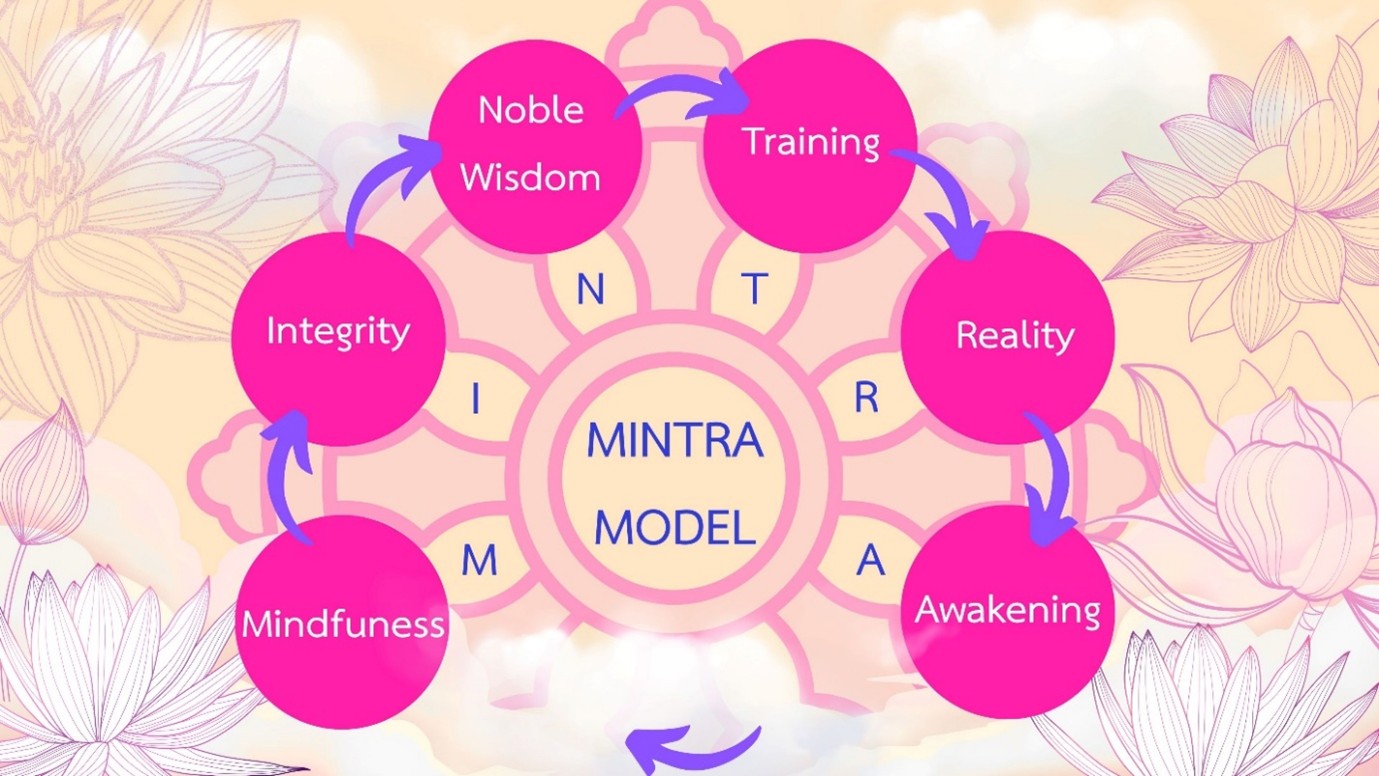
Main Results: The study found that the Buddhist-based model for developing the competencies of university administrators at Mahachulalongkornrajavidyalaya University yielded findings on three components of administrator competency development within the university context: 1) Components of administrator competency: Including knowledge related to administrative and professional work, such as leadership and decision-making skills; 2) Principles of Saddhamma: referring to the authentic teachings of Buddhism, comprising theory (Pariyatti), practice(Patipatti), and realization (Pativedha); and 3) Administrator competency effectiveness, referring to the ability to apply knowledge, skills, and leadership attributes effectively. The conceptual model derived from the study can be summarized as the M-I-N-T-R-A Model, which includes Mindfulness, Integrity, Noble Wisdom, Training, Reality, and Awakening.
Involvement to Buddhadhamma: The Buddhist-based administrative competency development model is consistent with the Buddhist principles of the Threefold Saddhamma (The Threefold True Dharma), which refers to the good, the true, and the noble teachings. These include: Pariyatti-saddhamma: The study of the scriptures or the theoretical teachings to be learned; Patipatti-saddhamma: The practice or the application of the teachings to be followed; and Pativedha-saddhamma: The realization or the fruits of practice to be attained or achieved through practical application.
Conclusions: Mahachulalongkornrajavidyalaya University faces challenges from limitations in management skills and modern technology among its administrators, impacting the institution's mission in the present era. This research aims to solve this problem by creating a "Buddhist Model" that integrates Buddhist principles with a systematic and contextually relevant global competency development process, while guiding the Buddhist educational institution toward academic and moral excellence for sustainable social development.
References
Bunajinda, P. (2024). HUMAN RESOURCES DEVELOPMENT IN A NEW WAVE OF CHANGE, ACCORDING TO SADDHAMMA (TRUE DHAMMA). Journal of Interdisciplinary Innovation Review, 7(4), 440-451.
Internal Audit Office, Mahachulalongkornrajavidyalaya University (MCU). (2021). Audit Report on Personnel Development Operations for Fiscal Year 2021. Phra Nakhon Si Ayutthaya, Thailand: Mahachulalongkornrajavidyalaya University.
Karutharochana, M. (2023). Leader of change in teacher competency development inMuang Nakhon Ratchasima School using a management model "MANA's Model" to raise the quality of learners. Journal of Palisueksabuddhaghosa Review, 9(2), 46-59.
Krishnalom, P. (2025). The Model of Human Resource Development in the Organization by Buddhist Leadership. Journal of Nakhonratchasima College (Humanities and Social Sciences), 19(2), 244-258.
Mahachulalongkornrajavidyalaya University. (2020). Mahachulalongkornrajavidyalaya University Strategic Plan 2020-2024. Phra Nakhon Si Ayutthaya, Thailand: Mahachulalongkornrajavidyalaya University.
Nakkaew, B. & Bussarakul, T. (2022). Information Technology Management Competency of Private School Administrator in Bangkapi District, Bangkok Metropolitan. The Journal of Sirindhornparithat, 23(1), 205-212.
Ngamkanok, S. (2021). Desirable Characteristics of School Administrators: Virtue, Merit, and Professional Ethics. Journal of Association of Professional Development of Educational Administration of Thailand (JAPDEAT), 3(1), 69-77.
Office for National Education Standards and Quality Assessment (Public Organization). (2020). Report on the Fourth Round of External Quality Assessment, Academic Year 2019. Bangkok, Thailand: Office for National Education Standards and
Quality Assessment (Public Organization).
Office of the Higher Education Commission. (2019). Higher Education Development Plan 2018-2022. Bangkok, Thailand: Office of the Higher Education Commission.
Thanyacharoen, T. (2018). The Development of Competencies of School Administrators under the Office of Primary Educational Service Area. [Unpublished doctoral dissertation]. Bangkok, Thailand: Srinakharinwirot University.
Viphoouparakhot, V. (2024). Model of Online Instructor Competencies Towards Professionalism for University Instructors in Enhancing Learning Management Effectiveness Through the Massive Open Online Course (Mooc) Platform. The Journal of Development Administration Research, 14(4), 1605-1622.
Downloads
Published
How to Cite
Issue
Section
License
Copyright (c) 2026 Journal of Buddhist Anthropology

This work is licensed under a Creative Commons Attribution-NonCommercial-NoDerivatives 4.0 International License.