BUDDHIST INTEGRATED SANGHA COURT: THE POSSIBILITY OF DRAFTING LEGISLATION ON ECCLESIASTICAL COURTS AND PROCEDURES FOR CASES CONCERNING THE SANGHA TO FOSTER BUDDHIST INNOVATION IN THAILAND
Keywords:
Sangha Court, Buddhist Integration, Buddhist Innovation, Procedural Law, FeasibilityAbstract
Background and Objective: The system for managing violations of the Buddhist monastic discipline in Thailand lacked a standardized adjudicative mechanism, inconsistently enforced the monastic discipline, and did not provide a formal appeals process or review of decisions. These conditions sparked debates over fairness and accountability in ecclesiastical proceedings. This research aimed to assess the feasibility of drafting legislation establishing a Sangha Court and procedures for adjudicating monastic cases to foster Buddhist innovation in Thailand.
Methodology: The study employed a mixed-methods research approach. It examined and analyzed legal documents, Buddhist texts, and related studies from both domestic and international sources. In addition, in-depth interviews were conducted with 10 purposively selected key informants representing the judiciary, public prosecutors, police officers, lawyers, and government agencies responsible for Sangha affairs. Focus group discussions were also conducted with 20 experts from various sectors in Southern Thailand. The data were analyzed through content analysis and conceptual comparison with relevant legal frameworks and theories. The researcher verified the data's trustworthiness through triangulation, member checking, and expert validation to confirm the consistency, accuracy, and reliability of the research findings.
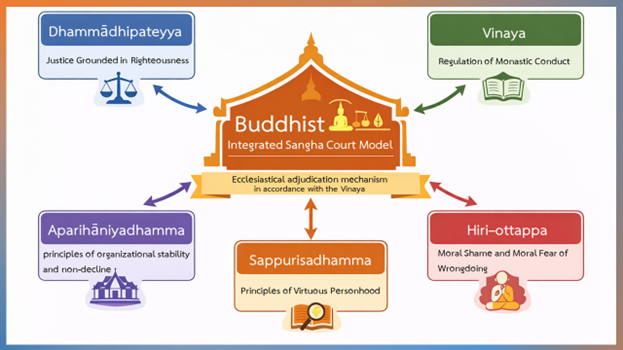
Main Results: The findings revealed that establishing a Sangha Court was feasible across four significant dimensions. First, from a legal-principle perspective, it could exist within the framework of the rule of law and substantive equality, provided that its jurisdiction was limited to cases concerning monastic discipline. Second, from a structural perspective, it could be designed as a specialized adjudicative body composed of both experts in Buddhist monastic discipline and legal experts. Third, from a procedural perspective, it required a specific procedural law integrating the principles of due process, an inquisitorial system, and appellate mechanisms. Fourth, from an institutional perspective, the establishment of a Sangha Court reflected an approach to developing governance within the Sangha under the framework of the modern state. The findings also generated a new body of knowledge, namely the "Buddhist Integrated Sangha Court Model," which differed from previous studies by proposing not only the establishment of a Sangha Court but also an institutional framework integrating Buddhist doctrinal principles with the rule of law and modern judicial processes.
Involvement to Buddhadhamma: The establishment of a Sangha Court was consistent with the principles of the Buddhist monastic discipline, which emphasizes careful consideration of offenses, inquiry, hearing explanations, and deliberation by the Sangha assembly. These principles reflected Buddhist governance aimed at preserving the purity of the monastic order and rehabilitating offenders rather than imposing retributive punishment. The integration of modern legal principles, therefore, represented a form of Buddhist innovation, translating the principles of monastic discipline into a framework that functioned appropriately within the context of a modern state.
Conclusions: The Buddhist Integrated Sangha Court Model constituted an institutional framework capable of linking the principles of Buddhist monastic discipline with the rule of law through a systematic adjudicative mechanism. Essential conditions included the establishment of clearly defined jurisdictional boundaries, the design of procedures consistent with the principles of fairness, and the maintenance of a balance between the autonomy of the Sangha and accountability under the principles of good governance.
References
Act on the Establishment of Labour Courts and Labour Case Procedure, B.E. 2522. (1979).
Act on the Establishment of the Central Intellectual Property and International Trade Court and Intellectual Property and International Trade Litigation Procedure, B.E. 2539. (1996).
Act on the Establishment of the Tax Court and Tax Case Procedure, B.E. 2528. (1985).
Bankruptcy Act, B.E. 2483. (1940).
Barak, A. (2012). Proportionality: Constitutional Rights and Their Limitations. New York, United States of America: Cambridge University Press.
Braithwaite, J. (2002). Restorative justice & responsive regulation. New York, United States of America: Oxford University Press.
Cappelletti, M. (1989). The Judicial Process in Comparative Perspective. Oxford, United Kingdom: Clarendon Press.
Collins, S. (1990). On the very idea of the Pali Canon. Journal of the Pali Text Society, 15, 89-126. https://doi.org/10.82103/jpts.1990.1.28140.
Constitution of the Kingdom of Thailand, B.E. 2560. (2017).
Damaska, M. R. (1986). The Faces of Justice and State Authority: A Comparative Approach to the Legal Process. London, United Kingdom: Yale University Press.
Djelic, M. & Quack, S. (Eds.). (2003). Globalization and Institutions. Cheltenham, United Kingdom: Edward Elgar Publishing. https://doi.org/10.4337/9781781950012.
Hirschl, R. (2010). Constitutional Theocracy. Massachusetts, United States of America: Harvard University Press.
Hooker, M. B. (2008). Indonesian Syariah: Defining a National School of Islamic Law. Heng Mui Keng Terrace, Singapore: Institute of Southeast Asian Studies.
Huxley, A. (1995). Buddhism and law: The View from Mandalay. Journal of the International Association of Buddhist Studies, 18(1), 47-95.
International Covenant on Civil and Political Rights. (1966).
Juvenile and Family Court and Procedure Act, B.E. 2553. (2010).
Kitiarsa, P. (2008). Religious Commodifications in Asia: Marketing Gods. London, United Kingdom: Routledge.
Matravers, M. (1999). Andrew von Hirsch, Censure and Sanctions, Oxford, Clarendon Press, 1993, pp. xviii + 111. Utilitas, 11(2), 246-251. https://doi.org/10.1017/S0953820800002466.
Phrakatavoot kavasakatammo (Pangtee) & Singkaneti, B. (2022). Problems with Enforcement of the Sangha Act, B.E. 2505 (1962). Law and Local Society Journal, 6(1), 129-162.
Phramaha Suchat Dhammakamo, Phrakhru Suphatthakitjanukarn & Naewphaya, C. (2022). The Judicial System in Justice Process of the Thai Sangha. The Journal of Research and Academics, 5(5), 317-330.
Sangha Act (No. 2), B.E. 2535. (1992).
Schonthal, B. & Walton, M. J. (2016). The (New) Buddhist Nationalisms? Symmetries and Specificities in Sri Lanka and Myanmar. Contemporary Buddhism, 17(1), 81-115. https://doi.org/10.1080/14639947.2016.1162419.
Tamanaha, B. Z. (2004). On the Rule of Law: History, Politics, Theory. Cambridge, United Kingdom: Cambridge University Press. https://doi.org/10.1017/CBO9780511812378.
Tambiah, S. J. (1976). World Conqueror and World Renouncer: A Study of Buddhism and Polity in Thailand against a Historical Background. Cambridge, United Kingdom: Cambridge University Press. https://doi.org/10.1017/CBO9780511558184.
Tyler, T. R. (2006). Why People Obey the Law. New Jersey, United States of America: Princeton University Press.
Downloads
Published
How to Cite
Issue
Section
License
Copyright (c) 2026 Journal of Buddhist Anthropology

This work is licensed under a Creative Commons Attribution-NonCommercial-NoDerivatives 4.0 International License.