GUIDELINES FOR THE APPLICATION OF THE TEN ROYAL VIRTUES DASAVIDHA- RĀJADHAMMA PRINCIPLES IN SANGHA ADMINISTRATION AMONG ECCLESIASTICAL ADMINISTRATORS IN NAKHON SI THAMMARAT PROVINCE
Keywords:
Application of the Ten Royal Virtues Dasavidha-Rajadhamma, Sangha Administration, Ecclesiastical Administrators in Nakhon Si Thammarat ProvinceAbstract
Background and Objective: The administration of Sangha affairs in contemporary Thai society is confronted with changes in social conditions, technology, the economy, and public expectations. Consequently, ecclesiastical administrative monks are required to possess administrative knowledge and competence, leadership, and moral integrity in governance in order to perform their duties appropriately within the context of contemporary society. The Ten Royal Virtues constitute a set of ethical principles for leaders that promote honesty, self-sacrifice, patience, compassion, and impartiality. These qualities are essential for the effective and transparent administration of Sangha affairs and for gaining the confidence of monks, novices, and the general public. Such principles can provide practical guidelines for planning, decision-making, problem-solving, conflict management, and the systematic and stable development of Sangha organizations in accordance with the Dhamma and Vinaya. This research aims to propose practical guidelines for applying the Ten Royal Virtues to the administration of Sangha affairs by ecclesiastical administrative monks in Nakhon Si Thammarat Province through a synthesis of previous research findings and qualitative data obtained from experts.
Methodology: This study employed a mixed-methods research design. The findings on the application of the Ten Royal Virtues (Dasavidha-Rājadhamma) in Sangha affairs administration were integrated with qualitative data obtained through in-depth interviews with nine key informants, consisting of ecclesiastical administrators and Buddhist scholars. The collected data were then synthesized using content analysis and descriptive interpretation to develop guidelines for promoting the application of the Ten Royal Virtues in the six major areas of Sangha affairs administration: Governance, religious education, educational welfare, Buddhist propagation, public utilities management, and public welfare services.
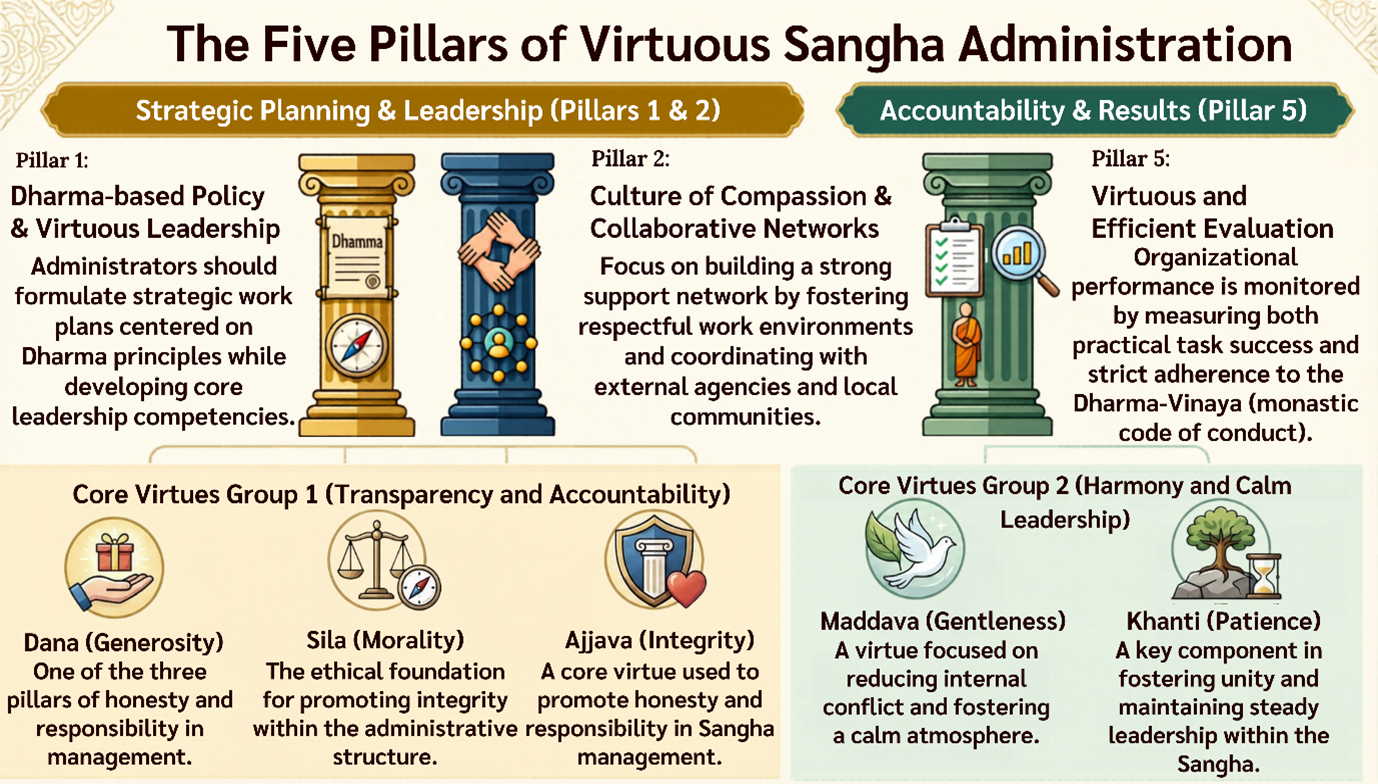
Main Results: Most key informants shared a common view that the application of the Ten Royal Virtues (Dasavidha-Rajadhamma) in the administration of Sangha affairs by ecclesiastical administrators in Nakhon Si Thammarat Province should be implemented systematically through five key dimensions: 1) Integrating Buddhist moral principles into Sangha policies, strategic plans, and administrative processes; 2) Developing ecclesiastical administrators to possess ethical leadership alongside managerial competencies; 3) Fostering an organizational culture grounded in transparency, accountability, and compassion; 4) Establishing collaborative networks among the Sangha, local communities, government agencies, and educational institutions; And 5) Developing monitoring and evaluation systems that take into account both administrative effectiveness and Buddhist moral values.
Involvement to Buddhadhamma: The findings indicate that the Ten Royal Virtues can be practically applied as an ethical framework for Sangha administration at the policy level, the operational level, and the level of community relationships. This is particularly relevant in a context where the Sangha must respond to growing expectations concerning transparency, participation, and adaptation to the digital society. Such an application can strengthen public confidence, faith, and cooperation among Buddhist monks, members of the public, and relevant organizations, thereby contributing to efficient and effective administration.
Conclusions: The application of the Ten Royal Virtues in Sangha administration should be carried out in an integrated manner through the development of leadership, administrative systems, and collaborative networks, with morality serving as the fundamental basis of administration. This approach will help enhance the efficiency, unity, and credibility of the Sangha in contemporary society, while also encouraging the participation of ecclesiastical administrative monks, Buddhist monks, novices, and the general public in developing Buddhist affairs in a stable, transparent, fair, systematic, and continuous manner.
References
Boonrueang, S. & Phra Anothai Gataponyo (Aunruean). (2021). Buddhistic Political Science According to Governance the Rajadhamma. The Journal of Research and Academics, 4(1), 233-242.
Key Informant 1. (2569). Guidelines for the application of the ten royal virtues dasavidha-rājadhamma principles in sangha administration among ecclesiastical administrators in nakhon si thammarat province. (Phra Wacharin Chumjeen, Interviewer).
Key Informant 2. (2569). Guidelines for the application of the ten royal virtues dasavidha-rājadhamma principles in sangha administration among ecclesiastical administrators in nakhon si thammarat province. (Phra Wacharin Chumjeen, Interviewer).
Key Informant 3. (2569). Guidelines for the application of the ten royal virtues dasavidha-rājadhamma principles in sangha administration among ecclesiastical administrators in nakhon si thammarat province. (Phra Wacharin Chumjeen, Interviewer).
Key Informant 4. (2569). Guidelines for the application of the ten royal virtues dasavidha-rājadhamma principles in sangha administration among ecclesiastical administrators in nakhon si thammarat province. (Phra Wacharin Chumjeen, Interviewer).
National Office of Buddhism. (2021). Handbook for ecclesiastical administrators. Bangkok, Thailand: National Office of Buddhism Publishing.
Phra Brahmagunabhorn (P. A. Payutto). (2002). Dictionary of Buddhism. Bangkok, Thailand: Mahachulalongkornrajavidyalaya University Press.
Phra Brahmagunabhorn (P. A. Payutto). (2006). The one who beautifies the Sangha. Bangkok, Thailand: Sahadhammika Press.
Phrakhru Suratviharkarn Khemadhammo (Rodkaew), Phra Natthaphong Yanametee (Kraithep), Phra Natthaphong Sirisuwanno (Janro), Nuthongkaew, K. & Threetrup, D. (2019). An Application of The Ten Royal Virtues in Sangha's Affairs Administration in Nakhon Si Thammarat Province (Dhammayut). Journal of MCU Nakhondhat, 6(10), 5425-5440.
Phrakhrudhammadhorn Phirach Siricando & Phrasamu Prajurak Mahapanno. (2025). Buddhadhamma With the Governance of The Sangha in Modern Society. Journal of Buddhist Innovation and Management, 8(1), 276-293.
Phrakhruphithunnakharaphirak (Anuchat Narintho) & Phramahasumek Samahito. (2021). Sanggha Administration Skills. The Journal of Research and Academics, 4(2), 235-249.
Phra Narong Sangkhawichit. (2017). Present Thai Sanghaadministration: Problems and Suggested Solutions. Journal of MCU Social Science Review, 6(1), 27-40.
Phrapalad Wanchai Mayong, Sabnawin, S. & Jindapon, W. (2015). The Administration of the Organization of the Buddhist Monastic Order in ChumphonProvince by using the Tenfold Virtue of the King. Veridian E-Journal, Silpakorn University, 8(1), 351-366.
Prasrivajiravati (Chatchai Moonsarn). (2024). The Governance of the Sangha in the Digital Era: Opportunities and Challenges. Journal of MBU Yotsunthon Review, 1(3), 59-77.
Downloads
Published
How to Cite
Issue
Section
License
Copyright (c) 2026 Journal of Buddhist Anthropology

This work is licensed under a Creative Commons Attribution-NonCommercial-NoDerivatives 4.0 International License.