BUDDHIST INNOVATION THE "SW6 MODEL" FOR A COMMUNITY WATER MANAGEMENT CHARTER INTEGRATING THE SIX PRINCIPLES OF SARANIYADHAMMA IN THE MAE KHAM RIVER BASIN, PHRAE PROVINCE
Keywords:
Buddhist Innovations, Model SW6, Community Water Management Charter, Six Principles of Harmony, Mae Kham River BasinAbstract
Background and Objectives: Community-level water resource management in the Thai social context requires participatory mechanisms consistent with local social, cultural, and local wisdom, particularly the application of Buddhist principles to promote cooperation among stakeholders. This research aims to present a process for drafting a community water management charter that integrates the Six Saraniyadhamma (Principles of Harmony) in the Mae Kham River Basin, Mueang Phrae District, Phrae Province, and to propose the Buddhist innovation "SW6 Model" as a Buddhist-based community water management framework developed from the research findings.
Methodology: This research is a qualitative study conducted in four sub-districts of the Mae Kham watershed: Suan Khuean, Pa Daeng, Kanchana, and Na Chak. Sixty key informants, both monastics and laypeople, were selected through an in-depth screening method. Data were collected via in-depth interviews, focus group discussions, participatory observation, and workshops. Data were analyzed using content analysis and inductive interpretation.
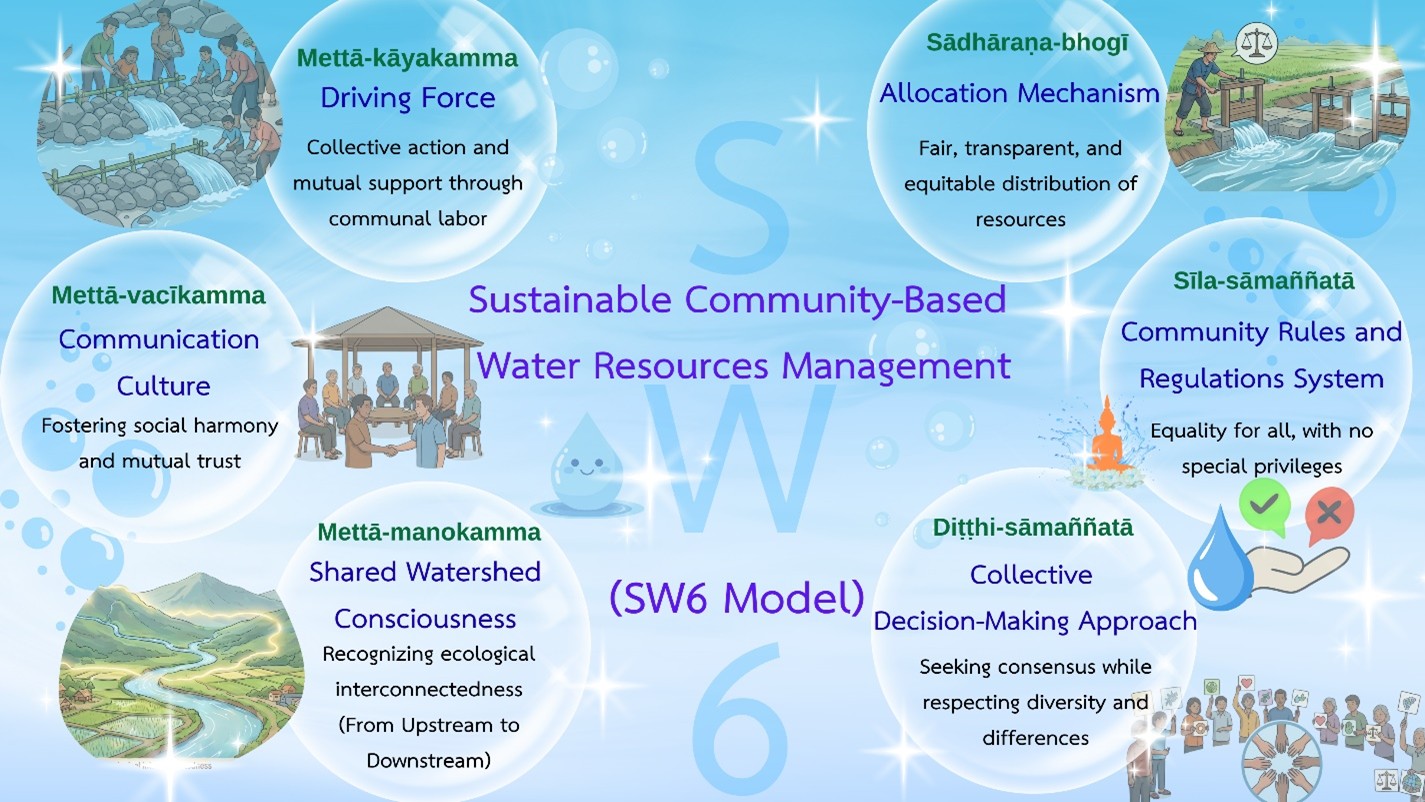
Main Results: The research yielded two significant findings: 1) The development of four draft community water management charters for the Mae Kham watershed, tailored to the contexts of the Suan Khuean, Pa Daeng, Kanchana, and Na Chak sub-districts, reflecting water management approaches consistent with upstream, midstream, and downstream conditions; And 2) The development of the Buddhist innovation "SW6 Model," comprising six components: compassionate physical actions and collaborative coordination, compassionate verbal communication and constructive interaction, compassionate mental actions and benevolent spirit, equitable resource allocation, equal adherence to rules and regulations, and equal understanding and shared vision for the watershed. This model is considered as a highly promising Buddhist mechanism that can scale and be applied to suitable water management in other watershed areas with similar contexts. Specially Buddhist-style communities that the religions as center in society. This model serves as a framework for promoting community participation and sustainable water resource management.
Involvement to Buddhadhamma: The findings reflect the application of the Six Saraniyadhamma (Principles of Harmony) in promoting cooperation, constructive communication, adherence to community rules, fair resource sharing, and the formation of shared goals in community water resource management.
Conclusions: This research demonstrates that integrating the Six Saraniyadhamma (Principles of Harmony) into the community water management charter process can promote public participation and develop water resource management approaches appropriate to the local context. Furthermore, the SW6 Model can serve as a framework for water resource management in Buddhist communities and areas with similar contexts for sustainability.
References
Cheevapattananuwong, P. & Khamnu, N. (2023). Plan on Water Management in 20Years: The Machinery of Thai State Power and Participation. Journal of Humanities & Social Sciences (JHUSOC), 21(2), 193-215.
Chirakitnimit, N. (2024). Water Problems in The Area of Ban Huai Salop, Huai Pha Subdistrict, Mueang District, Mae Hong Son Province. Journal of Social Science and Cultural, 8(2), 336-347.
Dangrat, J., Wangukkarangkul, A. & Jaturat, W. (2025). The Development of Water User Organizations Participation in Water Management in the Western Southern River Basin. School of Administrative Studies Academic Journal, 8(4), 225-242.
Dulyapach, K. (2025). Upgrading Community Products to be a "SMART Local" Business Organization. Thaksin Law Journal, 13(1), 17-28.
Kaewnim, P. (2025). Participatory Local Water Management by Water User Organizations around Bung Boraphet, Nakhon Sawan Province, Based on the Principles of Aparihaniya Dhamma. Journal of Public Administration and Interdisciplinary Studies for Society, 1(1), e1840. https://doi.org/10.14456/jpais.2025.1.
Laeni, N. (2024). The Institutional Landscape Analysis of Thailand's Water Management System: A Systematic View on Water-Related Agencies. Journal of Political Science Review, 10(1), 117-168.
Nuanmanee, R., Taweekul, K. & Borisutdhi, Y. (2024). Productivity of Agricultural Water Use in the Dry Season of Huai Kut Daeng Reservoir Use Association Member, Chaturaphakphiman District, Roi-Et Province. Rajabhat Agriculture Journal, 23(1), 57-64.
Office of the National Water Resources. (2000). The 20-Year Water Resources Management Strategy. Bangkok, Thailand: Office of the National Water Resources.
Phrakhrusuwanthammapimon (Somchai Charoenpha), Phueakbuakao, S. & Seepradit, P. (2022). Application to the principle of the administration of local administrative organizations in muang district suphanburi province. Mahachula Academic Journal, 9(3), 222-236.
Phramaha Suphachai Piyadhammajayo (Tivapee), Ruansangsanka, R. & Boonpoo, S. (2024). Educational Management based on the Principles of Sāraṇīyadhamma in Sunday Dhamma School. Dhammadhara Journal of Buddhist Ideology for Development, 2(5), 40-55.
Rattanarat, N., Phramaha Somboon Vudฺdhikaro & Kraichakr, O. (2024). Buddhist Perspective on Prevention of Domestic Violence by The Community Participation. Mahachula Academic Journal, 11(2), 435-450.
Rattanayotasakul, J. & Sukmaitree, J. (2025). Management of Local Water Resources in Thailand. Modern Academic Development and Promotion Journal, 3(2), 17-31.
Thipchai, K. & Onnamkham, W. (2024). Issuing an order for Subdistrict Administrative Organization Mayorto be removal from their positions in accordance with the District Assembly and District Administrative Organization Act B.E. 2537: In case study of the supreme count of Administrative Cour. Journal of Local Governance and Innovation, 8(3), 379-398.
Wongrat, C. (1998). Techniques for using statistics for research. Bangkok, Thailand: Thepneramit Printing.
Downloads
Published
How to Cite
Issue
Section
License
Copyright (c) 2026 Journal of Buddhist Anthropology

This work is licensed under a Creative Commons Attribution-NonCommercial-NoDerivatives 4.0 International License.