GUIDELINES FOR EMPOWERING EDUCATIONAL LEADERS BASED ON THE FIVE VESARAJJAKARANA-DHAMMA PRINCIPLES TO DEVELOP EDUCATIONAL INSTITUTIONS AS LEARNING ORGANIZATIONS IN THE DIGITAL ERA
Keywords:
Empowerment, Five Vesarajjakarana-Dhamma Principles, Leadership, Learning Organization, the Digital Era OrganizationAbstract
Background and Objectives: In the digital era, information and communication technology plays a crucial role in transforming lifestyles and work practices across all sectors. Educational institutions must adapt to these changes by evolving into learning organizations that are responsive to rapid change. One key approach to achieving this is by strengthening the leadership capacity of school administrators through the application of the Five Vesarajjakarana-Dhamma principles-moral guidelines that emphasize compassion, selflessness, sincerity, ethical conduct, and visionary thinking. This research aims to examine the current situation and needs concerning to enhancing the leadership capabilities of school administrators based on the Five Vesarajjakarana-Dhamma principles. It also seeks to propose strategies for developing these capabilities to enable effective organizational transformation in the digital age. The findings are expected to contribute to the development of management models that are well-suited to the contemporary educational context and promote the integration of moral leadership principles into school administration.
Methodology: This was a mixed-methods research study with a quantitative approach. The research tool used was a five-level rating scale questionnaire with a reliability coefficient of 0.92. The population consisted of 3,500 people, and the sample size was 346, determined using the Krejcie and Morgan table. The sample was selected through stratified random sampling, with the location of the educational institutions serving as the stratification factor. The statistical methods used in the research included mean, standard deviation, and ranking for prioritization. For the qualitative aspect, group discussions were conducted. The research instrument was a semi-structured interview. The key informants were experts and educational administrators, totaling 9 individuals, selected through purposive sampling based on specific criteria. The data were analyzed using content analysis and validated through triangulation techniques, including data, researcher, and theory. The findings were presented using descriptive analysis.
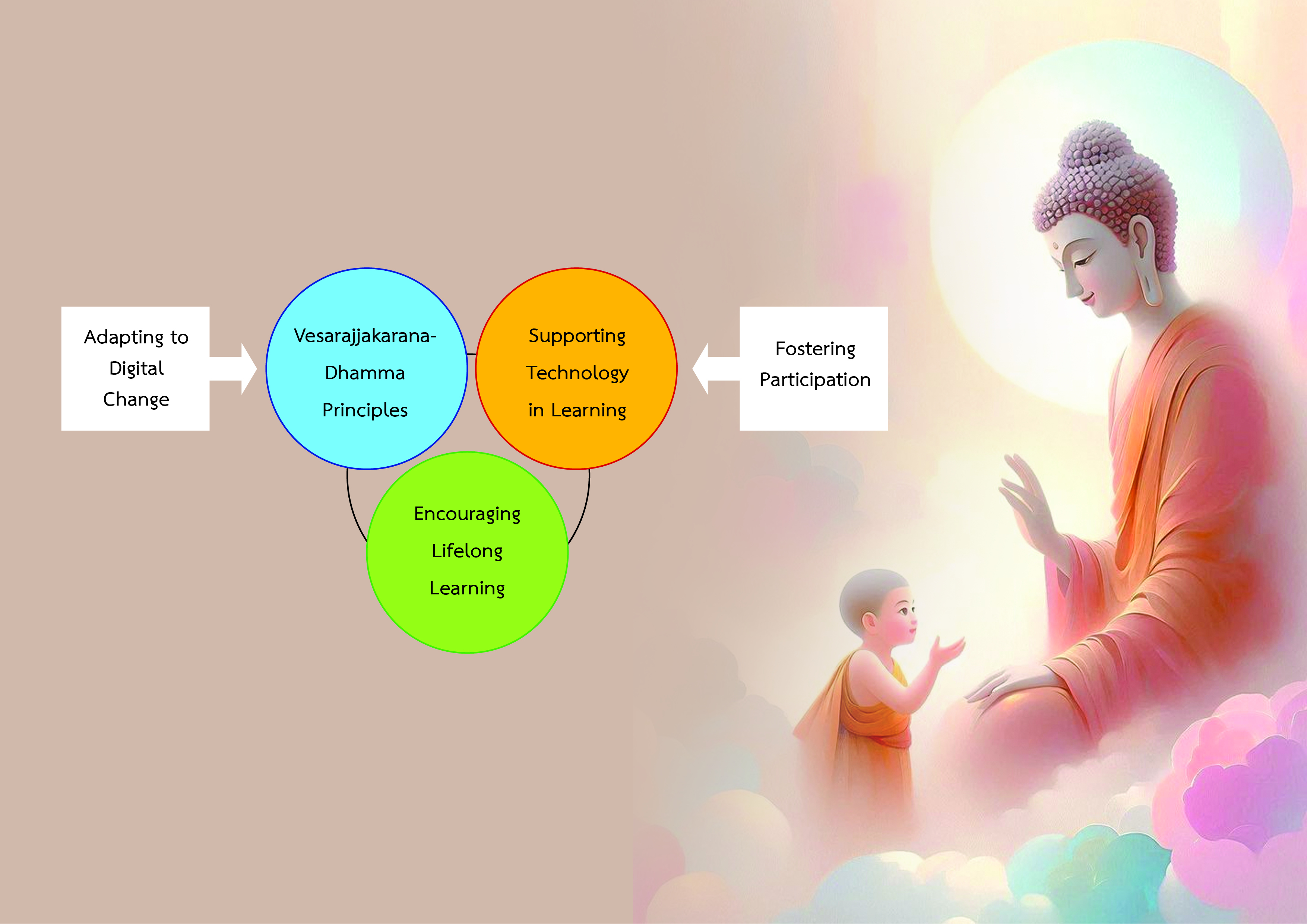
Main Results: Research Findings: 1) The situation and the need to enhance the capacity of educational administrators based on the Five Vesarajjakarana-Dhamma Principles to develop educational institutions into learning organizations in the digital age were found to be at a high level ( = 4.12, S.D. = 0.57),and 2) The approaches for empowering educational administrators based on the Five Vesarajjakarana-Dhamma Principles to develop educational institutions into learning organizations in the digital age included: 2.1) Promoting the integration of Buddhist principles in organizational development; 2.2) Supporting the use of learning technologies;2.3) Promoting lifelong learning; 2.4) Fostering participation, and 2.5) Developing and adapting to changes.
Involvement to Buddhadhamma: The study titled on “enhancing the potential of educational administrators based on the Five Vesarajjakarana-Dhamma Principles” is categorized under Applied Buddhism, as it applies core Buddhist teachings to the field of educational management in the digital era. In particular, it focuses on the application of the Five Vesarajjakarana-Dhamma Principles: Saddhā (Faith), Sīla (Good Conduct; Morality), Pāhusaccha (Great Learning), Vīryārambha (Exertion; Energy), and Paññā (Wisdom; Understanding) which are fundamental virtues that support Buddhist leadership. These principles are integrated with the concept of the Learning Organization, aiming to foster school administrators' ability to lead institutions that are adaptive, knowledge-based, and capable of continuous improvement in response to rapid technological and societal change.
Conclusions: This research aims to enhance the capacity of educational administrators based on the Five Vesarajjakarana-Dhamma Principles, which include: Saddhā believe in what should be believed, Sīla preserving the body and speech in a proper manner, Pāhusaccha being a person who studies much, Vīryārambha great and constant diligence and attention, and Paññā possessing wisdom and knowing what should be known. It serves as a key guideline for developing educational institutions into learning organizations in the digital age, with an emphasis on integrating Buddhist principles into management.
References
Cronbach, L. J. (1990). Essentials of psychological testing (5th ed.). New York, United States of America: Harper & Row.
Goleman, D. (1995). Emotional Intelligence: Why It Can Matter More Than IQ. New York, United States of America: Bantam Books.
Intagaew, P. (2019). Buddhist Ethics and Career Development for Lifelong Learning. Journal of MCU Nakhondhat, 6(10), 4658-4669.
Kanjanawasee, S. (2016). Empowerment Evaluation: Differential Perspectives. The Social Research Association of Thailand Journal, 3(1), 19-25.
Likert, R. (1967). "The Method of Constructing and Attitude Scale," in Attitude Theory and Measurement. New York, United States of America: Wiley & Son.
Nilkote, R., Singsorn, N., Saisena, N., Sukpom, T. & Papan, N. (2024). Knowledge Management and Empowering Professional Learning Communities based on Buddhist Principles: The Dimension of Suppurisa Dhamma. Journal of Innovation Research on Education and Technology (JIRET), 2(3), 1-11.
Podhisita, C. (2016). The art and science of qualitative research (7th ed.). Bangkok, Amarin Printing and Publishing.
Representative of teachers and educational personnel Person 1. (2023). Guidelines for empowering educational leaders based on the five vesarajjakarana-dhamma principles to develop educational institutions into learning organizations in the digital era. (Jantarak, S., Interviewer)
Representative of the executive Person 1. (2023). Guidelines for empowering educational leaders based on the five vesarajjakarana-dhamma principles to develop educational institutions into learning organizations in the digital era. (Jantarak, S., Interviewer)
Representative of the executive Person 2. (2023). Guidelines for empowering educational leaders based on the five vesarajjakarana-dhamma principles to develop educational institutions into learning organizations in the digital era. (Jantarak, S., Interviewer)
Representative of the executive Person 3. (2023). Guidelines for empowering educational leaders based on the five vesarajjakarana-dhamma principles to develop educational institutions into learning organizations in the digital era. (Jantarak, S., Interviewer)
Salovey, P. & Mayer, J. D. (1990). Emotional Intelligence. Imagination, Cognition, and Personality, 9(3), 185-211.
Solovic, W. S. (2007). The girl's guide to power and success. New York, United States of America: AMACOM.
Srisa-ard, B. (2011). Introduction to research (9th ed.). Bangkok, Suweeriya Sasan.
Wongwanit, S. (2019). A study on assessing needs (4th ed.). Bangkok, Chulalongkorn University Press.
Downloads
Published
How to Cite
Issue
Section
License
Copyright (c) 2025 Journal of Buddhist Anthropology

This work is licensed under a Creative Commons Attribution-NonCommercial-NoDerivatives 4.0 International License.