THE FORMATION OF RELIGIOUS IDENTITY AND ETHICAL SELF THROUGH CELIBACY: A COMPARATIVE STUDY OF INDONESIAN BUDDHIST AND CATHOLIC NUNS
Keywords:
Tantrayana-Tibetan Buddhism, Catholic, Women's Agency, Total Institution, IdentityAbstract
Background and Objectives: The opportunity for women to actualize themselves in non-domestic and masculine spheres, like religion, has become more accessible nowadays. Women are fully permitted to commit themselves to God's path by living a celibacy life even though they need to deal with several challenges. As highlighted in this research, Indonesian Buddhist and Catholic nuns had to face a difficult life path before they were firmly engaged in their new identity in monastic life. Their holy aspirations to achieve the ultimate goal of the spiritual journey as nuns conflicted with the socio-cultural values deeply embedded in Indonesian society, which define the ideal female figure. Briefly, this study investigated how Indonesian Buddhist and Catholic nuns confronted their changing identities and negotiated multiple tensions to maintain their commitment and self-agency by devoting their lives to religious orders.
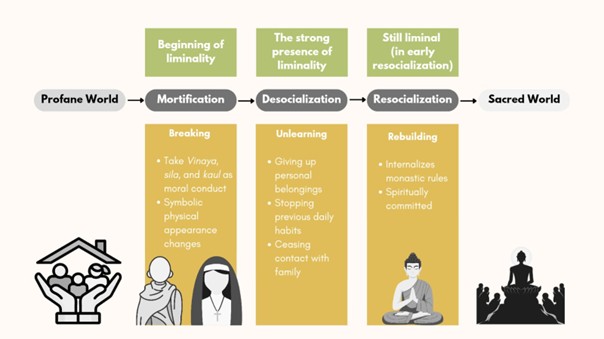
Methodology: This research employed a qualitative method as a suitable approach to gather more comprehensive data on the personal journeys of Buddhist and Catholic nuns. It involved in-depth interviews with several Buddhist nuns from Tantrayana-Tibetan Buddhist monasteries in Malang Regency, East Java, and Catholic nuns from the Order of St. Francis in a church in Semarang City, Central Java. By comparing the two traditions of women's celibacy across different religions through a phenomenological approach, this study explored the gradual transformation of women who aspired to become Buddhist and Catholic nuns, starting from the mortification phase, through desocialization to the resocialization phase, based on Erving Goffman's concept of total institution.
Main results: As a voluntary total institution, the monastery implied a subtle distinction from the involuntary total institution-the mortification phase is not portrayed as a loss of selfhood but rather as a manifestation of devotion for the nuns. Moreover, fellow ascetics are not seen as new authority figures but rather as guides who support them amid the upheaval of shifting identities. Other research findings showed that both Buddhist and Catholic nuns also experienced difficulties from internal forces. They encountered in-between situations during the mortification phase since they had to drop their old identities that had been embedded for years. With help from religious viewpoints, they managed to get through this phase by reinterpreting their previous social roles and integrating them into their new identities.
Involvement to Buddhadhamma: This research explored the application of Buddhism in contemporary contexts, integrating modern scholarship with traditional Buddhist knowledge to cultivate wisdom and morality within the Buddhist framework. There are many Dhamma lessons to be learned from the struggles that women faced in fully engaging spiritually through joining the sangha (Buddhist Religious Community) as nuns. Under pressure from the socio-cultural environment, they had to redefine their social and spiritual roles wisely by practicing anatta (Selflessness). This is indirectly related to the concept of tanha (Attachment), which is represented as the cause of dukkha (Suffering) and must be renounced by Buddhist ascetics to ease their spiritual path toward achieving bodhi (Enlightenment) and vimoksha (Liberation from the Cycle of Birth and Death) easier. Furthermore, karuna (Compassion) served a vital function in connecting existing identities with new ones rather than eliminating the former.
Conclusions: The presence of other monastic members is crucial for Indonesian Buddhist and Catholic nuns. They work as a support system in maintaining religious agency through celibacy and navigating the dynamics of identity change. The social roles attached to old identities could be reconciled by combining them with spiritual roles through reinterpretation in the framework of religious teachings (Idea of Karuna and Serving God), forming a unified personality of Indonesian Buddhist and Catholic nuns.
References
Antony, A. K. & Robinson, R. (2022). Called to God: Event, Narration and Subject Formation in the Vocation of a Catholic Nun. Critical Research on Religion, 11(1), 33-47. https://doi.org/10.1177/20503032221148471.
Avishai, O. (2008). "Doing religion" in a Secular World: Women in Conservative Religions and The Question of Agency. Gender & Society, 22(4), 40-433. https://doi.org/10.1177/0891243208321019.
Chomczynski, P. (2017). Emotion Work in the Context of the Resocialization of Youth in Correctional Facilities in Poland. Polish Sociological Review, 2(198), 219-235.
Claussen, H. L. (2004). Unconventional Sisterhood: Feminist Catholic Nuns in the Philippines. United States of America: The University of Michigan Press.
Collins, S. (1982). Selfless Persons: Imagery and Thought in Theravada Buddhism. Cambridge: Cambridge University Press.
Douglas, M. (1970). Natural Symbols. London: Routledge.
Falzon, M. (2009). Multi-sited Ethnography: Theory, Praxis and Locality in Contemporary Research. London: Routledge.
Foucault, M. (1991). Discipline and Punish: The Birth of the Prison. United Kingdom: Penguin Books.
Frankenberg, E., Thomas, D. & Beegle, K. (1999). The Real Costs of Indonesia's Economic Crisis: Preliminary Findings from the Indonesia Family Life Surveys. [Research Report]. RAND.
Geertz, H. (1961). The Javanese Family: A Study of Kinship and Socialization. New York: The Free Press of Glencoe, Inc.
Gil, S. (2008). The Role of Monkhood in Contemporary Myanmar Society. Germany: Friedrich Ebert Stiftung.
Goffman, E. (1959). The Moral Career of the Mental Patient. Psychiatry, 22(2), 123-142. https://doi.org/10.1080/00332747.1959.11023166.
Goffman, E. (1961). Asylums: Essays on the Social Situation of Mental Patient and Other Inmates. New York: Anchor Books.
Gotlib, A. (2016). "But You Would Be the Best Mother": Unwomen, Counterstories, and the Motherhood Mandate. Journal of Bioethical Inquiry, 13(2), 327-347. https://doi.org/10.1007/s11673-016-9699-z.
Groenewald, T. (2004). A Phenomenological Research Design Illustrated. International Journal of Qualitative Methods, 3(1), 42-55. https://doi.org/10.1177/160940690400300104.
Higgins, P. C. & Butler, R. R. (1982). Understanding Deviance. United States of America: McGraw-Hill.
Huls, J., & Carm, O. (2021). Religious Life as a Search for Liminality. Carmelus, 68(1), 13-85.
Inglehart, R. & Norris, P. (2003). Rising Tide: Gender Equality and Cultural Change Around the World. United Kingdom: Cambridge University Press.
Kemper, T. D. (2011). Status, Power and Ritual Interaction: A Relational Reading of Durkheim, Goffman, and Collins. United Kingdom: Ashgate Publishing.
Khu, S. & Khumairoh, I. (2023). "A Dream of Guru Came to Me": Meanings of Dreaming About Spiritual Teacher for Chinese Indonesian Buddhists. Ethos, 52(2), 259-273. https://doi.org/10.1111/etho.12426.
Khumairoh, I. (2022). Rambut Sebagai Aspek Pendisiplinan Tubuh Perempuan: Studi Kasus Pada Biksuni Buddha Tantrayana-Tibetan. Endogami: Jurnal Ilmiah Kajian Antropologi, 5(2), 21-28. https://doi.org/10.14710/endogami.5.2.21-28.
Koning, J. (2004). Generations of Change: Migration, Family Life and Identity Formation in a Javanese Village During the New Order. Yogyakarta: Gadjah Mada University Press.
Lama Zopa Rinpoche. (2010). The Joy of Compassion. Boston: Lama Yeshe Wisdom Archives.
Linton, R. (1936). The Study of Man: An Introduction. United States of America: Appleton-Century.
Mahmood, S. (2005). Politics of Piety: The Islamic Revival and the Feminist Subject. United States of America: Princeton University Press.
Ortner, S. B. (1972). Is Female to Male as Nature Is to Culture? . Feminist Studies, 1(2), 5-31. https://doi.org/10.2307/3177638.
Ortner, S. B. (1989). High Religion: A Cultural and Political History of Sherpa Buddhism. United Kingdom: Princeton University Press.
Park, K. (2002). Stigma Management among the Voluntarily Childless. Sociological Perspectives, 45(1), 21-45. https://doi.org/10.1525/sop.2002.45.1.21.
Rinaldo, R. (2013). Mobilizing Piety: Islam and Feminism in Indonesia. United Kingdom: Oxford University Press.
Scott, S. (2010). Revisiting the Total Institution: Performative Regulation in the Reinventive Institution. Sociology, 44(2), 213-231. https://doi.org/10.1177/0038038509357198.
Sinclair, K. (1986). Women and Religion. In Dudley, M. I. & Edwards, M. I. (Eds), The Cross-cultural Study of Women: A Comprehensive Guide (pp. 107-124). The Feminist Press.
Spielhaus, R. (2020). Islam and Feminism: German and European Variations on a Global Theme. In Omari, D.E. & Hammer, J. (Eds), Muslim Women and Gender Justice. Concepts, Sources, and Histories (pp. 46-61). Routledge.
Sundberg, M. (2015). Hierarchy, Status, and Combat Motivation in the French Foreign Legion.In King, A. (Eds), Frontline: Combat and Cohesion in the Twenty-first Century (pp. 216-233). Oxford University Press.
Sundberg, M. (2024). The Promise of Total Institutions in the Sociology of Organizations: Implications of Regimental and Monastic Obedience for Underlife. In Clegg, S., Grothe-Hammer, M. & Velarde, K.S. (Eds), Sociological Thinking in Contemporary Organizational Scholarship (Research in the Sociology of Organizations, Vol. 90) (pp. 253-259). Emerald Publishing Limited https://doi.org/10.1108/S0733-558X20240000090010.
Suryakusuma, J. (2021). Ibuisme Negara: Konstruksi Sosial Keperempuanan Orde Baru. Jakarta: Komunitas Bambu.
Turner, V. (1969). The Ritual Process: Structure and Anti-Structure. London and New Brunswick: Routledge.
Ven. Thubten Chodron. (2019). Preparing for Ordination: Reflections for Westerners Considering Monastic Ordination in the Western Buddhist Tradition. United States of America: Originally published by Life as a Western Buddhist Nun.
Weber, M. (1994). The Theory of Social and Economic Organization. New York: Free Press.
Downloads
Published
How to Cite
Issue
Section
License
Copyright (c) 2025 Journal of Buddhist Anthropology

This work is licensed under a Creative Commons Attribution-NonCommercial-NoDerivatives 4.0 International License.