DEVELOPMENT OF PILGRIMAGE ROUTES TO PROMOTE CULTURAL TOURISM AT WAT PHRA BOROMMATHAT CHAIYA RATCHAWORAWIHAN, SURAT THANI PROVINCE
Keywords:
Development, Pilgrimage Routes, Cultural Tourism, Wat Phra Borommathat Chaiya Ratchaworawihan, The Threefold TrainingAbstract
Background and Objectives: Surat Thani Province has a variety of natural resources as an important economic base and supports international tourism. The people are kind and compassionate and have a good cultural base, making it a valuable asset. This pilgrimage route promotes cultural tourism by connecting the southern region with world-class cultural tourism sites. It is a tourism route that emphasizes quality and sustainability, in line with the 13th National Economic and Social Development Plan (2023-2027), particularly development goal 2, which aims for Thailand to be a tourism destination focused on quality and sustainability. The plan Promotes cooperation and participation from the private sector in developing community tourist attractions. The objectives of this study were: 1) To analyze pilgrimage routes to promote cultural tourism; 2) To develop pilgrimage routes to promote cultural tourism, and 3) To create and develop a set of cultural tourism activities Wat Phra Borommathat Chaiya Ratchaworawihan, Surat Thani province.
Methodology: This was qualitative research on pilgrimage route design, tourism activities, tourism management, and community participation. Key informants included Buddhist scholars, local wisdom holders, social development experts, tourism academics, and cultural, totaling 27 individuals. Data were collected through in-depth interviews and focus group discussions. Data analysis was conducted using inductive and descriptive analysis.
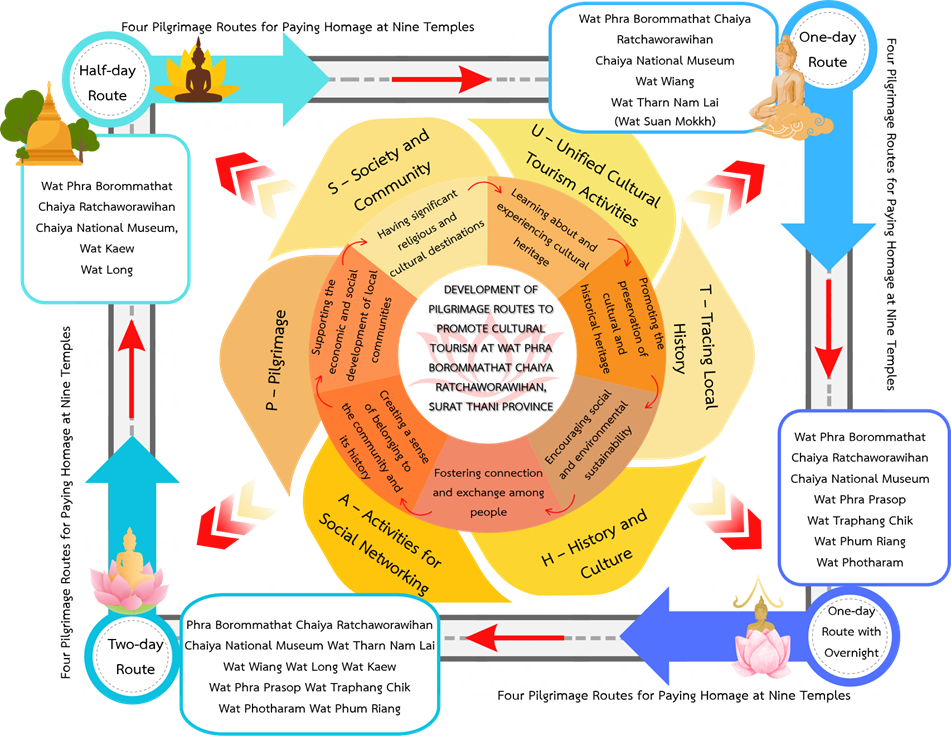
Main Results: The study found that: 1) Pilgrimage routes, religion, and spirit were at the heart of journeys with the purpose of faith and spiritual seeking. Pilgrims travel to holy places to perform religious practice, pray, pay respect, meditate, and cultivate a pure mind. History and culture reflect the identity of people in each era. These were connected to important religious and historical events. Society and community reflect the relationship between people through shared faith and common beliefs. Include activities that bring people together to meet and build social networks. Economics and tourism help stimulate economic growth in the area, support local businesses, and generate income for the community; 2) Pilgrimage routes were developed into four tourism route types: Half-day, one-day, one-day overnight, and two-day programs. These routes include Paying homage at nine temples: Wat Phra Borommathat Chaiya Ratchaworawihan, Wat Kaew, Wat Long, Wat Wiang, Wat Tharn Nam Lai (Wat Suan Mokkh), Wat Phra Prasop, Wat Trapang Chik, Wat Phum Riang and Wat Photharam, and 3) A complete set of cultural activities was created and developed, including paying homage to the Phra Borommathat Chedi, learning about architecture and antiques, retracing local history and the history of Chaiya city, managing activity sites in collaboration with the community, acting as a local tour guide, and developing local products, all under the framework of the "Suthap Model."
Involvement to Buddhadhamma: The Tri-sikkha principles (Threefold Training) include morality (Sīla), training in behavior; Morality is discipline and serves as the starting point of the human development process, concentration (Samādhi), training of the mind and wisdom (Paññā), training or development of knowledge of the truth, beginning with belief, view, knowledge, and understanding. Rooted in the principles of Buddhism and aligned with the goals of sustainable development, the application of Dhamma principles contributes to fostering sustainability in all three dimensions: Economic, Social, and Environmental.
Conclusions: The application of the Dhamma principles, specifically the Tri-sikkha, to the development of pilgrimage route enables individuals to develop in an integrated and holistic manner, fostering balanced human development.
References
Aksonsri, S. (2024). Development of Pilgrimage Routes to Promote Cultural Tourism Wat Phra Borommathat Chaiya Ratchaworawhan, Suratthani Province. (Phrakru Phitak Chetiyaanukul, Interviewer)
Chanbuathong, K. (2024). Development of Pilgrimage Routes to Promote Cultural Tourism Wat Phra Borommathat Chaiya Ratchaworawhan, Suratthani Province. (Phrakru Phitak Chetiyaanukul, Interviewer)
Chansurang, N. (2024). Development of Pilgrimage Routes to Promote Cultural Tourism Wat Phra Borommathat Chaiya Ratchaworawhan, Suratthani Province. (Phrakru Phitak Chetiyaanukul, Interviewer)
Chantamali, T. (2024). Development of Pilgrimage Routes to Promote Cultural Tourism Wat Phra Borommathat Chaiya Ratchaworawhan, Suratthani Province. (Phrakru Phitak Chetiyaanukul, Interviewer)
Chincharoentham, K. (2024). Development of Pilgrimage Routes to Promote Cultural Tourism Wat Phra Borommathat Chaiya Ratchaworawhan, Suratthani Province. (Phrakru Phitak Chetiyaanukul, Interviewer)
Chujit, T. (2024). Development of Pilgrimage Routes to Promote Cultural Tourism Wat Phra Borommathat Chaiya Ratchaworawhan, Suratthani Province. (Phrakru Phitak Chetiyaanukul, Interviewer)
Inthachum, P. (2024). Development of Pilgrimage Routes to Promote Cultural Tourism Wat Phra Borommathat Chaiya Ratchaworawhan, Suratthani Province. (Phrakru Phitak Chetiyaanukul, Interviewer)
Khamtrong, S. (2021). Guidelines for the Development of Cultural Tourism Routes in Bang Kruai District, Nonthaburi Province. Journal of Humanities and Social Sciences, Rajapruek University, 7(2), 96-109.
Kongphan, J. (2024). Development of Pilgrimage Routes to Promote Cultural Tourism Wat Phra Borommathat Chaiya Ratchaworawhan, Suratthani Province. (Phrakru Phitak Chetiyaanukul, Interviewer)
Office of the Secretary of the National Strategy Committee, National Strategy 2018-2037 (Abridged Edition), page 6 . (2018).
Onrat, N. (2018). Policy for promoting cultural tourism in Ubon Ratchathani Province. Rangsit Journal of Graduate Studies in Business and Social Sciences, 4(2), 228-234.
Phibanthan, R. (2024). Development of Pilgrimage Routes to Promote Cultural Tourism Wat Phra Borommathat Chaiya Ratchaworawhan, Suratthani Province. (Phrakru Phitak Chetiyaanukul, Interviewer)
Phramaha Sara Yanutthamo. (2018). Management of temples as cultural tourist attractions in Samut Songkhram Province. [Unpublished doctoral Thesis]. Mahachulalongkornrajavidyalaya University, Bangkok, Thailand.
Phrapalat Sudrit Thanasaro & Siripaprabhakon, Y. (2020). Religion and Cultural Tourism for Promoting the Pilgrimage Route to Wat Phrai Phatthana, Sisaket Province. Surin Rajabhat University Management Science Research Journal, 4(1), 79-92.
Suansida, R., Makboon, B. & Kan, C. (2020). Communication to promote sustainable cultural tourism in the pilgrimage route of the Buddha's footprint in Saraburi Province. Journal of the Research and Development Institute, Rajabhat Bansomdejchaopraya University, 5(2), 114-121.
Treepongphan, K. (2024). Development of Pilgrimage Routes to Promote Cultural Tourism Wat Phra Borommathat Chaiya Ratchaworawhan, Suratthani Province. (Phrakru Phitak Chetiyaanukul, Interviewer)
Wichian, W. (2024). Development of Pilgrimage Routes to Promote Cultural Tourism Wat Phra Borommathat Chaiya Ratchaworawhan, Suratthani Province. (Phrakru Phitak Chetiyaanukul, Interviewer)
Downloads
Published
How to Cite
Issue
Section
License
Copyright (c) 2025 Journal of Buddhist Anthropology

This work is licensed under a Creative Commons Attribution-NonCommercial-NoDerivatives 4.0 International License.